Retiring teacher, coach urges Colony grads to ‘find their 68’
By Jeremiah Bartz Frontiersman.com A football coach using a hockey reference as the centerpiece for his keynote address may


PALMER — A piercing scream rose above the din of activity in the Hoskins Exhibits building of the Alaska State Fairgrounds early Friday afternoon.
“That’s a frightened scream,” a volunteer with a Fairbanks organization joked with 12-year-old Dessa Gerger after painting injuries on the Juneau girl’s feet and legs. “We need hurt screams.”
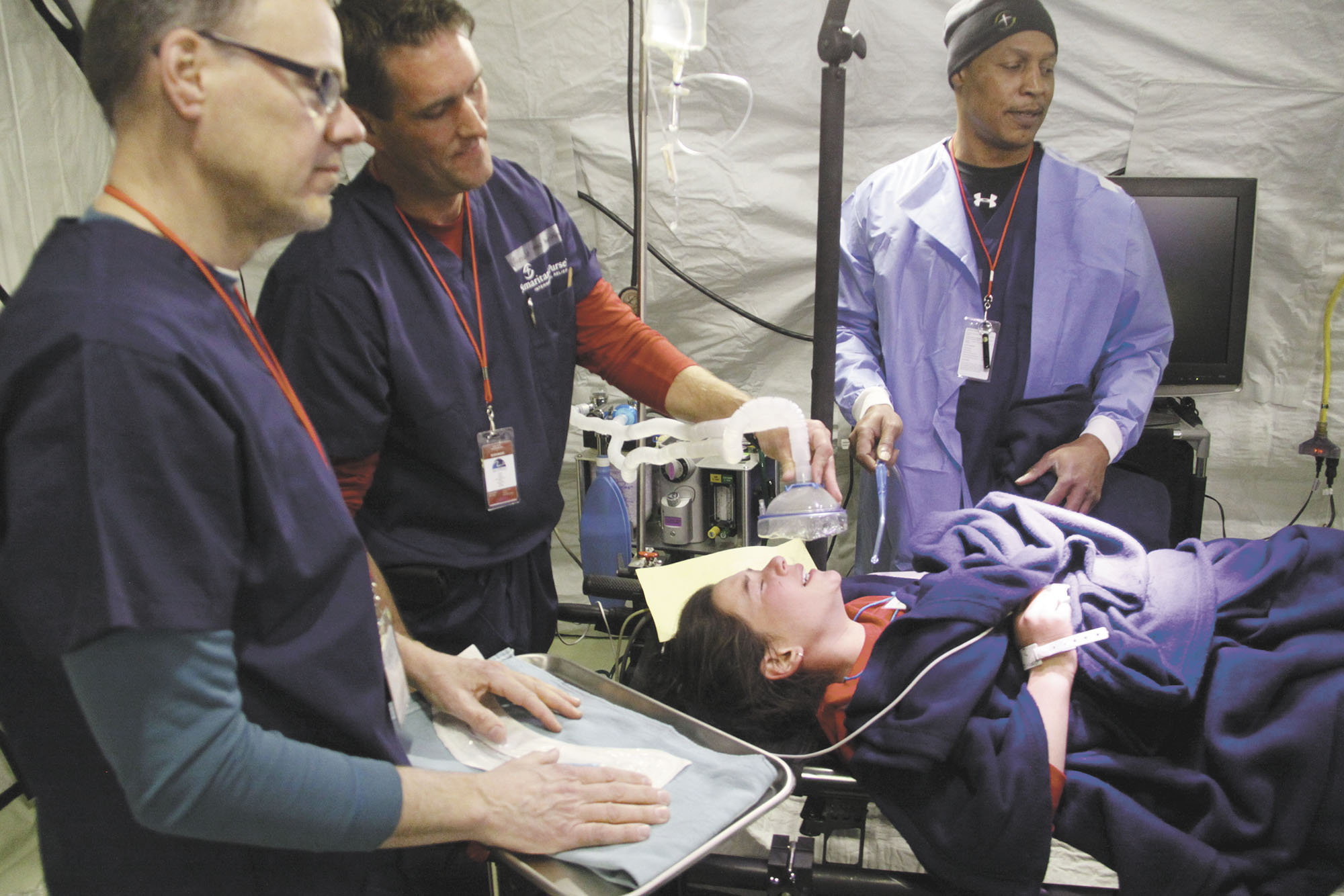
Later, Gerger shook with fear on a gurney.
“They’re going to cut me open!” she cried, the realism of her acting the part of a disaster victim uncanny as another volunteer, this one from North Carolina, comforted her.
Gerger’s faux leg wounds and terror were one very dramatic piece of an exercise unprecedented in its scope that took over large parts of the Valley this weekend. Alaska Shield, an annual event that this spring took on an added significance landing on the 50-year anniversary of the most powerful earthquake to ever hit North America — the 9.2-magnitude 1964 Good Friday earthquake and tsunami that devastated large parts of Alaska.
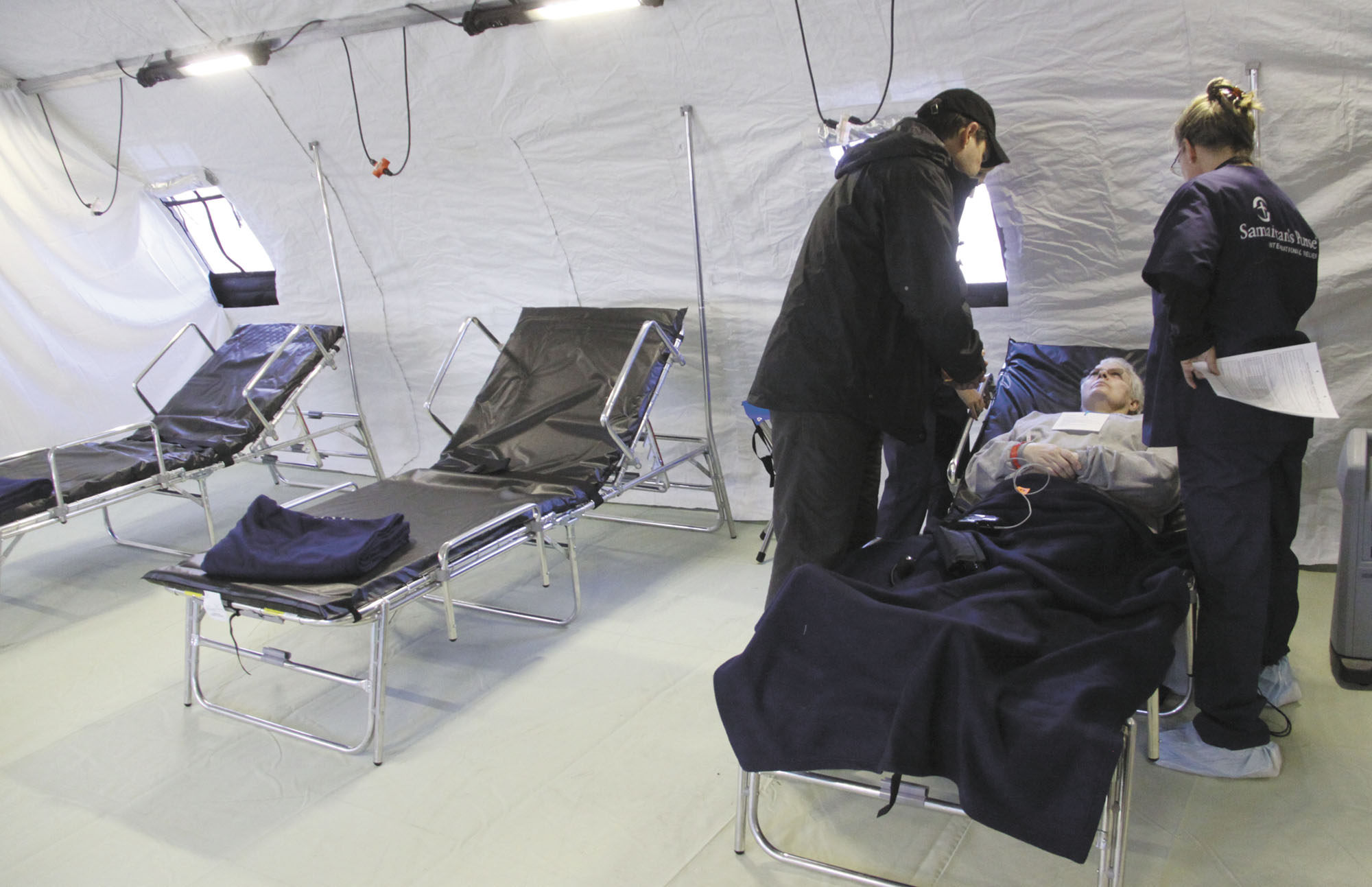
At the fairgrounds, the state for the first time set up its mobile hospital, dubbed the Alaska Medical Station. Over the course of the weekend, 300 volunteer patients were expected to make their way through the hospital, working with more than 100 staff members.
“We are the first state to ever roll this out,” said Merry Carlson, section chief for emergency programs at the state Department of Health and Social Services.
In fact, this kind of mobile, large-capacity hospital setup is a capability that the federal government has, not state governments. Alaska is the only state with such a hospital.
The beds — there are hundreds of them, though not every one was set up Friday — arrive on long-haul trucks in giant cardboard boxes. Once the equipment is unloaded and set up, the boxes serve as walls, breaking up the space in which they are deployed — Raven Hall in this case — into multiple rooms.
Carlson said the staff of this kind of federal response runs 110 to 130 people. In Alaska, it’s a volunteer pool of responders drawn from multiple sources.
“We know it would be at least three days before the feds get here, so we need to figure out how to staff the facility without drawing from the hospitals,” she said.
She said the facility was mostly for people who have things like chronic illnesses cut off from care by a disaster. Maybe their personal care attendant was injured. Maybe their home is no longer livable.
For more acute patients — people with severe injuries or heart attacks — the charitable organization Samaritan’s Purse, headquartered in North Carolina and with a significant presence in Alaska — set up a tent hospital just outside Raven Hall on one of the fairgrounds’ plazas.
“Normally they do international disaster relief, but Alaska is the closest thing they can practice in,” Carlson said.
Over in the tents, Luther Harrison, Samaritan’s Purse’s vice president for North American Ministries, said that in 2006 when fire decimated the village of Hooper Bay, the organization’s president, Franklin Graham, was in Alaska and decided to help. Since then, Samaritan’s Purse has helped rebuild communities struck by disaster and also build churches. This summer, they’ll be in Galena helping a recovery effort from flooding there.
The organization has aircraft stationed in Alaska and a state headquarters in Soldotna. Harrison said that the tents set up on the fairgrounds are stationed in Alaska. The equipment inside — hospital beds and medical equipment — are palletized and go all over the world.
The hospital came with a staff of dozens of medical personnel, who all paid their own way to Alaska. He said the goal Friday was just to practice, but also to make connections with state and local agencies.
“They know our capacity. They know the resources we can bring to the table,” he said.
That’s not the sort of work you want to have to accomplish after disaster has struck.
“You can’t make new friends in the middle of a crisis,” he said.
Contact Andrew Wellner at 352-2270 or andrew.wellner@frontiersman.com.

By Jeremiah Bartz Frontiersman.com A football coach using a hockey reference as the centerpiece for his keynote address may

Frontiersman.com With its headquarters in Wasilla, the Frontiersman has been a primary source of news for the Matanuska-Susitna

By Katie Stavick Frontiersman.com The next generation of leaders took flight this week as the Houston High School Class

By Kyle Wilkinson For the Frontiersman Keynote speaker and Carry the Cure President Bill Pagaran’s words boomed through the