Retiring teacher, coach urges Colony grads to ‘find their 68’
By Jeremiah Bartz Frontiersman.com A football coach using a hockey reference as the centerpiece for his keynote address may


WASILLA — Late Saturday morning, Ron Harvey took a seat next to a window in the scoring tower at North Star Speedway.
As he gazed through the large pane of glass, Harvey stepped about 15 years back in time to the days that led to the birth of Valley’s quarter-mile asphalt racetrack. Harvey, the board president of the South Central Alaska Motorsports Association, was there when the track’s founder, A.J. Scwichtenberg, broke ground on the property at the end of Jensen Road, near the intersection of the Glenn and Parks Highways. A former driver, longtime supporter and lifelong fan of racing, Harvey has seen the Valley track through its 15-year history; a past that’s seen victories, but also a fair share of struggles.
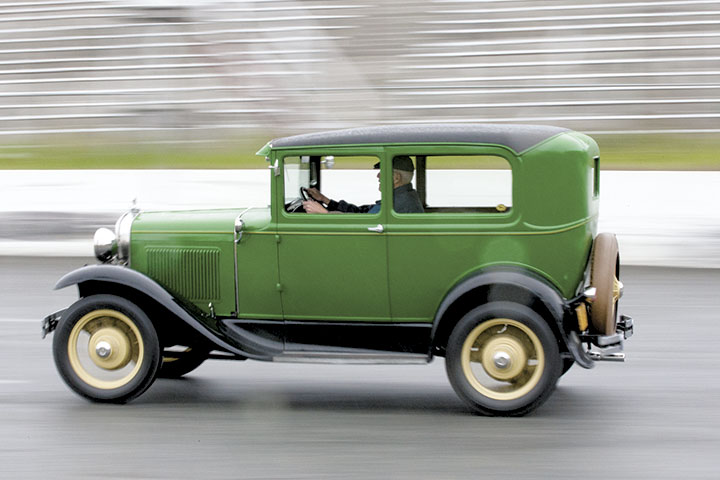
As Harvey sat next to that window Saturday, a mix of ’50s and ’60s rock-and-roll music played through the loud speakers fixed to the corner of the tower. Rows and rows of classic cars brought to the track by the 49th State Street Rodders club circled the tower. The smell of hot dogs on a nearby grill flavored the air.
The venue was alive with activity. But it’s been nearly a year since the track has seen that much life. This summer, Saturday nights have been eerily quiet in the Jensen Road neighborhood. Harvey and the SCAKMA board of directors, who oversee the race-day operations at North Star Speedway, spent the offseason trying to guarantee the race cars would once again circle the quarter-mile asphalt track this year. But after months of trying to spark, their efforts stalled.
Last month, Harvey was forced to formally announce there would be no official racing season this year at North Star.
“I’ve been at this track a lot. I love it. It’s a passion,” said Harvey, wearing his Daytona 500 jacket and North Star Speedway ball cap. “It was really with deep regret that I had to make that public announcement that there will be no races in 2012. But financially, we couldn’t do it.”
North Star Speedway Inc., a group led by majority owner Lud Larson, has held the track since purchasing the property in 2000. North Star Speedway is once again for sale. It’s been listed locally and nationally. One listing features an asking price of $1.5 million for the 15-acre property, which includes grand stands, kitchen, rest rooms, fences, public address system, a sales and beer building, an 11,000-square foot shop, and license to sell beer and wine seasonally.
With the land for sale, the future of the speedway is very much in doubt.
Harvey and many other North Star Speedway supporters don’t want to see an end to this era that was created by Schwichtenberg’s leap of faith.
Nearly two decades ago, Harvey’s longtime friend, Schwichtenberg, had a vision. By mortgaging his own future, Schwichtenberg was able to see his vision became a reality and witness the birth of North Star Speedway, which at the time was the northernmost asphalt oval track in North America.
“A.J. Schwichtenberg had a dream. He’d bought this facility that’d been operating years ago as a chicken ranch,” Harvey said.
As Harvey continued to look outside down onto the track, against the white sidewalls that have been stripped of most of its advertising and billboards, he told the story of the beginning of North Star Speedway.
“I personally stood on this bank right over here to your left,” Harvey said as he pointed to a spot at the property that gives visitors a full view of Pioneer Peak and the Palmer Hay flats. “He had this little diagram on a piece of paper. He said, what do you think Ron?” What do you think Ron if we build a racetrack, an asphalt racetrack? I said, yea, that sounds good.”
At that time, NASCAR continued to grow in popularity and the state of Alaska was home to only two oval dirt tracks, one in Willow and another in Kenai.
“He ended up building it with credit cards and credit. That’s how he built the track,” Harvey said. “He extended his credit to the max.”
Controversy has surrounded North Star since Harvey himself waved the flag on the first race day in 1997. Uncertainty regarding Mat-Su Borough rules and regulations for racetracks and opposition from the local group, Friends of Mat-Su, complicated matters for track owners and operators.
Harvey said when Schwichtenberg sought out permits prior to construction, they found out such documents didn’t exist.
“He first went to the borough and said he needed a permit to build a race track. They borough said they didn’t have permits to build a racetrack,” Harvey said.
Soon after Schwichtenberg opened his quarter-mile track with seating for 3,500 fans in 1997, things became complicated for the owners. Borough regulations regarding such properties were vague, and a new group formed that featured members who were very vocal with their opposition of North Star Speedway.
Michelle Church, a nearby homeowner, is one of the founders of Friends of Mat-Su, a non-profit group that was created by residents who were upset by the speedway.
In a March 2011 edition of the Frontiersman’s “Peak Magazine,” Church said, “When the track opened and we could hear not only the noise from the cars but the loudspeakers in our house a quarter-mile away, we were incredulous and truly believed that there was no way the local government would let this stand because it was so clearly a lot more than just a little nuisance. It made the houses closest to the track unlivable during the race.”
Larson said recently he didn’t understand why there was so much opposition to the speedway operating just a few summer days per year.
“Noise for 16 race days. Big deal,” Larson said.
According to a Frontiersman article published in 2000, the controversy surrounding the racetrack led borough officials to place racetracks on the list of business that required a conditional-use permit to operate. Schwichtenberg appealed, saying the racetrack opened before any regulations were in place and North Star’s ability to operate would be grandfathered in.
Debate continued in the following years with the borough adopting multiple ordinances relating to the operation of racetracks.
North Star Speedway supporters thought they had found compromise in 2006 when a group of investors formed with the intent of moving race operations to a piece of property adjacent to Alaska Raceway Park, the drag strip in the Butte.
“Investors were willing to invest and build a new race track out at the Butte, and eliminate this track,” Harvey said. “Lud was willing to do that.”
Larson put the North Star Speedway up for sale and joined the group that included a number of NSS supporters and drivers, and Alaska Raceway Park owner Earl Lackey.
“Why not build a racetack where a racetrack already is?” Harvey said. “It was the perfect scenario. (North Star Speedway) would have been commercial real estate.”
Permission to purse the project was not granted by the borough.
“It was a bad move on the borough not to approve it, in my opinion. That would have been a nice facility,” Harvey said. “The drag strip has been out there since the ’60s, so that wouldn’t have made any difference.”
Failure of the plan to move to the Butte coincided with the birth of SCAKMA, a nonprofit group that took over race day operations of the speedway.
“It was a venue for the drivers to speak for what they needed at the race track,” Harvey said of SCAKMA. “They actually took over control of the race track.”
SCAKMA’s original board of directors signed a five-year contact with Larson, and his group, North Star Speedway Inc.
The fifth year of that contract would have been 2012.
Despite the turmoil, NSS did show promise. NASCAR sanctioned the track in 1998.
“This track really popped out to us because of all the great things it offers. It’s exactly the kind of high-level track that NASCAR wants to support,” NASCAR spokesman Matthew O’Connor said in an article published by the Orlando Sentinel in 1998.
Harvey said that added to the value and significance of the track.
“What that did, it brought a wider range of cars,” Harvey said. “It brought the Winston Cup style race cars.”
During its best years, NSS featured a number of classes of cars: late model, sportsman, trucks, baby grands and legends. There were also mini-stocks.
“Sometimes we had six classes of races. We put on a good show for 10 bucks,” Harvey said.
There was a renewed excitement among race fans when the Larson-led group of investors purchased the property in 2000.
But overall, NSS didn’t meet expectations.
“It’s never been at its full potential,” Harvey said.
Lack of advertising support recently is the big reason NSS was unable to offer a season of racing this summer, but Harvey said operators did have some success marketing its product in the past.
“In the early days it was pretty easy to get sponsorships. It was a new venue in the Valley,” Harvey said.
But as years went on, things became more difficult.
NSS has recently lost major sponsors such as GCI, which had been the title sponsor for the speedway’s weekly GCI Saturday Night Thunder racing series. Harvey said GCI was a major reason NSS was able to operate as long as it did.
“After that sponsorship money started to decline and the racers started to decline, it was really tough to get that amount of money,” Harvey said.
Harvey said in a typical season it cost about $2,500 per day to operate the track, and that didn’t include the money it took to lease the facility from North Star Speedway Inc., the board Larson serves on as majority owner.
“Normally it takes $80,000 to $90,000 a year in operating money,” Harvey said.
Harvey said operators have made that budget in the past. To help, Larson also has reduced the lease fee amount multiple times, Harvey said.
“He wanted to see the track running. He didn’t want to have to put any of the corporation’s money into the track,” Harvey said of Larson.
It was a struggle during 2011 for the racetrack. In addition to declining sponsorship money, the track also was steadily losing its drivers. With many of those drivers gone, some of the loyal fans stopping coming, too.
“Last year the operators of the track had a real tough time,” Harvey said. “They did an excellent job trying to put on a show, but basically they only had two classes of cars.”
Following the season, in November of 2011, SCAKMA elected a completely new board of directors. Once again, there was promise, Harvey said. One board member had a great knowledge of grants, he said. The member had presented a grant to NASCAR and told the grant that NASCAR had pledged $40,000 to NSS with a second check for $60,000 to follow.
“We said, we’re set, we’re going to do the 15-race schedule,” Harvey said.
But for reasons not know by the board, Harvey said, the NASCAR money did not come through, leaving SCAKMA looking for another way to make budget.
“When that NASCAR grant didn’t come through we were scrambling to make something happen,” Harvey said.
The board struggled to secure advertising. In April, SCAKMA had secured only $1,200 in advertising for the 2012 season. The board approached Larson about once again reducing the lease fee, which he did. He lowered it all the way to $1,000 per race day, a fraction of what it once was.
“We needed about $40,000 in the kitty to make the opening day happen,” Harvey said.
The board sought the help of a local marketing promoter, with a 30-day window to try to raise the money. The board was unable to meet its goal and gave a full refund to those who did give sponsorship money, and formally announced that there would be no races this year.
Lack of advertising has been central to the board’s inability to put together a season this year. But losing drivers also hurt, both Harvey and Larson said.
“We don’t have that feeder group coming in,” Larson said. “As the older folks quit racing, the participation declines. You don’t have the interest.”
NSS was once home to two- and three-generation racing families. But the new generation of drivers is slowly going away.
“We’ve lost a lot of good racers. We lost the late model class because of attrition,” Harvey said. “There are 20-some late model cars sitting in garages and in weeds, or in storage buildings. Sportsman’s cars sitting out there. Trucks sitting out there.”
Larson said the lack of that new generation and lack of recognition have been factors in the struggles.
“Many people don’t even know we’re here,” Larson said.
Larson said he’s contributed what he can. But now it’s time to sell.
Harvey said NSS supporters are grateful for what Larson and the NSS Inc. board have done.
Nobody knows what the future holds for the 15-acre parcel at the end of Jensen Road. It’s in a prime location. It’s minutes from Mat-Su Regional Hospital and the intersection of the Glenn and Parks highways. It’s a prime location to be subdivided, Harvey said.
Harvey said NSS has done enough to keep its grandfathered conditional use permit. Larson said as long as there is one official racing event at the track per year, the conditional-use permit remains in effect. Saturday, members of the 49th State Street Rodders competed in an official classic car race on the NSS asphalt.
With no races scheduled at NSS this year, the drivers are heading north and south to find tracks. There are still three circle tracks left in the state, with dirt tracks in Willow and Kenai and an asphalt track in North Pole. Capitol Speedway in Willow is now the Valley’s only oval track.
“Some guys have migrated to Capitol. Some legends car drivers race down in Kenai. Some go up to Fairbanks to run once or twice,” Harvey said.
Larson said he recently returned from watching the races in Kenai.
“I went down to watch their dirt races. It’s a very nice event. They’re a very nice bunch of people. Everybody had a good time. But the community supports it down there,” Larson said.
If the property does not immediately sell, Harvey said he’d love for the board to take a run at a 2013 season.
“If Mr. Larson doesn’t have any bona fide offers on the track, we’d surely like to try it in 2013,” Harvey said. “Maybe this is what the track needs? A year to rest and recoup. I would be on board to try to make it happen. I know the board of directors would be behind me 100 percent. They’re all racers or passionate about racing or they wouldn’t be on the board.”
Regardless, Harvey said he’s very grateful for all of those who have worked at the track during its 15 years.
“Speaking for the board of directors for SCAKMA as president I’d like to personally thank all those people that have supported this race track in one fashion or another from the drivers to the crews to the sponsors to the track managers to the owners and operators of the facility,” Harvey said. “To all who have made this thing happen since 1997.”
Contact Mat-Su Valley Frontiersman sports editor Jeremiah Bartz at sports@frontiersman.com.

By Jeremiah Bartz Frontiersman.com A football coach using a hockey reference as the centerpiece for his keynote address may

Frontiersman.com With its headquarters in Wasilla, the Frontiersman has been a primary source of news for the Matanuska-Susitna

By Katie Stavick Frontiersman.com The next generation of leaders took flight this week as the Houston High School Class

By Kyle Wilkinson For the Frontiersman Keynote speaker and Carry the Cure President Bill Pagaran’s words boomed through the