Retiring teacher, coach urges Colony grads to ‘find their 68’
By Jeremiah Bartz Frontiersman.com A football coach using a hockey reference as the centerpiece for his keynote address may


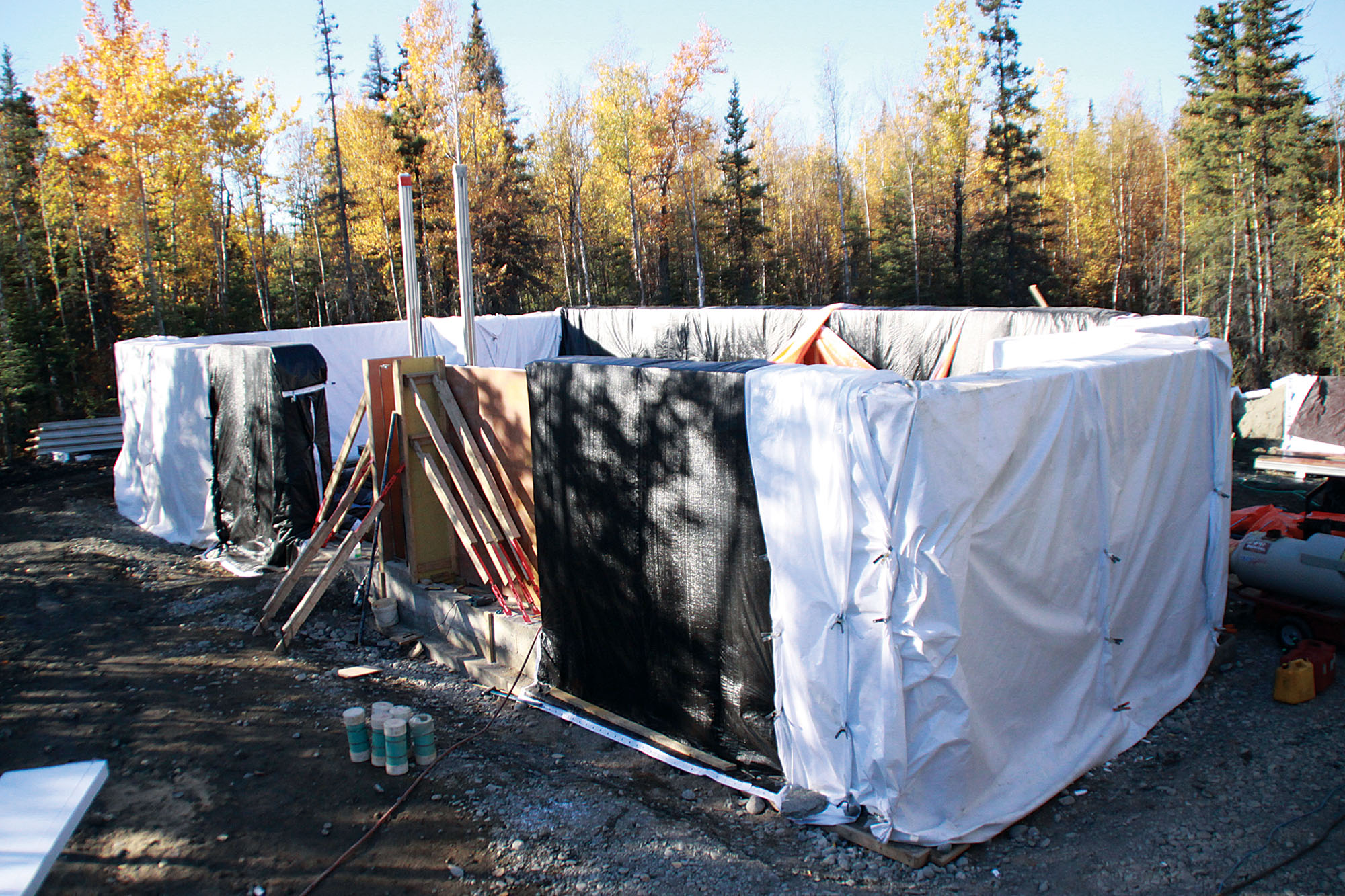
BUTTE — The house rising layer by layer at the intersection of Plumley Drive and Butte Circle may look like an ungainly aggregation of tarps and braces at the moment.
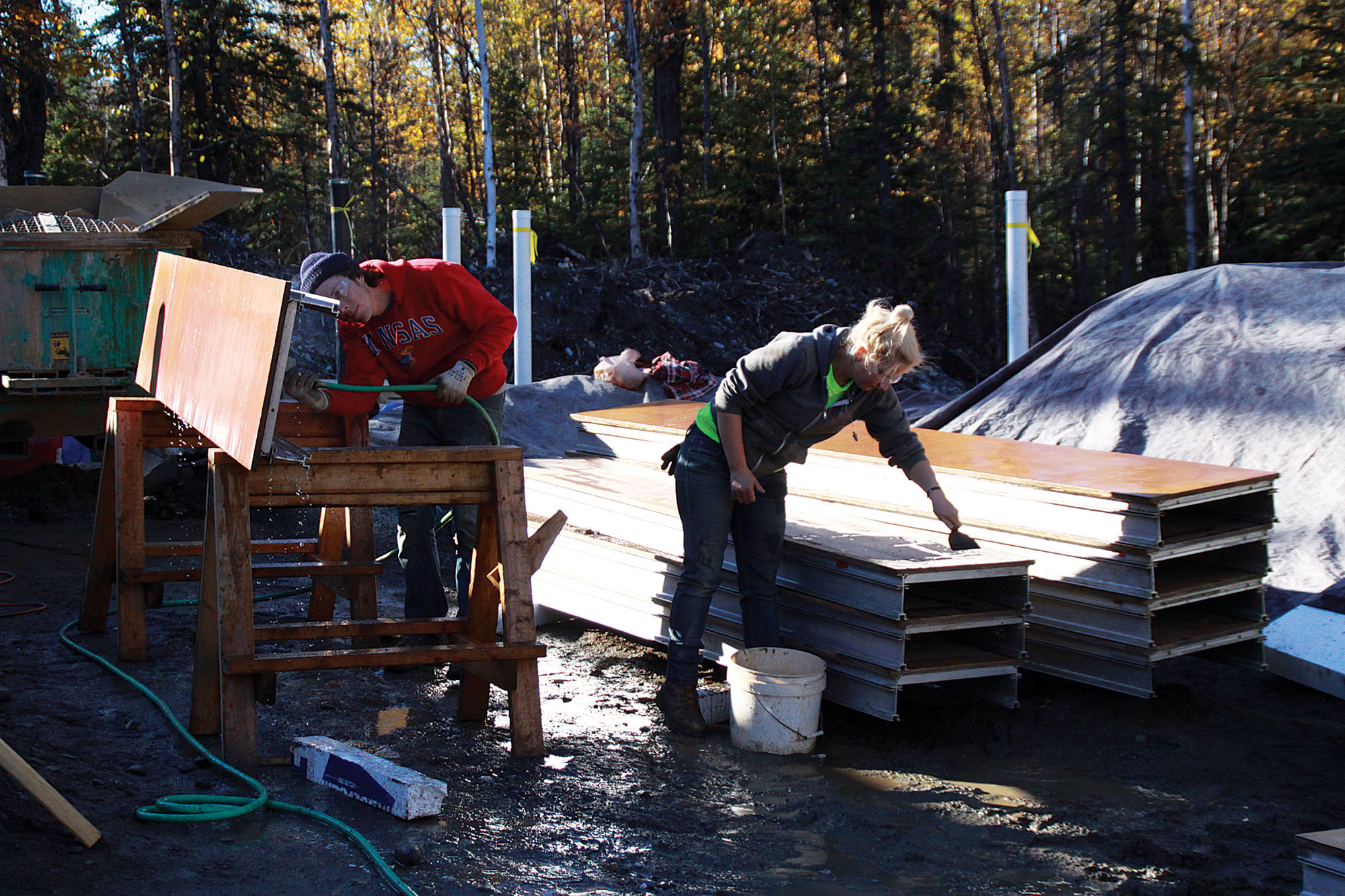
But the soon-to-be three-bedroom house is the first example of something new — or potentially very old — in Alaska. A crew of recent Kansas University masters degree graduates toiled the summer away constructing Alaska’s first rammed-earth house. The project is a joint venture of the Aleutian Housing Authority — which owns the land and will eventually hold title to the house — Port Townsend, Washington-based construction firm Earth Dwell, Ltd., and West Virginia University.
Rammed earth — also known as taipa, taipal, or pisé de terre construction — uses molded shapes and primarily local materials to build houses. The method of construction was used to build portions of the Great Wall of China, and is still used to construct traditional housing in remote parts of the world. It involves using a combination of sand and clay fed into molding shapes and then compressed. Traditionally, wood poles and foot stomping were used to flatten materials into the mold. When the top layer is compressed, the molds are taken away, leaving a wall of alternating layers of compressed material.
Bly Windstorm compares the striped aesthetic to sandstone.
“We basically build the wall in layers, like a layer cake,” he said. “The walls end up being, essentially, they’re stone.”
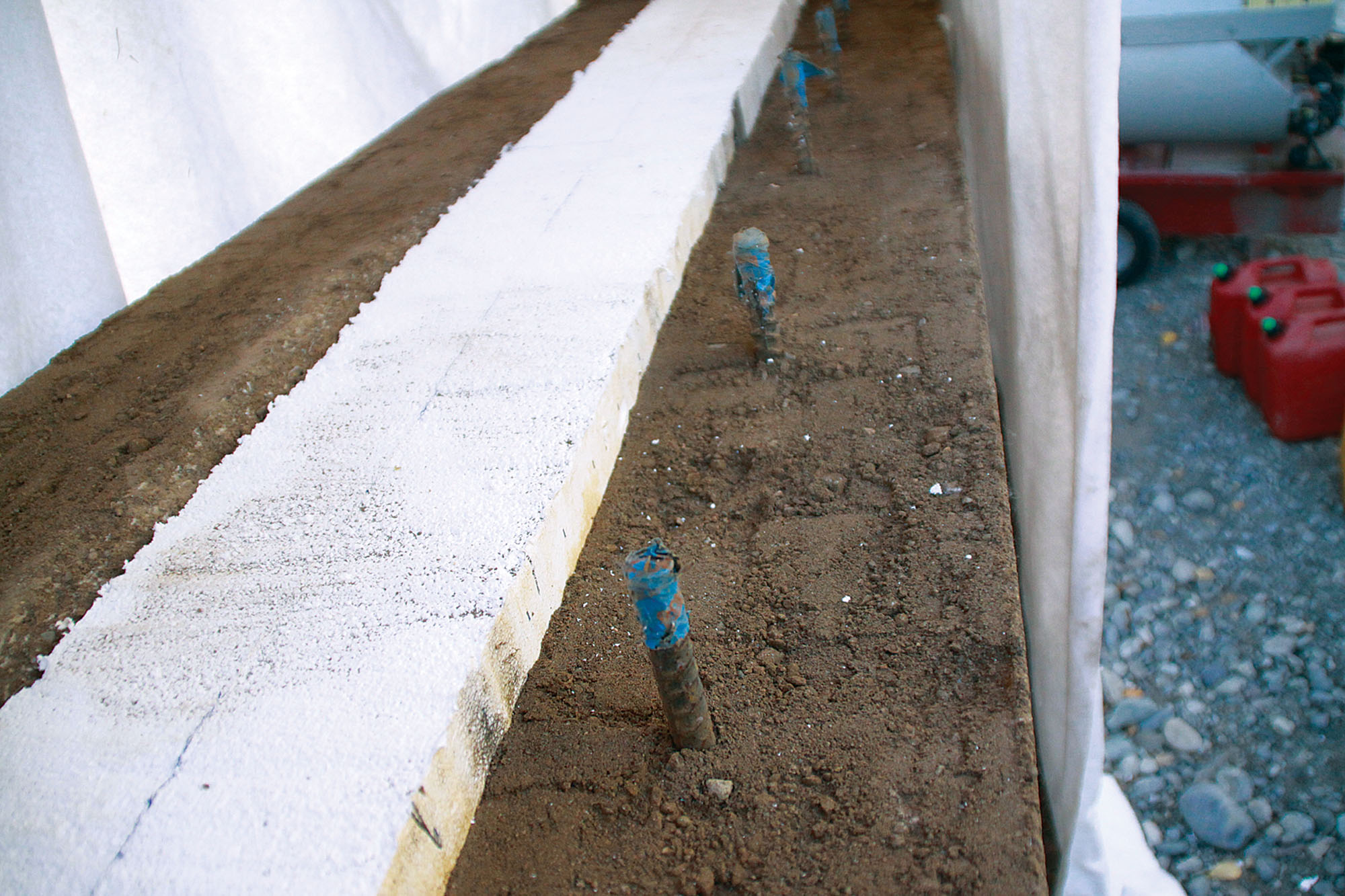
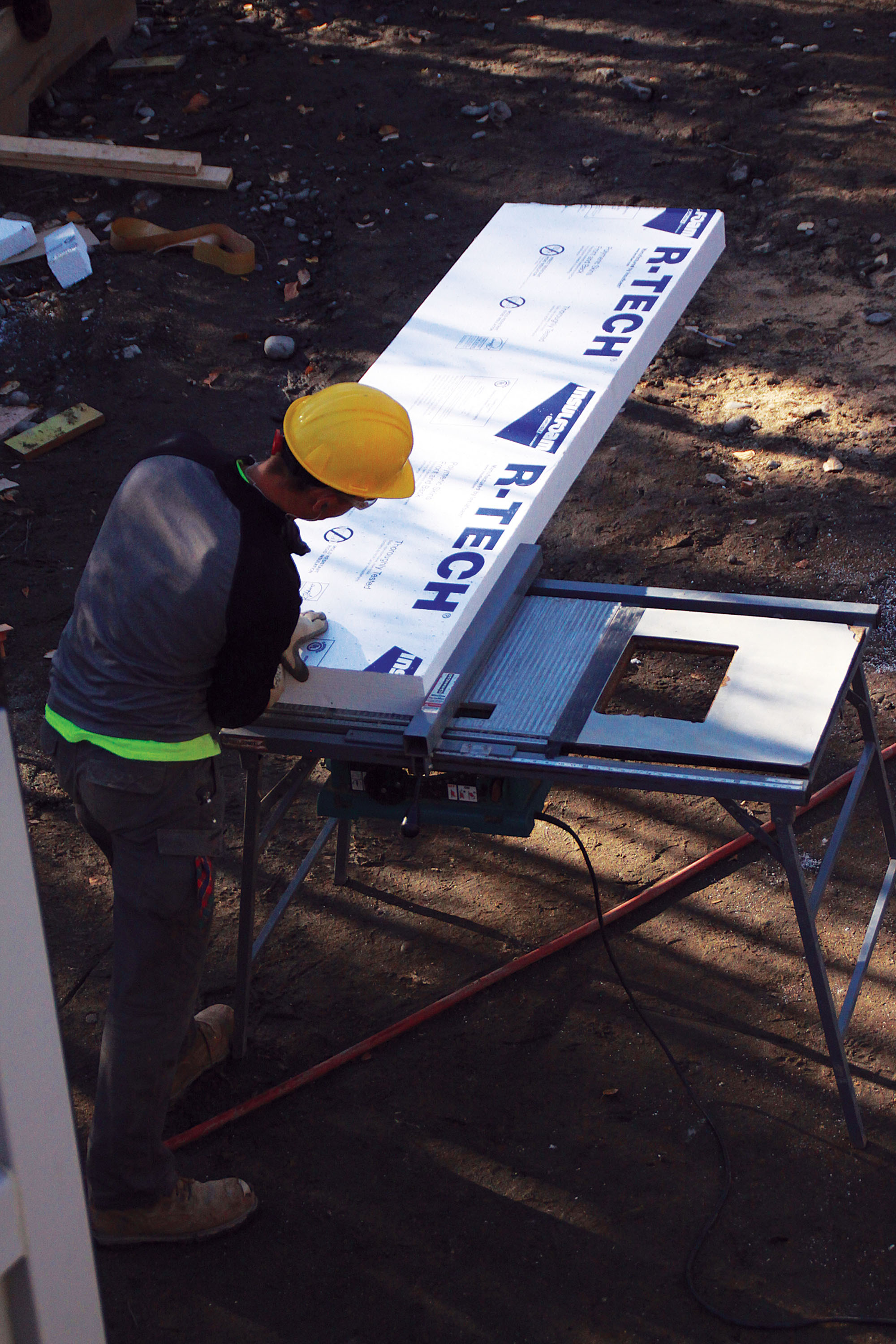
The house at Butte and Plumley uses pneumatic presses to compress, rather than manual labor. Designers are using Portland cement to stabilize the walls, and large sections of the wall are reinforced with steel rebar as a safeguard against potential effects from one of any of the estimated 1,000 earthquakes that strike the state each month. The walls also have a large foam insulator in the middle, and will soon have sensors to monitor energy efficiency and temperature changes, Windstorm said.
“Part of the project is embedding thermal and moisture sensors in our walls and monitoring the energy performance of the house and how the walls perform when there are temperature swings,” he said. “Which, you guys have pretty good temperature swings throughout the year.”
For example, one end of the construction site was a sunny agreeable 50 degrees Thursday, while frost was still visible on the opposite side.
Windstorm is a big proponent of this type of construction. The chief advantage is energy efficiency in addition to environmental soundness, he said. The house’s thick walls make it even more insulated than a typical house.
“We know from previous clients that the energy efficiency is extraordinary, but we’ve never been able to quantify it,” he said. “Other benefits are: it’s completely nontoxic. There’s zero maintenance in a person’s lifetime. You never paint it, you never stain it, you don’t have to finish it in any way. The walls are beautiful. It’s the most sustainable form of construction I know of.”
Most of all, rammed-earth construction is flexible, Windstorm said.
“If you had access to good subsoils anywhere in Alaska and basic equipment, yeah, you could build it,” he said.
The Aleutian Housing Authority has twofold interest in the project, though authorities are waiting to see how the house proves out before committing to future development, said executive director Dan Duame. One notion is to use rammed-earth’s versatility to bring affordable housing to remote areas. Another is to use to use the technique to sell houses on the real estate market to raise money to provide affordable housing for the authority’s clientele.
“Our original objective was to develop a sustainable, highly energy efficient, healthy, and environmentally friendly house while at the same time trying to reduce our cost,” he said.
The idea of using rammed earth grew out of a 2012 contest for architects to design homes suitable to the high-energy-cost, wind-pummeled Aleutian Archipelago. Windstorm’s was among more than 100 ideas for practical Aleutian housing submitted, though the top prize eventually went to a Spanish design firm.
The authority isn’t yet ready to provide figures or construction costs: the building still needs to be roofed and finished using more conventional materials, and workers are rushing to enclose the building before winter sets in, Duame said.
Construction costs for the house are typically higher than conventional housing, especially given the requirements for earthquake-prone areas. In San Francisco, a house of this type can cost between $75 and $100 per square foot, according to an article about high-end rammed-earth mansions published on sfgate.com. By way of comparison, conventional construction in the most expensive rural location on the Alaskan mainland (Barrow) runs about $26.54 per square foot, according to figures provide by the Alaska Housing Finance Corporation in 2013. A series of studios used for similar construction at the University of Arizona estimates construction costs at about $11 per square foot, given student laborers working at minimum wage, according to academic paper comparing three buildings constructed during the program.
The bottom line for affordable housing: authorities will have to carefully evaluate whether or not the energy savings are enough to offset high construction costs.
“We’ll know even after one or two years,” he said. “We’re going to be monitoring the home carefully for performance on energy efficiency. We’ll find out based on that research how this compares to other products. We’re going to take our time and just see how it develops.”
Officials also haven’t yet determined what to do with the house moving forward, Duame said. For example, the wrong type of tenant could skew the results of the study.
“Once the monitoring is all in place, is that something that requires the participation of the occupant?” he said. “We don’t want somebody who’s going to leave the windows open all the time because they like the cold.”
While officials wait to see how the final construction cost will come out, fifth graders at Butte Elementary have already learned something about it. After several students asked questions about a new house being constructed at a relatively well-trafficked intersection near the school, fifth-grade math and science teacher Rob McLain arranged a tour. At least one of his students expressed an interest in architecture after the trip, he said.
“We published a story in our school paper under the headline ‘Mystery solved,’” he said.
Despite the uncertainty, authority officials remain optimistic about the method’s potential, Duame said.
“Our goal is that this would be competitive for what it is,” he said. “It’s not a low-end product. I’m still cautiously optimistic. It’s the first time we’ve ever done this in Alaska. There is still a lot to be learned.”
Contact Brian O’Connor at 352-2269, brian.oconnor@frontiersman.com, or on Twitter @reporterbriano.

By Jeremiah Bartz Frontiersman.com A football coach using a hockey reference as the centerpiece for his keynote address may

Frontiersman.com With its headquarters in Wasilla, the Frontiersman has been a primary source of news for the Matanuska-Susitna

By Katie Stavick Frontiersman.com The next generation of leaders took flight this week as the Houston High School Class

By Kyle Wilkinson For the Frontiersman Keynote speaker and Carry the Cure President Bill Pagaran’s words boomed through the