Retiring teacher, coach urges Colony grads to ‘find their 68’
By Jeremiah Bartz Frontiersman.com A football coach using a hockey reference as the centerpiece for his keynote address may


MOOSE CREEK — Students at the Ya Ne Dah Ah School learned from researchers Brettwood “Hig” and Erin McKittrick about the week their family spent exploring the coal fields in Chickaloon, Jonesville, and Wishbone Hill to get a personal ground’s eye view of the projects.
The McKittricks live with their daughter Lituya, 3.5, and son Katmai, 5.5, in a yurt in Seldovia when they aren’t trekking around Alaska. This “brief” — by their measure — human-powered adventure began Sept. 13 at Chief Gary Harrison’s house and ended in Palmer Sept. 20.
The McKittricks founded their 501(c)(3) nonprofit Ground Truth Trekking in 2007 to “educate and engage the public on Alaska’s natural resource issues through a combination of wilderness adventure, scientific analysis, and the creation of web resources.”
Some of the adults in the room Friday remembered hearing about the McKittricks in an APRN story that followed the family from March to July as they walked and paddled the 800 miles around Cook Inlet’s coastline.
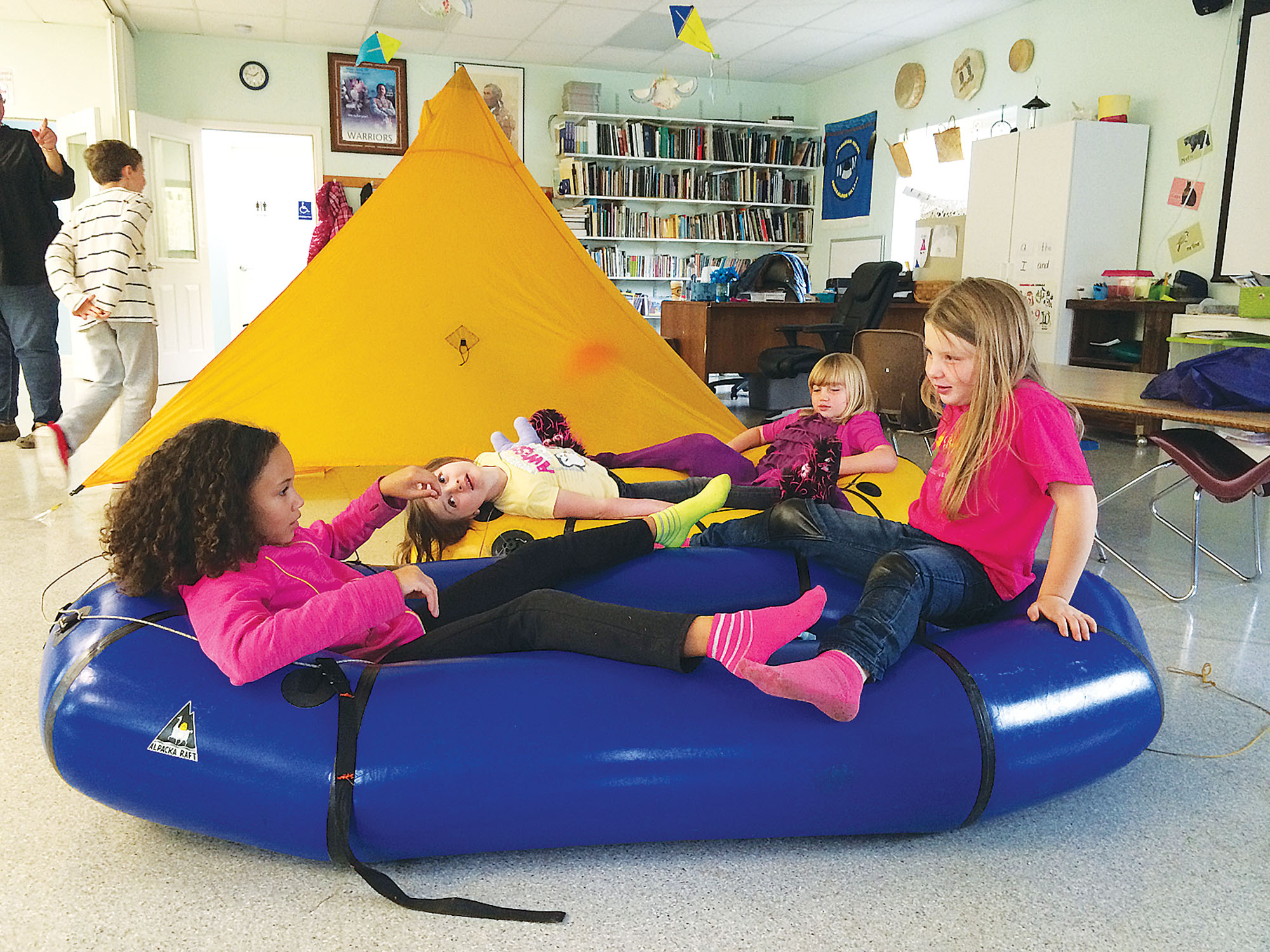
For students, the highlight seemed to be the tent Hig set up and the two pack rafts Erin inflated and then invited the class to explore.
“There’s what you can learn from Google and what you can learn from boots on the ground,” Hig said.
He said he and Erin began doing human-powered adventures in college. After they finished graduate school in Seattle, he said they spent the next year walking, skiing and paddling from Seattle through the Mat-Su and down to the Kenai Peninsula.
“We learn a lot more when we go somewhere,” Hig said.
He said their website includes their research about the various coal projects proposed in Alaska. The information they gathered will be added to their section about the Wishbone Hill project, though it has not been updated yet, Hig said.
Last summer, Katmai was the pacesetter. This summer it is Lituya.
“It took us several days to walk across Anchorage,” Erin said of their 2013 adventure.
Erin is a writer. She’s written two books and essays and articles about their treks. Hig is the photographer for the website and books. Both have science backgrounds.
Erin says they start with facts and try to use their experiences to gain perspective.
According to Ground Truth Trekking’s website, its mission is to “provide people with the knowledge they need to make smart decisions about these issues, now and into the future.”
Hig said they asked people they met as they hiked and floated through the area what they see as the future of the region. “How do people see the future and how can they be empowered to work toward that future? How will it look in one or two generations, particularly with regard to coal?”
Erin said they don’t see themselves as activists. She said their goal is to research the costs and benefits to resource development.
The development projects underway in the Valley’s coal fields are different in a key way from other Alaska coal mines the Ground Truth has studied, she said. Here there is a complex community in the midst of the mining area, Erin said.
“We ran into hunters right on top of the coal mine proposal,” Hig said.
Asked about the coal mine, the hunters from Eagle River and Anchorage said they liked to hunt there and didn’t want to lose the area, but if there is money in it, it will happen eventually.
The driveway to the proposed Wishbone Hill coal mine is almost directly across the Glenn Highway from the small tribal school. The woods where the mine would be have been a classroom to generations of the tribe’s children, says Lisa Wade, director of Health, Education and Social Services for the Chickaloon Village Traditional Council.
“The way the air smells. The way the trees feel. If they don’t see the value in that, it’s very easy to say oh, bulldoze it,” Wade said. “I recognize the smells the touch, the foods that are around me. That’s a really powerful connection to place.”
She said she sees a real disconnect in people between the environment and what it gives us and industry and what it does to us.
The McKittricks compared the destruction they saw at Jonesville to their campsite on the top of Wishbone Hill.
Wade said the tribe spends a lot of time each spring cleaning up the trash, burned vehicles and discarded, shot-up appliances from the Jonesville area.
“There is no incentive to protect it when it is already a wasteland,” she said.
While the Usibelli Coal Mine project is only projected to operate for 15 to 25 years, Wade said she fears the area will be degraded into another Jonesville.
“It’s different how people treat Jonesville versus the woods,” she said. “People consider it almost their right to destroy that area.”
Hig said their research looks at the positives alongside the negatives.
Jobs create people’s lifestyles, their standards of living, he said. It’s easy to focus on the negative and understate the benefits, he said.
Part of the couple’s research has looked at other countries and how they handled resource development.
“I kind of think we could do a better job here,” Hig said of balancing industry and human interests.
Next up the family says they are considering a trip in spring 2015 from Nome to Kotzebue.
“We have so much of Alaska left to explore,” Erin said.
For more information, visit groundtruthtrekking.org.
Contact Heather A. Resz at 352-2268 or heather.resz@frontiersman.com.


By Jeremiah Bartz Frontiersman.com A football coach using a hockey reference as the centerpiece for his keynote address may

By Katie Stavick Frontiersman.com The next generation of leaders took flight this week as the Houston High School Class

By Kyle Wilkinson For the Frontiersman Keynote speaker and Carry the Cure President Bill Pagaran’s words boomed through the

By Jeremiah Bartz Frontiersman.com The community of Palmer is known for a couple of things. At or near the