Retiring teacher, coach urges Colony grads to ‘find their 68’
By Jeremiah Bartz Frontiersman.com A football coach using a hockey reference as the centerpiece for his keynote address may


The rain began as small droplets, like tears of joy, as people arrived for the healing ceremony. An Elder and a culture bearer took shelter beneath the deck, waiting for the rain to pass. The light sprinkle felt fitting, as though the land itself was preparing for something sacred.
“This is Refuge,” said artist Holly Gittlein, who organized the creation of the Refuge fire pit. Gittlein returns each summer to lead an art and nature camp with the young people served by My House, a local nonprofit. “Nature has always been my refuge,” she said simply. The firepit, she explained, “was created for students as a refuge for My House, in partnership with Knik Tribe.”
Refuge is a life-size compass rose designed as a gathering area around a fire pit. The borders, lines, and shapes are formed from rocks the students picked and laid themselves.
Gittlein invited the crowd to reflect: “Where do I find refuge? Life changes quickly for all of us, and what we have is our refuge. Maybe it’s your home, or maybe it’s a person, or maybe it’s a job. Anchor yourself in your own inner refuge and hold that inner flame.”
She went on to describe the building of the firepit. “We built this firepit with Knik Tribe, to have a gathering place for healing, a place for sharing, a place to come as you are—whether you’re on top of the world or you’re filled with grief and alone. This is living art.”
Ceremony of Fire and Smoke
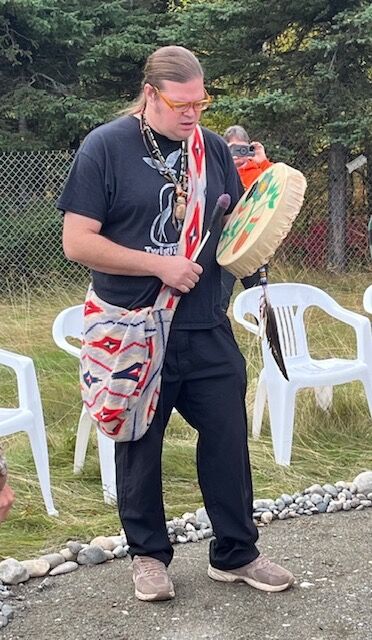
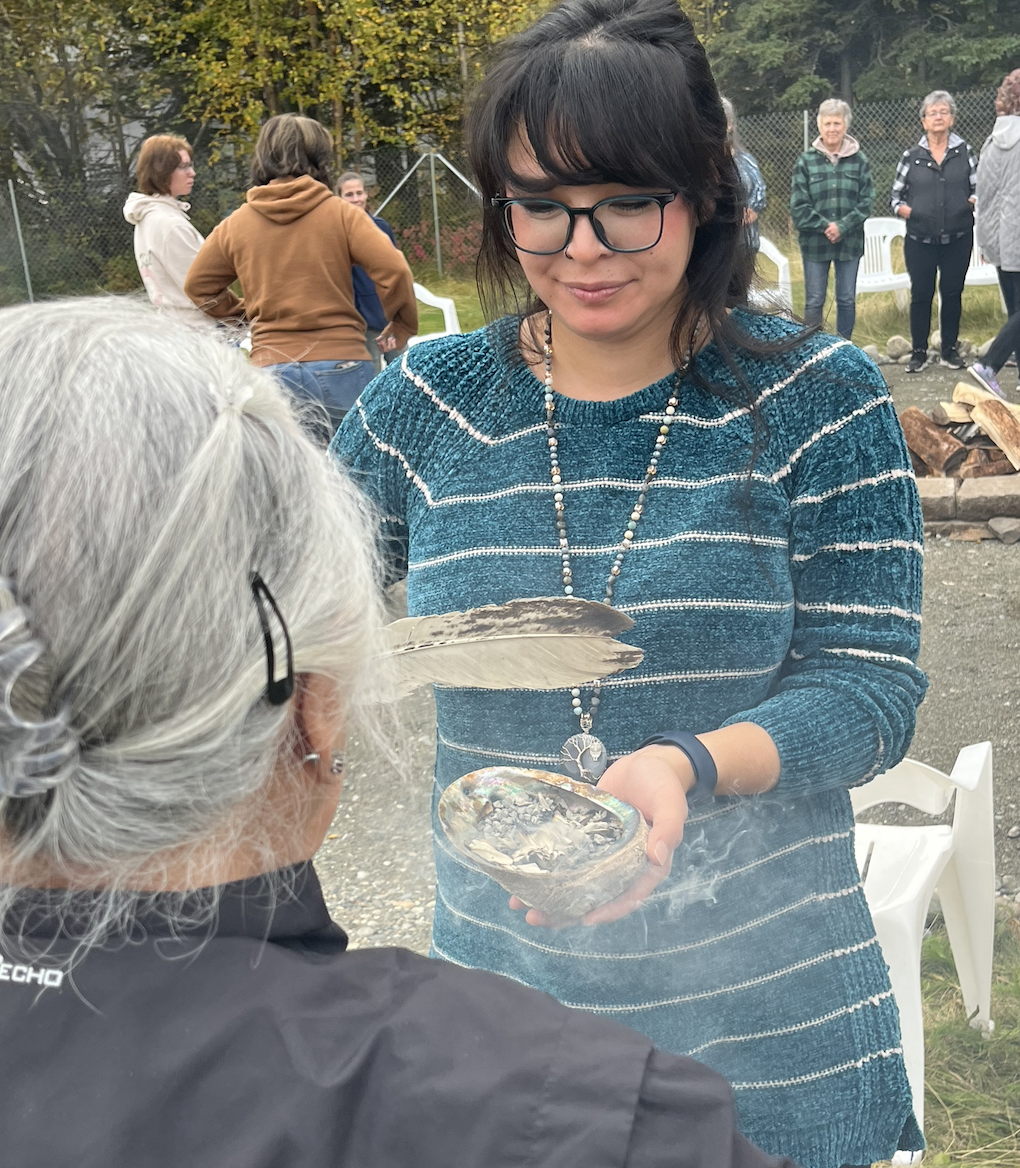
The ceremony began with Drew Regner and Michelle Parker leading a smudging ritual at the eastern entrance to the firepit. Regner explained the practice:
“We do this to start off our ceremonies. It helps get you in the right mindset. It helps you clear the air of any negativity with good, positive intentions. When we light it, you bring the smoke to your heart and up over your head. Most of us live in our head, and this helps clear that channel from your head to your heart. We use the Eagle feather to take our prayers to the Creator.”
After the smudging, people gathered inside the compass circle in silence. Once everyone was assembled, Margorie, a Yupik Elder from the Kuskokwim region, opened with prayer. Gittlein then instructed the group to pick up rocks, attach their intentions of what refuge meant to them, and place the stones by the fire.
The first student to speak said, “Peace.” Soon after, others offered “love,” “gratitude,” and “community.” The fire was lit, closing prayers were spoken, and before long people were
laughing, talking, and breaking bread together. A local church provided the meal, and many roasted hot dogs over the new fire.
This Refuge ceremony was held on the grounds of a major new project: a $23 million construction site where a 34,000-square-foot facility will soon rise. Once completed, it will house 64 beds for Matanuska-Susitna youth ages 18 to 26 who are experiencing homelessness. The project is funded through a 2022 federal appropriation. The land was purchased earlier this year; now they are waiting on the steel.
For Michelle Overstreet, CEO of My House, the moment is nearly unimaginable. She began this work in 2010, helping homeless students out of a small closet at Burchell High School, where she served as a life coach.
“She is an amazing lady,” said Jay Dagenhart, the first employee and founding board member. “I’d charge into Hell with a water pistol for her.” A pastor by training, Dagenhart came to Alaska as a missionary and became the organization’s first outreach coordinator in 2013. Today, he oversees health and safety.
“We are saving lives,” said Overstreet. “The cornerstone of our program is that every young person has a plan. Sixty-eight percent of the students who come in don’t have a diploma. After one year, that number drops to 32 percent. They get to choose their path, whether it’s Nine Star, the Mat-Su School District, or another program.”
Her vision is long-term. “When they leave us, they are not chained by generational curses, addiction, poverty, or abuse. We have ten years of breaking these cycles.”
She added, “We serve 100 kids a year—over 1,500 in ten years. Tell me that 1,500 kids off the streets doesn’t make a difference. We end that cycle. They are buying houses and starting businesses.”
As the ceremony wound down and some people began to leave, the sun started to break through the smoke and clouds, as if to say there is hope and refuge at My House.
“There’s something so magical about a fire,” said Patty Wallman, administrative assistant and, affectionately, the “general grandma” at My House. Wallman was excited about what is yet to come. “I can’t wait to see the walking trail.”
Her words echoed something Regner had shared earlier: “The longest distance you’ll ever walk is the distance from your head to your heart.”
Onward & Upward, promotes a culture of One Health through programs that nurture heart, health, and community. Contact Russell Clark at rusty.clark@onwardandupward.org

By Barbara Hunt Palmer Buzz It was 6:43 on Friday morning and the Plant Owner was sound asleep when

By Kyle Wilkinson Frontiersman Memorial Day Weekend was filled with a variety of events in Willow. From live music to

By Kyle Wilkinson For the Frontiersman The Susitna Valley Emergency Preparedness Fair will be held at the Willow Community Center

By Barbara Hunt Palmer Buzz Green-Up happened at exactly 9:34 am on Saturday morning in Palmer. This was