Retiring teacher, coach urges Colony grads to ‘find their 68’
By Jeremiah Bartz Frontiersman.com A football coach using a hockey reference as the centerpiece for his keynote address may


SUTTON — A painting hangs on the wall in Ed Musial’s house. It shows a log cabin next to a salmon stream surrounded by trees, with mountains in the distance.
“That’s all I ever wanted in life,” Musial, 91, said. “A cabin, a dog, a stream with some fish in it. A dog will never disagree with you.”
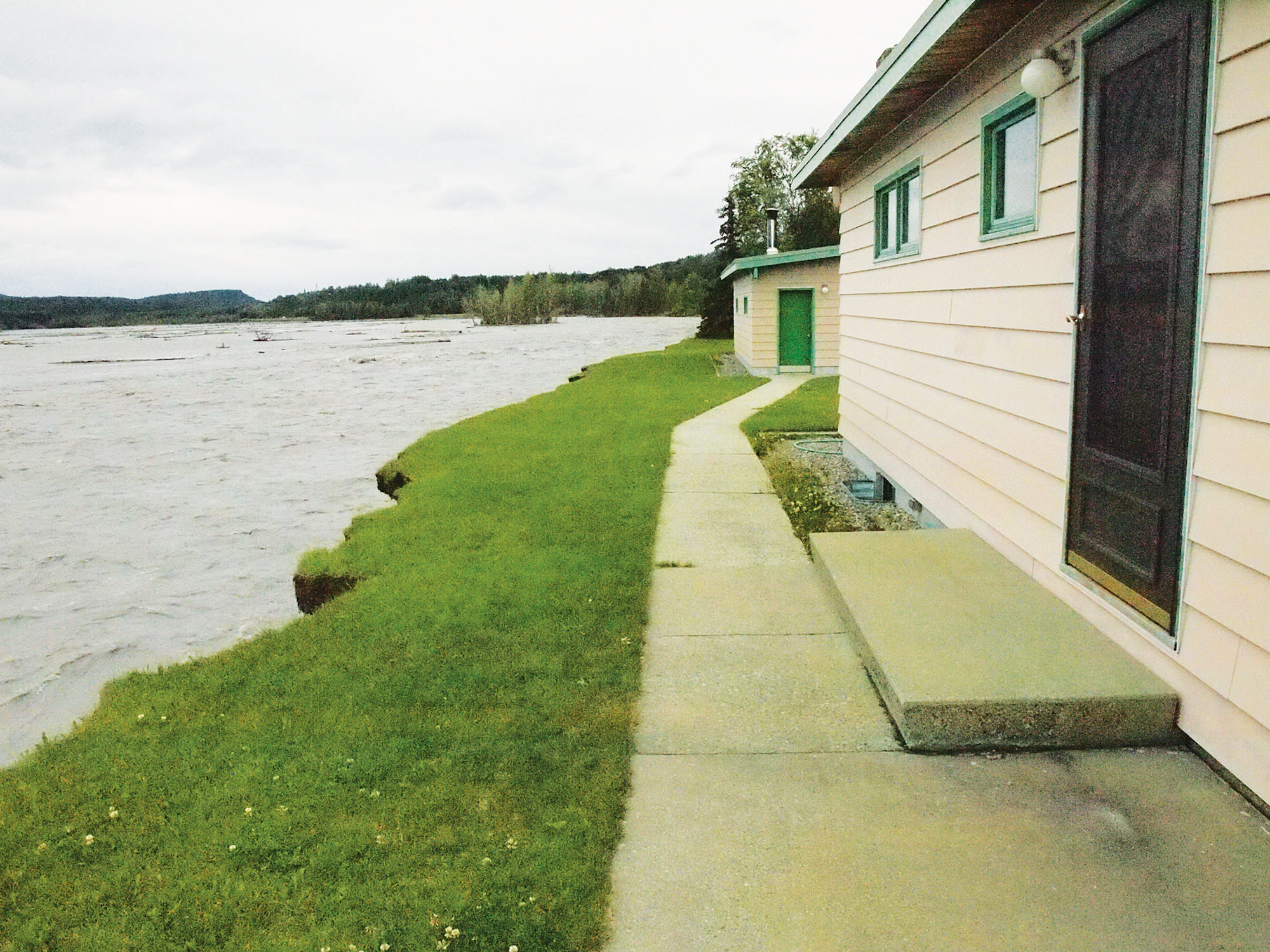
While Musial explained his life’s ambitions, the roar of the Matanuska River poured in through the screen door at the back of his house. The edge of the river, which used to be as far as 300 feet away when Ed and Valeria Musial first claimed their lot off of Glenn Highway north of Sutton and screened from view by trees, is now less than six feet from his back door and, year by year, its flood stage inches closer to the house. That 300 feet of earth has disappeared since the Musials staked their claim in 1952 under the Homestead Act (The family lived for a period in what is now the home’s basement).
Now there’s a concrete walk, a narrow strip of under-eaten grass that used to be a backyard, and then rapidly moving grey water.
The river ate his septic tank whole Sunday, leaving a rusty, soil-encrusted pipe hanging a few inches above the waters. The septic tank followed the salmon stream, which was overtaken by the river years ago.
The Musials plan to get a portable toilet, Ed Musial said. They’re dumping gray water into the river. No matter what happens next, they plan to stay, motivated in part by suspicion about state government motives.
“We’re not going no place,” he said. “That’s what they want us to do. Once you desert the place, that’s it. It belongs to the state then. You dumped it. I’m not leaving here. We’re gonna stay right here. If they have to pay out of their own pocket to move that water, that’s them.”
Musial blames a burst finger dike in 1986 for the encroaching river. The project was a joint venture between the borough and the state Department of Transportation, and involved a series of finger dikes. On the last day of construction in June, the most upstream dike in the series burst. The contractor volunteered to remove culverts from a nearby stream and do some mitigation, but only if the DOT would agree to void the warranty for the project. According to a photocopy of a DOT telephone memorandum dated June 2, 1986, and provided by Musial, then-director Bob Tyson agreed to exactly that. Subsequent correspondence shows state officials denying liability for erosion that Musial says he is certain is a result of the failed dike under the terms of the project’s contract.
Nor are the Musials the only ones facing the wrath of the Mat River.
Further downstream, entire houses have disappeared into the river over the years. Evelyn Johnson has lived in her house since 1980, and even then, the Mat flowed closer to mountains on the other side of the Vvalley. Now, it’s in her backyard, though the water had begun a gradual retreat Thursday, leaving a relatively quiet backwater stream.
Johnson had suitcases packed and was ready to evacuate if the river got much worse Thursday. She was taking a wait-and-see attitude to the approaching water.
“I’ve got suitcases here,” she said. “There was a lot more water the other day. All this grass was covered.”
While floodwaters have retreated somewhat — high water isn’t unusual through late August — the question of what to do about the encroaching water as the Matanuska alters course over the ensuing years lingers. Mat-Su Borough officials, like Department of Emergency Services Director Dennis Brodigan, say the best remaining course of action is to buy out houses in Sutton and Butte now in the path of the shifting river at market prices, then knock them down. They estimate that cost could be between $8 million and $9 million, Brodigan said. They hope about $6 million would come in the form of a grant from the Federal Emergency Management Agency, though that process could take as long as a year, and goes through the state, which receives the grant and determines which local projects will receive the money, officials said. Officials are working to complete a Request for Proposal for a civil engineer and a hydrologist to complete a survey of the affected properties, Brodigan said.
The bulk of the money — $6 million — would be spent on property buyouts, while demolition and removal of existing structures could cost between $1 million and $2 million, Brodigan said.
Musial said he wouldn’t take the buyout. Johnson was more open to the idea.
“I guess, if I could find another place, I’d take it,” she said.
Officials see the present gradually changing course of the river as an act of nature, in particular a wild, fast-flowing glacial river seeking a straight line, and not as the result of man-made obstructions, Brodigan said. Officials have also heard the diversion was caused by an improvised dike made from old cars dumped into the river.
What is likely happening instead is something else, Brodigan said.
“Eventually the Knik (River) and the Mat (River) are going to meet,” he said.
Both rivers currently flow into the Knik Arm.
Alternatives, like dredging a different channel for the Mat, or damming it in some way, will prove more expensive and futile than simply buying out present property owners and re-zoning the land to prevent future construction, Brodigan said.
“The end game has gotta be to get everyone out,” he said. “That’ll be a lot less expensive. The river’s gonna do what the river’s gonna do.”
Flooding this year is not as severe as it was in 2012, when multiple rivers and creeks entered flood stage at about the same time.
“They (residents) don’t like it when we say it, but that’s the reality,” Brodigan added.
In addition to local response, in a press statement U.S. Sen. Mark Begich called for federal officials to declare the Matanuska flooding a disaster under the Stafford Act, which would allow the area to receive federal funding as a designated disaster area.
“We know that erosion will continue to be a threat to Alaska’s Interior and coastal communities,” Begich’s statement reads in part. “FEMA must recognize this ongoing threat and make the policy changes necessary to prevent event more damage and loss of property. Erosion is a slow disaster that puts entire communities at risk. FEMA must recognize this threat and put the policies in place in order to save lives and property.”
The National Weather service predicted Tuesday Mat waters will return to a height of 9.28 feet by 4 a.m., Friday, retreat briefly, then return to a height of 9.18 by 10 p.m. tonight.

By Jeremiah Bartz Frontiersman.com A football coach using a hockey reference as the centerpiece for his keynote address may

Frontiersman.com With its headquarters in Wasilla, the Frontiersman has been a primary source of news for the Matanuska-Susitna

By Katie Stavick Frontiersman.com The next generation of leaders took flight this week as the Houston High School Class

By Kyle Wilkinson For the Frontiersman Keynote speaker and Carry the Cure President Bill Pagaran’s words boomed through the