Retiring teacher, coach urges Colony grads to ‘find their 68’
By Jeremiah Bartz Frontiersman.com A football coach using a hockey reference as the centerpiece for his keynote address may


MAT-SU — Bruce Knowles loves to fish.
For more than 25 years, Bruce has run boats up and down Mat-Su rivers in search of salmon. He’s had a sportfishing business and has guided clients from all over the world on the Deshka, Yentna, Little Susitna and Susitna Rivers.
About nine years ago, having become attuned to the migration of each salmon species and the prime fish-catching windows for clients, Bruce noticed the salmon runs change. As each year passed, Bruce, his friends and fellow fishing guides were catching fewer and fewer fish.
Eventually, the Alaska Department of Fish and Game was forced to limit sport fishing and placed restrictions on certain rivers and species. Bruce became really concerned about the loss of salmon and the ripple effect closures would have on all the small businesses that rely on healthy fisheries to make a living, whether they are fishing guides, lodge owners or retail businesses.
Rather than accept the changes in fish counts, Bruce hit the books and educated himself about fisheries management, read fisheries reports, attended Board of Fisheries meetings, and talked to fishery managers with the hope of piecing together the puzzle that would explain what was happening to Mat-Su salmon. He learned that the freshwater habitat in most Mat-Su systems was healthy and that commercial fishing in lower Cook Inlet was likely having some impact on salmon destined for Mat-Su rivers. He also discovered that Fish and Game fishery managers did not have sufficient information about how salmon stocks were using ocean migration corridors in Cook Inlet to effectively establish escapement goals and accurately monitor the populations on Mat-Su salmon.
With answers in hand, Bruce got busy. He helped the Upper Susitna Fish and Game Advisory Committee get started and was actively involved with the Mat Valley Fish and Game Advisory Committee. These committees are made up of local residents who act as advisors to the Department of Fish and Game on regional fish and game management issues. Bruce was also appointed to the Mat-Su Borough Fish and Wildlife Commission, which formed in 2007, and has now served on that commission for eight years, the past five as chair.
Sitting in meetings may not seem like a way to protect salmon, but Bruce recognized that the policies used for fishery management significantly impact the health of our salmon populations, and citizens need to be involved to make sure the policies fit changing realities on the ground.
For the 2014 Upper Cook Inlet Board of Fisheries Management meetings, Bruce and the other members of Mat-Su Fish and Wildlife developed a research report for the Board of Fisheries to explain the salmon population problems and management issues in the Mat-Su Borough. The commissioners attended 14 days of meetings, testifying and commenting on more than 400 proposals affecting Cook Inlet salmon fisheries.
At the conclusion of the meeting, the Board of Fish unanimously adopted regulations proposed by the commission to establish a “conservation corridor” in central Cook Inlet by restricting the commercial fleet, in order to allow salmon headed to Knik Arm rivers to safely pass the gauntlet of commercial nets. It’s too early to tell if the new regulations are making a difference, but Fish and Game reported that summer of 2014 was one of the best coho fishing seasons in the Mat-Su that many have seen for years.
Bruce never hesitates to call Mat-Su legislators to keep them informed of on-the-ground fishery issues and the impacts to Mat-Su communities. He has spent time in Juneau advocating for more state resources to help Upper Cook Inlet salmon. And in 2014, thanks to his efforts, the Mat-Su Borough was awarded a $2.5 million grant to replace old culverts that block fish passage and to conduct research to better understand salmon stocks in Upper Cook Inlet.
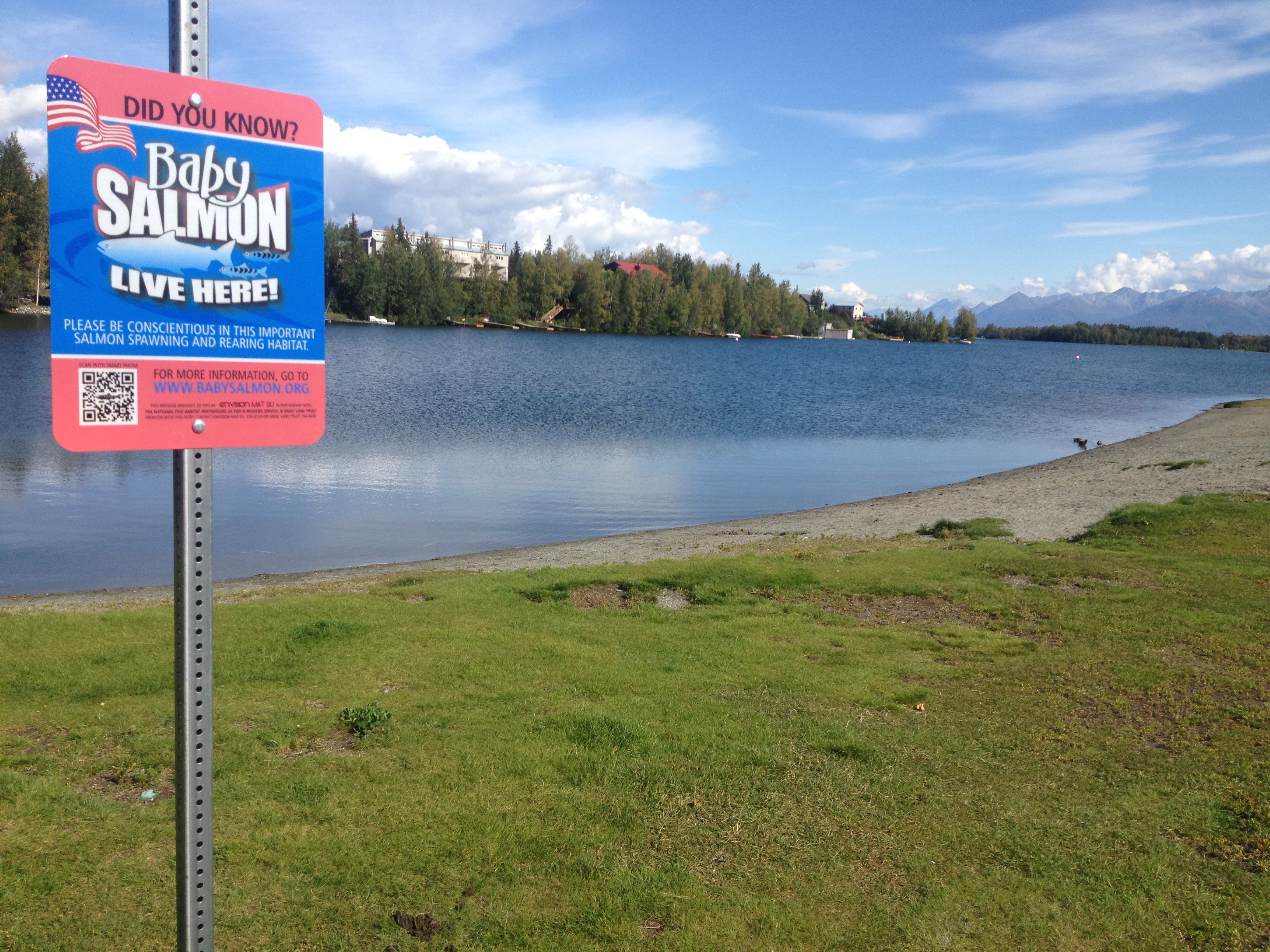
Bruce’s latest call to action is helping Mat-Su residents and visitors understand where baby salmon live, all year long. An initiative started last year by Envision Mat-Su, with funding support from the Mat-Su Salmon Habitat Partnership, allowed for the placement of 20 “Baby Salmon Live Here” signs at public boat launches and along major roadways where salmon streams cross. Envision Mat-Su also had a local MASCOT bus wrapped with a similar sign and created a website to educate people about the threats to Mat-Su salmon populations.
Bruce loved the project and wanted to see it expand to include signs at every major salmon stream road crossing on the Parks and Glenn Highways, as well as other major roadways. Great Land Trust is happily partnering with Bruce to help his vision become a reality.
Currently, Bruce and the trust are in the process of identifying potential sign locations and working with Fish and Game and the Department of Transportation to get the appropriate permits to install the signs. Bruce has also been reaching out to community members, inviting them to sponsor a sign to help pay for the project. In return, the sponsor gets their name on the sign.
Bruce Knowles is a King Maker.
Knowing that people like Bruce and all the other King Makers in our community are out there gives me hope that the Mat-Su will have a future filled with salmon. I am humbled by the amount of time and financial resources Mat-Su residents are willing to spend to be part of the solution ensuring our salmon have healthy river systems to come back to, that they have access to spawning grounds and rearing habitat, that the water is clean, and that the fisheries are being managed to support sustainable populations.
Great Land Trust is a local, nonprofit land trust dedicated to conserving the lands and waters Alaskans love and depend on to maintain an outdoor lifestyle. We are driven by a shared connection to the land, and we use strategic and scientific tools along with community input to identify and conserve the purity of our drinking water, the integrity of fish and wildlife habitat, and access to public lands and waterways for all.
Over the last 20 years, Great Land Trust, in partnership with private landowners, has conserved more than 11,000 acres of land, including 7,000 acres of wetlands and 44 miles of salmon streams. We have also helped conserve seven municipal parks, five historic homesteads, three farms, four public trails and five public access projects through voluntary agreements with private landowners.
We work throughout Southcentral Alaska. Loosely shaped like Italy, our service area umbrella includes the communities of Anchorage, Eagle River, the Mat-Su Valley, Girdwood, Cordova, Prince William Sound, Whittier, the Copper Valley, Kodiak Island Borough, and Western Cook Inlet.
We look forward to sharing more Mat-Su King Maker stories with the public in the future. For more information about Great Land Trust, land conservation options available to private landowners or to support our work, please visit our website at greatlandtrust.org.

By Barbara Hunt Palmer Buzz It was 6:43 on Friday morning and the Plant Owner was sound asleep when

By Kyle Wilkinson Frontiersman Memorial Day Weekend was filled with a variety of events in Willow. From live music to

By Kyle Wilkinson For the Frontiersman The Susitna Valley Emergency Preparedness Fair will be held at the Willow Community Center

By Barbara Hunt Palmer Buzz Green-Up happened at exactly 9:34 am on Saturday morning in Palmer. This was