Retiring teacher, coach urges Colony grads to ‘find their 68’
By Jeremiah Bartz Frontiersman.com A football coach using a hockey reference as the centerpiece for his keynote address may


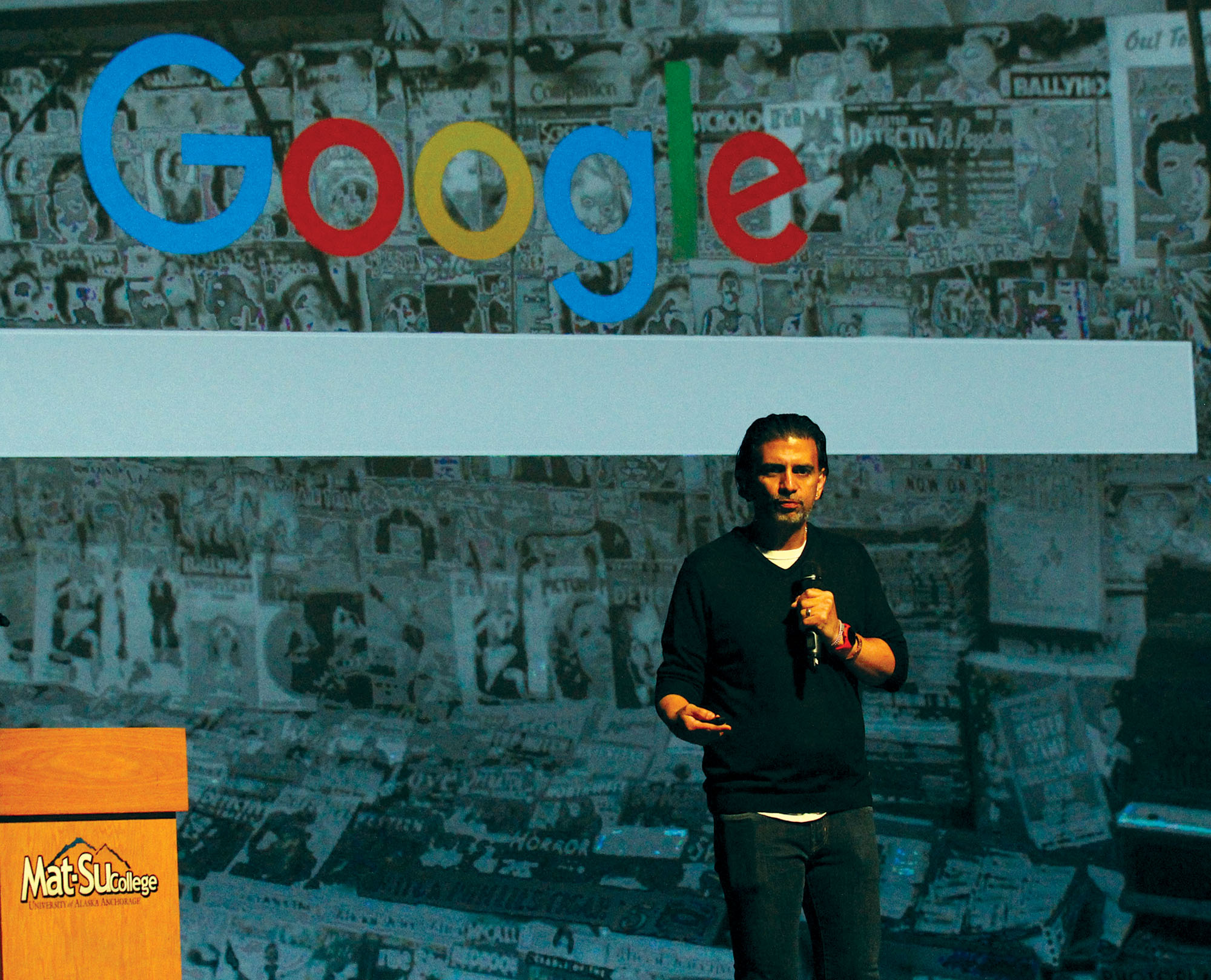
PALMER — According to Google’s “chief education evangelist,” Jaime Casap, education is as much a matter of opportunity and motivation as technological innovation.
Casap regaled and inspired hundreds of Mat-Su teachers and school district staff at the Glenn Massay Theater last Friday, describing his own educational journey and the ways in which schools today are the same as, yet different from, those teachers once experienced as students.
A first-generation American, Casap said he grew up in Hell’s Kitchen, New York, on welfare and food stamps in the 1970s and ’80s. When he was old enough to go to school, he learned to speak English the hard way.
“They said, ‘Welcome to (Public School) 111,’ and I said ‘que?’” Casap said, to chuckles from the audience.
Casap went on to graduate high school, college and graduate school, and last year gave a presentation to students on the president’s home turf as Google’s chief education evangelist.
“That’s the power that education has — you can take a kid from Hell’s Kitchen, New York, and put him in the East Wing of the White House. That’s the American ethos, that if you work hard, you get your education, you can accomplish anything,” he said.
But there’s more that can be done to give students a leg up in this ever-advancing world, Casap said, including providing more opportunities for technological education.
“(We need to) ask ourselves, what’s the model of education that we need for the economy that we face?”
According to Casap, the U.S. Bureau of Labor and Statistics predicts that more than 1 million computer science jobs will become available in the next 10 years. The bureau also reports that 60 percent of today’s kindergarteners will work jobs as adults that don’t exist yet, he said.
Furthermore, people with computer science degrees make about 40 percent more money than the average college graduate, yet only one in four U.S. schools offers computer science classes, Casap said.
“I’m not saying every kid needs to be a programmer, but … you need to know computer science,” he said.
Even at the most basic level, technological knowledge is important, Casap said. For example, students ought to be able to conduct online research and know how to vet sources of information, as well as how to stay secure and private on social media, he said.
Because contrary to popular belief, Casap said, the students of “Generation Z” are not born “digital natives” that excel at multitasking, but regular people that need to be cultivated as “digital leaders.”
“They do two things at the same time poorly just like we do … but how they think about learning is different,” Casap said.
Using his own children as an example, Casap noted that the youth of today tend to pick YouTube videos over textbooks, and prefer independent learning methods to information handed down from one source within the confines of a set curriculum.
“(My son) never said, ‘hey, you work at Google — where do you think I need to learn how to code?’ He just taught himself how to code,” Casap said.
All that said, Casap emphasized that he does not think there will ever be schools without teachers.
“Technology is not a solution — it’s an enabling and supporting capability,” Casap said. “At the end of the day, when that door in that classroom shuts, nothing is more important than having a great teacher in that classroom.”
Adapting from the era of black-and-white success or failure to the world of “consistent and constant iteration,” Casap said, will require a culture shift on the part of teachers and students, which starts with asking the right questions.
Swapping “what do you want to be when you grow up” with “what problem do you want to solve,” for example, gives a student the focus and autonomy to determine what they need to learn to get into a position that allows them to achieve the goal.
Casap also challenged teachers to scrutinize the difference between cheating and collaboration in students’ pursuit of such goals.
“Real collaboration is the ability to listen … to ask good questions … to change your mind when presented with real analysis and real data … to build consensus,” he said.
Teachers talk
Mat-Su Career and Technical High School social studies teacher Zack Lanphier said Casap’s suggestion to ask different questions was what struck him the most about the presentation.
“I took one note, (of) that idea of asking ‘what problem,’ not ‘what do you want to be when you grow up,’ because I don’t even know that,” Lanphier said.
Palmer High School language arts teacher Kelly Kuzina said she appreciated Casap’s comments about the latest generation, expressing what looked like relief that Google agreed students still need teachers.
“The kids … they’re so far beyond us in so many ways, but I think we’re not completely useless to ’em,” Kuzina said. “No matter what age I think that we can really work with them to show them all the different aspects of technology and how to apply it in the business world.”
This year, as part of the district’s five-year technology plan, Palmer High became the second school (after Colony High) to more broadly embrace the online Google Classroom, where all students in a given class can log on simultaneously to view, submit and receive assignments written in Google Docs from anywhere at any time, as long as there is internet access. In class, students use school-issued Chromebooks.
Kuzina said her students have been very receptive to and adept at using the new system, which she envisions as particularly useful in grooming younger generations for a world with fewer and fewer 9-to-5 jobs.
“We are moving into an era where time and place mean something different,” Kuzina said.
Contact reporter Caitlin Skvorc at 352-2266 or caitlin.skvorc@frontiersman.com.

By Jeremiah Bartz Frontiersman.com A football coach using a hockey reference as the centerpiece for his keynote address may

Frontiersman.com With its headquarters in Wasilla, the Frontiersman has been a primary source of news for the Matanuska-Susitna

By Katie Stavick Frontiersman.com The next generation of leaders took flight this week as the Houston High School Class

By Kyle Wilkinson For the Frontiersman Keynote speaker and Carry the Cure President Bill Pagaran’s words boomed through the