Retiring teacher, coach urges Colony grads to ‘find their 68’
By Jeremiah Bartz Frontiersman.com A football coach using a hockey reference as the centerpiece for his keynote address may


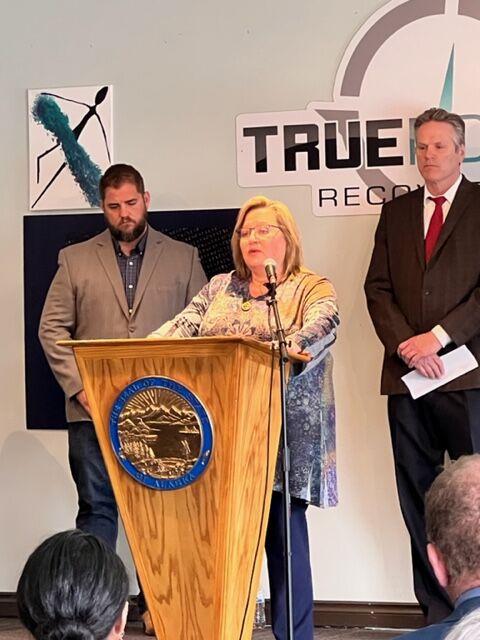
Tuesday, Governor Mike Dunleavy visited True North Recovery in Wasilla to address the surging Fentanyl crisis in Alaska. Partnering with Public Health and Law Enforcement, Governor Dunleavy had a simple message: One pill can kill.
Addressing staff, members of the Mat-Su Opioid Task Force, and others, Governor Dunleavy described the potent, highly lethal synthetic opioid Fentanyl as a “scourge plaguing Alaska.” As previously reported, overdoses in Alaska have risen drastically from 2020-2021 by 71% and noted the 6 overdose deaths to Fentanyl earlier this year.
He also commended the High-Intensity Drug Trafficking Area (HIDTA) Task Force for the seizures of Fentanyl, specifically the 1244 grams of Fentanyl has been seized the first 3 months of 2022, nearly twice the amount seized in all of 2021.
“The 1244 grams seized is enough to kill 622,000 Alaskans,” he said. For context, the population of Alaska is estimated at 732,000.
He announced that Alaska had recently joined a multi-state task force led by Arizona (American Governor’s Border Strike Force) to stem the flow of Fentanyl into the United States. As Fentanyl flows from China to Mexico, the drug makes its way to Alaska through an insufficiently protected southern border, a gateway to the American market.
“We don’t border Mexico, but we are seeing the results of a border that’s wide open,” Governor Dunleavy said. The task force is also designed to share information and resources.
The Governor also said that the states have no ability to exert diplomatic force on China and Mexico, and the current presidential administration is ignoring the problem while the “poison” of Fentanyl flows into the US. “We’re going to continue to do everything we can here in Alaska.”
With that, Governor Dunleavy is issuing a Community Threat Alert, which includes receiving and making available 11,000 Narcan kits to help people suffering an overdose.
Another area addressed is law enforcement. He stated that he will be introducing legislature that makes knowingly dealing in Fentanyl that results in death a 2nd degree murder charge, along with stiffer penalties.
The current Alaska State statute 11.41.120-Manslaughter, states that it is a Class A felony to knowingly manufacture or deliver a controlled substance and a person dies as a result of ingesting a controlled substance. Governor Dunleavy is hoping that with the charge moved to murder, a strong message will be sent that law enforcement has the tools to prosecute Fentanyl dealers
“As a result of that total disregard for the safety of others, these drug dealers will be prosecuted to the fullest extent of the law including being charged with manslaughter if an individual ingests that drug and dies,” said Governor Dunleavy. “I will be asking for the Legislature to increase the penalties to the maximum extent possible for anyone who deals fentanyl or fentanyl-laced drugs.”
Public Safety Commissioner James Cockrell addressed the audience, reassuring that the Alaska State Troopers are working everyday with local and federal partners to combat illegal drugs from entering the communities at every level. He also recounted his own tale of how drugs have impacted his family.
“As a parent, I lost a son. He was 28 years old,” Cockrell shared, stating that his son died of a heroin and Fentanyl overdose in 2019. Cockrell recalled a phone conversation he’d had with his son just a week prior. “He (his son) talked about how people who do what he does, don’t live very long.” A week later, his son was found dead in a home in Pennsylvania.
Cockrell warns that while he should have known the signs, what to look for as a career law enforcement officer, but said simply,
“Whether I chose to ignore it or just didn’t see…the bottom line is my son’s dead because he used heroin and Fentanyl, and that’s what you end up with,” Cockrell solemnly warned.
A recurring message was that this is a multi-layered problem that will require assistance from all levels of the community, not just the Governor, legislature, the Public Health office, or recovery centers such as True North. “Every one of us has a role to play in breaking this tidal wave of destruction,” said Commissioner Cockrell, pointing to drug seizures like the one experienced last week would not be possible without information about drugs or drug trafficking from community members. Cockrell urged people to reach out to law enforcement so they can take action.
“The more information you provide us, the more efficient, the better cases we can make, and the more people we can catch,” said Cockrell.
Governor Dunleavy said there is a focus on ending the stigma of opioid addiction so that those in the throes of addiction will seek help. This includes expanding efforts in schools to both healthcare providers and students, expanding treatment and recovery services.
Governor Dunleavy directed Health and Social Services Commissioner Adam Crum to warn schools and parents through an alert bulletin, in addition to ongoing outreach efforts with school nurses across the state.
Commissioner Crum also spoke about the prevalence of Fentanyl not just in heroin, but methamphetamines and increasingly in counterfeit pills.
“Nationally, 4 out of every 10 fake prescription pills contain Fentanyl,” Crum warned, “1 pill can kill.” He reiterated that there is no way to distinguish by everyday observation counterfeit pills from that which has been prescribed, and to only take pills prescribed to you by a professional healthcare provider.
Crum also spoke about an alarming increase in overdoses in working adults age 25-44 here in Alaska. While the highest percentage of overdoses has been seen in Anchorage, the Mat-Su was among the top 5 locations for overdoses.
He recommended treating addiction as the medical and behavioral condition that it is, and address the many factors that lead to addiction, including genetics, behavior, and environment.
Crum reminded people that Narcan is the best weapon available in giving recovery a chance, and encouraged everyone to carry a Narcan kit, “You never know when it will be your chance to save a life.” He reminded people that Narcan is available through Project HOPE and doesn’t require a prescription.
Also speaking was Dr. Thomas Quimby, the Mat-Su Regional Medical Center’s Emergency Department Medical Director, who echoed the alarming increase in overdoses that have come through the past few years. “We are continuing to see this crisis get worse,” Dr. Quimby said, “maybe there are less people using but what we know for sure…it’s more dangerous than ever to use because of Fentanyl.”
“What I see every day in our Emergency Department is that this problem knows no bounds. It crosses all levels of our society,” Dr. Quimby said, adding that “this is not a moral failing.”
The already subdued tone turned compassionate as Sandy Snodgrass tearfully recounted the loss of her son, Robert, last year to Fentanyl.
“Fentanyl took my son. It took my grandchildren. It took the last remaining Snodgrass in our family tree.”
Her pain was felt throughout the room as she spoke of a young man with an uncanny kinship for wildlife, was a free-solo mountain climber, and someone who had plans to be a wilderness guide here in Alaska. He had recently returned home after completing a treatment program, but suffered a relapse.
“Fentanyl prevented that relapse from being just a stumbling block on his long-term recovery. Fentanyl killed him,” she said through tears to many in the room who felt her pain the way only those who have been in similar situations could understand.
Snodgrass expressed gratitude that there will be legislation to make Fentanyl a murder charge as she told the audience that the amount of Fentanyl that caused her son’s death was the same that could sit on the tip of a pen, “That cannot be an overdose. That’s a poisoning.”
Governor Dunleavy extended special thanks to True North and Mat-Su Health Foundation, and similar organizations for their efforts to help all Alaskans combat addiction, overcome the stigma of opioid addiction, and provide education to schools, hospitals, and communities on how they can help and continue building on the gains made against Fentanyl.
If you or anyone that you know has information about drug trafficking in Alaska, please call the Alaska State Troopers at (907) 451-5100, or to remain anonymous, submit a tip on the AKtips smartphone app or online at: https://www.dps.alaska.gov/tips.
To request a free Narcan kit, contact DHSS website Project HOPE online at: https://dhss.alaska.gov/osmap/Pages/hope

By Jeremiah Bartz Frontiersman.com A football coach using a hockey reference as the centerpiece for his keynote address may

Frontiersman.com With its headquarters in Wasilla, the Frontiersman has been a primary source of news for the Matanuska-Susitna

By Katie Stavick Frontiersman.com The next generation of leaders took flight this week as the Houston High School Class

By Kyle Wilkinson For the Frontiersman Keynote speaker and Carry the Cure President Bill Pagaran’s words boomed through the