Retiring teacher, coach urges Colony grads to ‘find their 68’
By Jeremiah Bartz Frontiersman.com A football coach using a hockey reference as the centerpiece for his keynote address may


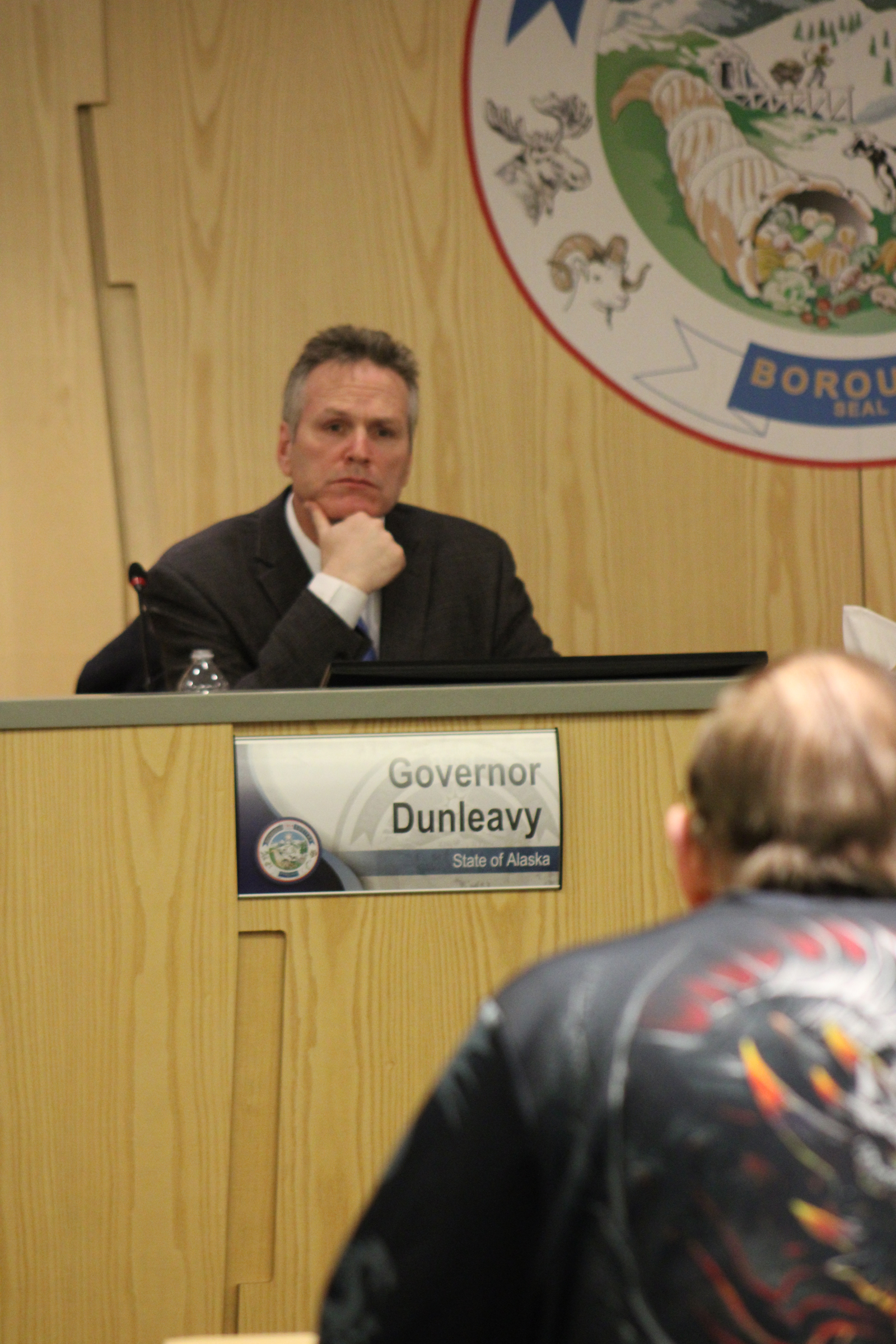
PALMER — Ahead of the start of the second half of the 31st legislature in Juneau on Tuesday, Gov. Mike Dunleavy met with the Mat-Su Borough Assembly during a special meeting Jan. 16 to discuss the legislative priorities for the Mat-Su Borough.
While the practice of councils preparing their prioritized projects for the state legislature is common, it is uncommon for the governor to attend the meeting and discuss it face to face with assembly members.
“I think this is the first time in at least my purview of 15 years that we’ve had a governor sitting up in the chambers with the Assembly, so I’m very pleased by that,” said Borough Mayor Vern Halter.
The mid-afternoon meeting was well attended, but few members from the public offered their thoughts during the public comment section. Much of what Borough Manager John Moosey presented, Dunleavy found some common ground with.
“I think everything on our list is pretty much meat and potatoes that takes care of our citizens or provides a better day for our citizens,” said Moosey.
The borough lists the reconstruction of Knik-Goose Bay Road as the top legislative priority. Dunleavy noted that the dangerous road poses a life safety issue and detailed the active plans to improve safety including berm mitigation, sanding, lighting, maintenance and fixing ruts in problem areas. Halter noted that it was the first time he had seen KGB as the top overall priority for the borough. While Halter is proud that the assembly has been able to keep a steady mill rate, he noted the seemingly constant emergencies occurring in the Mat-Su Valley. The 12th priority listed by the borough is support for a repair and replacement of the Shirley Towne Bridge that could provide a second access point to residents in Willow that were affected by the flood on Deneki Road.
“This is the second time very recently we’ve had communities isolated,” said Halter.
Dunleavy noted that he would engage in discussions on the issue of repairing the bridge damaged during flooding in 2012. While not the most recent natural disaster in the area, the borough is still searching for additional funding to reopen Houston Middle School. Awaiting action from the Army Corps of Engineers, the Assembly has yet to make a final decision on what to do with the earthquake-damaged middle school.
“The waiting, like Tom Petty said, is the hardest part,” said Moosey.
Dunleavy mentioned the miraculous feats of Mat-Su Borough staff and students preventing any major injuries district-wide, particularly in HMS during the magnitude 7.1 earthquake and said he would continue to discuss possibilities. Listed as the eighth priority for the borough, full funding of the state portion of the School Bond Debt Reimbursement was a much discussed topic during last year’s budget reaction and continues to dominate the conversation prior to this session. Dunleavy has allocated $9 million in his budget for SBDR.
“The cost back to the Valley residents is more per person in the Valley than anywhere else in the state on this issue,” said Moosey.
While listed second on the borough’s priorities, Assemblyman George McKee does not feel that more police presence will result in a decrease in crime. However, Moosey noted that the Borough is asking for the full complement of 71 Troopers in the Valley.
“I personally am very irritated with the article in ADN that pretty much blamed no troopers out in the hinterlands on the Valley. I don’t think that was a fair shot,” said Moosey.
Dunleavy noted that public safety is a priority of his administration, and said he would have further discussions on how to continue to increase Trooper staffing in the Valley.
Third on the borough list is West Susitna public access. Moosey asked for support for both a Department of Transportation and Department of Fish and Game office and listed statewide transportation bonds at six. Hoping for the 50 percent state portion of 2018 voter approved bond projects came in at nine. Moosey listed $130 million for the Port MacKenzie rail extension at 10 and $6 million for sleeve protection at the Port at 11. While the state has already invested $184 million in Port Mack, Moosey said that the pricetag for the rail extension was too high for the borough to pay. Dunleavy continued his discussion of the overall state budget and his plan to control spending.
“One of the questions was are we going to use the earnings reserve of the permanent fund my answer was, the permanent fund, the use of the earnings reserve in the permanent fund was, I think always a discussion that people had that put the permanent fund together. The question really comes out at this stage of the game is, is it part of the earnings reserve or all of it, including the permanent fund dividend that’s going to be used for government? That’s the big question that we have to answer this year,” said Dunleavy. “I’m hoping that out of this session we come up with answers to those questions. We introduced a flat budget last year when we introduced pretty steep reductions that became the focus and to some degree it kind of paralyzed the discussion about how else we can solve this issue.”
Dunleavy promoted the long-term prospects of the state and the president’s favorable view of the state. Among a variety of ways to increase resource development and revenues to balance the budget, Dunleavy hoped to have discussion to keep formula programs from growing the budget yearly.
“We just have to get this budget issue settled. It’s painful and if we get it settled this year or at least make a major move in coming up with a sustainable approach, I think we’re going to be in pretty good shape,” said Dunleavy. “What I’m getting from people is, hem us in on spending so that when we come into more oil in the next several years which we are projected to do 2-300,000 barrels, that we’re able to take that quote windfall or that money, pay off some of our debts, underwrite some of our capital projects etc., as opposed to growing programs.”
While not a borough priority, discussion about the removal of the state dairy inspector from Dunleavy’s budget for a second year sparked during public comment. Dunleavy addressed the issue, noting that in the 1960’s he estimated there were 60 or more dairies operating in the state.
“That particular decision seemed to get made a little bit in a vacuum and sort of hit without discussion with the farmers, so in terms of being consistent for our businesses we can scale down our support for them but let’s give them some notice,” said Assemblywoman Stephanie Nowers.
Dunleavy noted the mandate from the Federal Government for a state dairy inspector without funding the project from the Federal Level and hoped to be able to find a way to reduce the cost of oversight.
“There’s not necessarily a correlation in the amount of money you have in a government division of agriculture that equates to a growing and robust agriculture section. As a matter of fact, you had more farms back then with less money. We’re looking at what are the barriers and regulations that we may have in place and marketing issues that we could address that would actually grow farms in the state of Alaska,” said Dunleavy.

By Jeremiah Bartz Frontiersman.com A football coach using a hockey reference as the centerpiece for his keynote address may

Frontiersman.com With its headquarters in Wasilla, the Frontiersman has been a primary source of news for the Matanuska-Susitna

By Katie Stavick Frontiersman.com The next generation of leaders took flight this week as the Houston High School Class

By Kyle Wilkinson For the Frontiersman Keynote speaker and Carry the Cure President Bill Pagaran’s words boomed through the