Retiring teacher, coach urges Colony grads to ‘find their 68’
By Jeremiah Bartz Frontiersman.com A football coach using a hockey reference as the centerpiece for his keynote address may


I never met my grandmother, Annie Nicolai. She died shortly before I was born, but she had one of the most tragic lives I know. She was born in 1905 at Old Man Lake near Chickaloon into a changing world blighted by the newcomers.
Annie was 11 or 12 years old, playing with her sisters in their natural environment. Mom told me she was pretending to be a horse and had a string around her neck with a tin can attached to it, swinging it back and forth. That’s when my grandfather first saw my grandmother and decided to take her as his wife. She ran away to be with him when she was 14.
My grandfather, Jesse Wickersham, was 38 years old when he spotted my grandmother, and a veteran from the Spanish American War, probably suffering with post-traumatic stress disorder. He was a bootlegger, moonshine-maker, alcoholic and obviously a pedophile. He also has the distinction of introducing alcohol into my branch of the family. His name was Jesse Wickersham. Mom said the trail to her father’s still was heavily traversed. She also said he was his own best customer. Furthermore, he was a mean drunk who threatened to do bad things to his family.
When my grandmother was not yet 20 years old and pregnant with her fourth child, grandfather was on a bender with his “friends.” He told them he intended to go home and wipe out his family. He had a knife, but my grandmother had a gun that he had given her when he was sober and remorseful after the last time he got drunk and beat her up. So in self-defense, she shot and killed my grandfather in 1924.
My grandmother was allowed to take her youngest baby with her to jail. It must have been obvious that it was self-defense because in a rare occurrence they let a Native woman go for killing a white man. Leland Harrison (who she later married) stood up for her and he was a big reason why they let her go.
My grandmother never got over that tragedy, as one might imagine. She took many sad turns in her life and had seven more children. She died alongside the railroad tracks in 1944.
Her older children, including my mother, had already started families of their own, but the younger ones were sent to boarding schools and other states, losing any connections they might have had to their cultural roots.
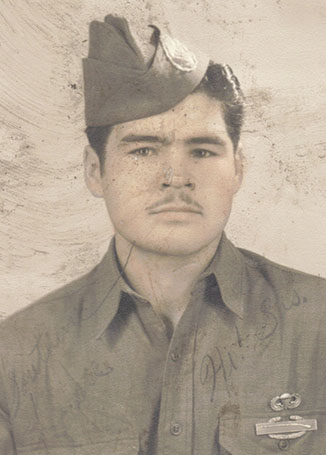
Mom’s brother, Bill Wickersham, was born a year after her in 1923. She said when he was 6 years old he fell and bumped his head on the corner of a table. He took off running and she had to run fast to catch him, tackle him to the ground and hold him down. Who knows what kind of injury he had from that fall, but he was strong and a good hunter who sometimes had a mean streak. Mom said he and their cousin, Paul Goodlataw, climbed the mountains as if they were sheep.
A boxing manager spotted Uncle Bill when he was 16 years old. There were no birth records of him, so who needed to know? The manager put him in the ring with the Palmer champion, Frank Pruitt, and Uncle Bill knocked him out cold. He became a boxing champ and we loved to dig into the box of his things in the attic and stare at the little golden gloves in small white boxes.
A year or so later, the military was recruiting for World War II. Uncle Bill was told that if he didn’t join up and fight for his country, the Japanese would come over and take the land away from his people.
Uncle Bill was very protective of his family and loved them very much, so he joined the Army and became a paratrooper. He was told that this would be the last war to be fought. It was “the war to end all wars.” He spent time training at Fort Benning, Ga., and his first stop was in Africa. Then he went to fight in the south of France and Italy. He wound up in the Battle of the Bulge in Belgium.
He was awarded the Bronze Star Medal and the citation read in part, “while serving in the Army of the United States, for heroic achievement in action, 7 November 1944. Company “H”, 517th Parachute Infantry was advancing against an enemy position near Sospel, France, with Private Wickersham as lead scout of the leading squad. The forward elements were subjected to machine gun fire from a pillbox immediately to their front. Private Wickersham advanced to within 20 yards of the pillbox, fired his rifle eight times, and then threw a smoke grenade. Under the cover of the smoke he threw a fragmentation grenade, which killed all four defenders in the pillbox. Private Wickersham’s aggressive action and courage under fire were an inspiration to the men of his unit …”
He later said that was the hardest thing he ever did. Some of the men he had to shoot reminded him of people he knew, but he also knew it was either them or him.
Uncle Bill fell in love with a beautiful girl in Germany who had tuberculosis. There was a picture of her in that box in the attic. The recruiters wanted him to re-enlist, of course, and he agreed if they would send him back to Germany, to his girlfriend. They promised to, but never did and he never heard from her again.
When he was released from the Army, Uncle Bill rode the railroad trains and visited his sister, Jessie, in Oregon once in a while. I never met him, but my cousins from Oregon told me how much they loved him and what he taught them and how they always felt protected when he was around.
My cousin Darlene was 9 years old, when Uncle Bill gave her a dictionary and two thick books, Plato and Socrates.
“Uncle Bill was a thinker along with the many other qualities he had,” she said. “In my childhood world of chaos and often danger, Uncle Bill was my hero.”
At one point when I was a teenager, Uncle Bill wanted to come home and I was very excited at the prospect. I had read some of his beautiful poetry and seen his illustrations. Although mom longed to see him, she said she knew if he came back, he would just “beat up the fat cops.”
Uncle Bill died in 1967, like his mother, alongside the railroad tracks.
Patricia Wade is an Ahtna Athabascan and a member of the Chickaloon Tribe who lives in Palmer.

By Barbara Hunt Palmer Buzz It was 6:43 on Friday morning and the Plant Owner was sound asleep when

By Kyle Wilkinson Frontiersman Memorial Day Weekend was filled with a variety of events in Willow. From live music to

By Kyle Wilkinson For the Frontiersman The Susitna Valley Emergency Preparedness Fair will be held at the Willow Community Center

By Barbara Hunt Palmer Buzz Green-Up happened at exactly 9:34 am on Saturday morning in Palmer. This was