Retiring teacher, coach urges Colony grads to ‘find their 68’
By Jeremiah Bartz Frontiersman.com A football coach using a hockey reference as the centerpiece for his keynote address may


We are living through what scientists call the “sixth extinction,” so named for the unusual scale and unprecedented rate of death of thousands of species. Freak astronomic or geologic events caused the previous five global extinctions; we continue to cause the sixth. There is a key difference between the first five and the current mass extinctions: ours is occurring far more rapidly, with many environmental changes occurring at a faster rate than species can respond through evolutionary adaptation.
Climate change, in conjunction with extensive habitat destruction and anthropogenic distribution of invasive species, is killing other species faster than the earth has ever experienced. Hawaii is ground zero.
Though its tourist reputation is for beaches and resorts, Hawaii is home to diverse and rugged habitat ranging. With elevations nearing 14,000 feet, and extreme differences in precipitation based on the ocean and prevailing winds, Hawaii has habitat ranging from coral reefs to deserts to rainforests to permafrost-encrusted peaks.
Though they receive little popular attention compared to coral reefs, Hawaii’s rainforests are no less astonishing. Ecologically, they are even more unusual. While most tropical rainforests have their maximum density and diversity of life in the canopy, Hawaii’s rainforests host most endemic inhabitants near ground level. Central American rainforests have dozens if not hundreds of canopy tree species, Hawaii has two: the ohi’a lehua (metrosideros polymorpha) and the koa (acacia koa).
The ohi’a is a keystone species--that is, essential to the survival of numerous other species in its ecosystem--like no other. In most forest systems, certain species colonize new or recently disturbed ground, only to be displaced by the “climax” species that ultimately dominate the canopy. In Hawaii, ohi’a is both the primary arboreal colonizer of lava and also the dominant canopy species. Countless species depend on it, for the nectar in its flowers or the shade from its leaves or the earth it creates as its leaves fall and turn to soil.
The ohi’a has developed some remarkable adaptations to colonize the Earth’s newest land: lava fields that in many cases are just a few years old, including in terrain with ongoing volcanic activity. Ohi’a have sensors that can detect dangerous levels of sulfur dioxide pollution, which volcanoes produce. When vents are producing unusually concentrated levels of sulfur dioxide, the ohi’a pause respiration till cleaner air is available. In another innovative development, they harvest water from the air: Ohi’a have root sacks that dangle from their branches. When light rains or clouds pass through, these airborne roots allow the ohi’a to collect water that wouldn't otherwise filter down through the canopy to their root systems. Ohi’a leaves are uniquely adapted as well. They are thick and feel leathery, like the leaves or needles of succulents. This helps them retain moisture and protect themselves in the intense tropical solar exposure, whose effects are greatly magnified by expanses of black and grey lava that elevate ambient temperatures and associated evaporation rates.
As a result of the ohi’a’s ability to colonize lava fields and create rainforest out of barren rock, dozens of other species have developed to thrive in Hawaii’s unusual ecosystems. Among these are, or were, more than 40 species of honeycreepers, birds that drink from and pollinate trees such as the ohi’a. While many of Hawaii’s endemic honeycreepers have gone extinct, primarily as a result of habitat destruction and invasive species such as mongoose, pigs, and feral cats, a few survive. The Apapane, a vibrant red and black bird, is among these. Unlike many threatened species, the Apapane is accessible to the casual tourist: Spend ten minutes in the ohi’a-dominated rainforest of Volcano National Park, and you will hear numerous Apapane singing and flying in the canopy. Their songs are joyful, particularly during the long mornings when they start singing around dawn and perform exuberantly for hours. Hearing just one song of the Apapane is an inestimable privilege, a window into a former world thronged with life.
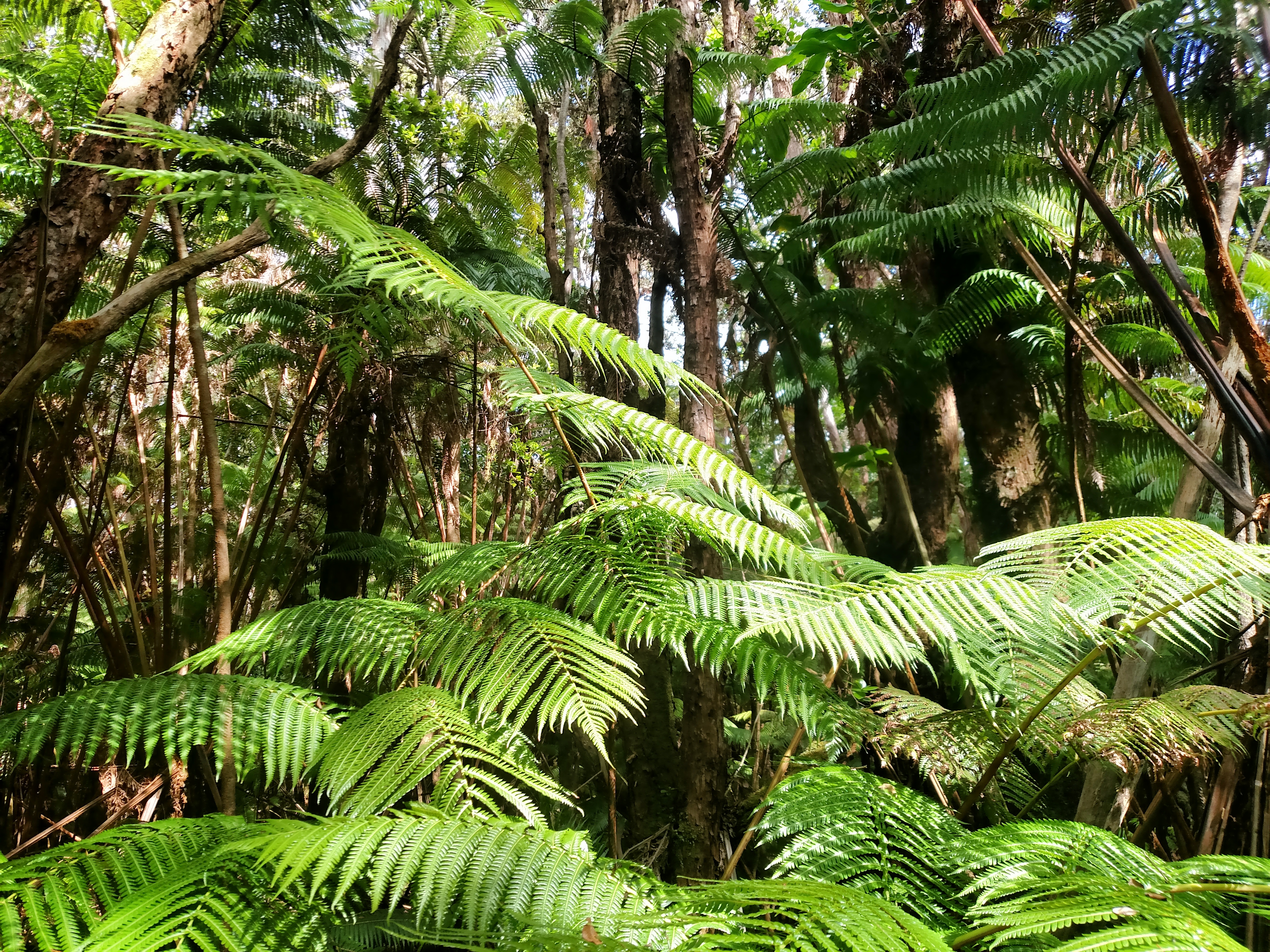
Today, vast swaths of mature ohi’a forest are dying of a fungus called Rapid Ohi’a Death. An invasive species, the fungus is currently limited to Hawaii, but that is also home to most intact, unfragmented rainforest in the Hawaiian archipelago. Since ohi’a is the keystone species for this rainforest, it's death will have sweeping impacts on the ecosystem. Loss of the colonizer means vast swaths of lava will take far longer to become forest, as the beneficent ohi’a canopy will not provide shade and earth to nurture tree ferns, thornless hollies, and other species that grow in the mid and understory of Hawaii’s rainforests. Loss of ohi’a makes it even more difficult, perhaps impossible, to sustain Hawaii’s last surviving species of honeycreepers, such as the Apapane, whose primary food source is ohi’a blossom nectar.
Without this improbable settler of lava fields and nurturer of rainforests, it is difficult to imagine how Hawaii’s other trees and shrubs will give life to the new earth that continues to emanate from Kilauea.
The twin threats of climate change and invasive species have the appalling ability to render unrecognizable landscapes that we humans have known for thousands of years. Entire nations are disappearing under rising seas, while retreat of sea ice is making subsistence ways of life incredibly difficult for many western Alaska communities. In Hawaii, this is what the sixth extinction looks like: Destruction of vast swaths of the species that not only anchors her rainforest ecosystems, but colonizes lava so just about all other species can live on the islands.
Evolution is a remarkable system, and if the ohi’a substantially perishes, some other species will evolve to fill its niche. In geologic time, it’s all a wash. But generations upon generations of humans may see Hawaii’s new lava uncolonized by ohi’a, and have no idea that those expanses of black rock could have been inhabited by ohi’a and dozens of other species. Tree ferns could have grown up under their arching branches. Apapane could have flitted in the canopy, singing their morning chorus. When a species like the ohi’a dies as a result of climate change or invasive species, it can take the whole forest with it.

By Kyle Wilkinson For the Frontiersman The Happy Gardener Greenhouse is neatly tucked away in a forest of spruce trees

By Katie Stavick Frontiersman.com Larson Elementary School is inviting the entire community to turn the page on a cherished

By Beth Rosenburg Alaska Pacific University Scientists from Alaska Pacific University (APU) and École Polytechnique Fédérale de Lausanne (EPFL) have

Katie Stavick Frontierman.com As spring approaches, hundreds of local gardeners and farmers, hobbyists and people just starting to sprout