Retiring teacher, coach urges Colony grads to ‘find their 68’
By Jeremiah Bartz Frontiersman.com A football coach using a hockey reference as the centerpiece for his keynote address may


MAT-SU — Mike Richardson doesn’t let his passion for archery leave him too high-strung.
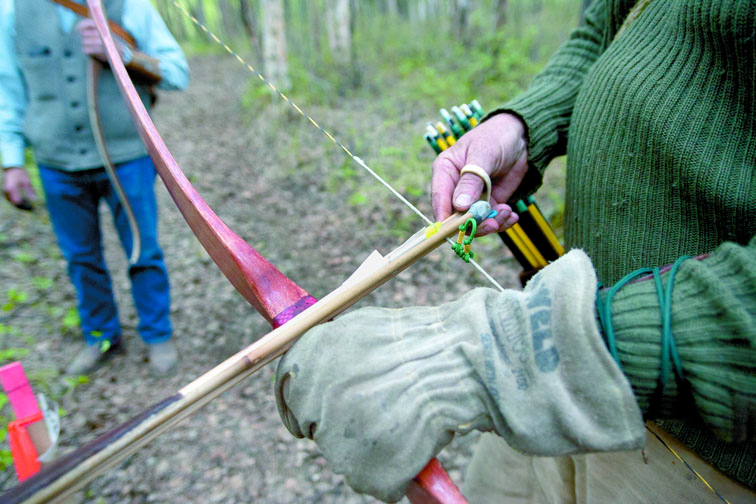
Sitting at his campsite patiently fletching a batch of homemade arrows for his grandchildren, the Anchorage resident speaks with authority on the mystique and history of archery. Among the dozens of Traditional Archers of Alaska members at Saturday’s annual 3-D target shoot outing, nearly all point to Richardson as one of their most respected.
“Only a few people do this because, well, I don’t know why,” Richardson said while deftly tying crisp white and orange feathers to arrows. He uses green thread and a jig he made himself, and can fully fletch an arrow in about two minutes. “It’s a lot cheaper for sure, and they look pretty. I mean, you can spend $14 apiece on carbon fiber arrows, but these are just poplar dowels from Lowe’s for 89 cents.”
And there’s good reason to be frugal. While he’s talking about archery and the art’s place in the history of mankind, 5-year-old grandson Max interrupts him frequently.
“Grandpa! Grandpa! I need more arrows!” the boy exclaims. “I ran out of arrows!”
Max takes the three arrows his grandfather has just finished and runs off. Three minutes later, he’s back and stops long enough to say why he likes learning the art of archery from his father and grandfather.
“I like that this bow is really flexy,” Max said. “It means you can pull it back far and you can shoot far.”
Really, Max? You can shoot pretty far, huh?
“Yeah, I can shoot far, about, like, a mile maybe,” he said.
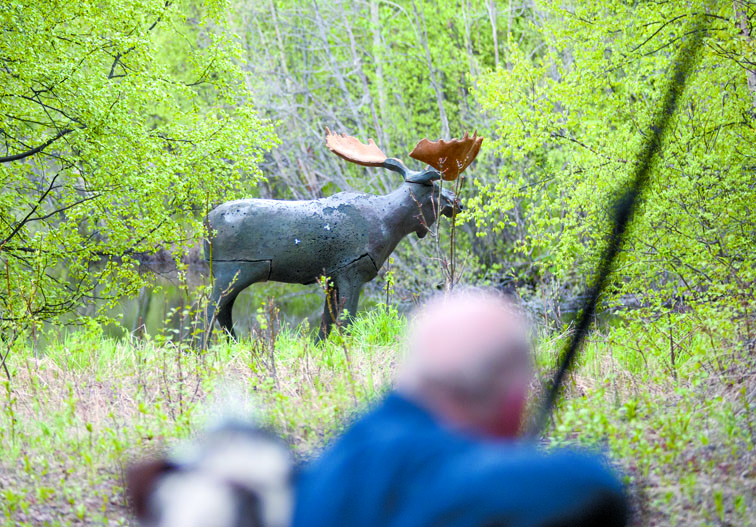
Along with practicing on the TAA course that features 38 stations with various reproduction targets of animals, it’s clear much of the allure of this weekend’s outing, which continues today at the Boyd Farm in Palmer, is the camaraderie of club members. It’s also clear by their good-natured ribbing that his compatriots respect Richardson’s knowledge.
In addition to making his own arrows and bows, Richardson “also clubs his own women and drags them into the cave,” said his friend Robert Palmer.
“Yeah, we shake him out of a sack when we want to know how they did it 1,000 years ago,” joked Bill Brickley, sitting at a table across from Richardson. “He’s voted the most valuable guy to have with you when you’re in a plane wreck and there’s no one coming to get you.”
For Vikki Gross, archery is more than one of the various hunting seasons. In addition to being the TAA club treasurer, she helps put on the annual 3-D shoot. It’s an opportunity to “just get together with people who do traditional archery,” she said. “Some of these guys are very hard-core with the equipment that they build. It’s all natural sources, they do flintheads for their arrows. We have one guy who’s very proficient with the atlatl.”
That would be Richardson as well. In addition to making and fletching his own arrows, he makes his own flint arrowheads and even his own bow, a 31-inch-long carved piece of hickory he calls “the man stick” because it features a 95-pound tension bowstring. “Even my son can’t pull it back.”
The atlatl actually predates the bow and arrow, said Kurt Schoephorster, a Sutton resident and 15-year TAA member. Along with enjoying the 3-D course, Schoephorster also is in charge of cooking the traditional whole pig for the group’s Saturday night dinner blowout.
“It’s the most basic form of archery,” he said of the atlatl (pronounced at-lat-el). “It came before the bow and arrow, and people used to hunt mastodons with those things.”
He enjoys archery because “it’s by far more challenging” than shooting rifles, Schoephorster said. “The way you have to hunt is a lot slower and you see a lot more. You’re not looking at something 100, 200 yards away, you have to be right on top of them with bows.”
Traditional Archers of Alaska encourages the sport as a fun family hobby, Gross said, but if you want to be part of the TAA, leave your crossbow at home.
“We don’t allow crossbows because they’re not traditional equipment,” she said.
Contact reporter Greg Johnson at greg.johnson@frontiersman.com or 352-2269.

By Barbara Hunt Palmer Buzz It was 6:43 on Friday morning and the Plant Owner was sound asleep when

By Kyle Wilkinson Frontiersman Memorial Day Weekend was filled with a variety of events in Willow. From live music to

By Kyle Wilkinson For the Frontiersman The Susitna Valley Emergency Preparedness Fair will be held at the Willow Community Center

By Barbara Hunt Palmer Buzz Green-Up happened at exactly 9:34 am on Saturday morning in Palmer. This was