Retiring teacher, coach urges Colony grads to ‘find their 68’
By Jeremiah Bartz Frontiersman.com A football coach using a hockey reference as the centerpiece for his keynote address may


WASILLA — Vic Jansen recalls his early morning excursions through the Valley.
Along with brother Jim, the Jansens own and operate Lynden Inc., including Lynden Transport, which used to have a contract to haul locally produced milk to Matanuska Maid during the dairy’s heyday 30 years ago.
“We had one driver who would work 10 days on and four days off,” Jansen said. “I would go up and relieve him. We’d pick up milk from 26 dairy farms from the Mat Valley and hauled the milk into Mat Maid.”
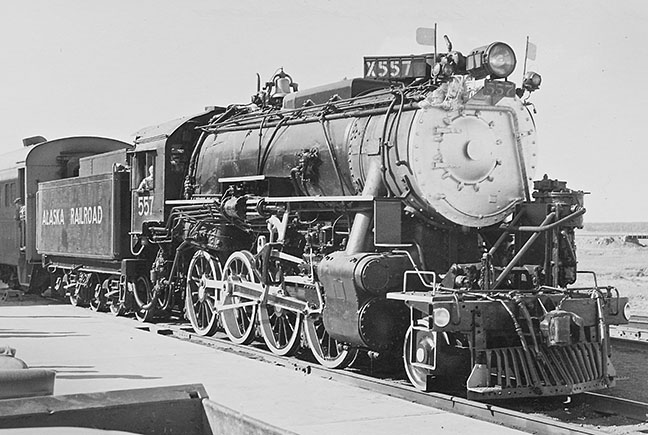
Another workhorse that saw plenty of action hauling necessities around the Last Frontier was Engine 557, a World War II-era locomotive pressed into service for Alaska Railroad. By the time No. 557 was finally sold for scrap in 1964, it had retired as the last steam locomotive in regular service in Alaska.
Nearly 50 years later, the Jansen brothers and Engine 557 are resurrecting a nostalgic piece of the Last Frontier’s railroad history. Over the next year or more, the locomotive will be restored and put back into service, where it will haul passengers between Anchorage and Portage.
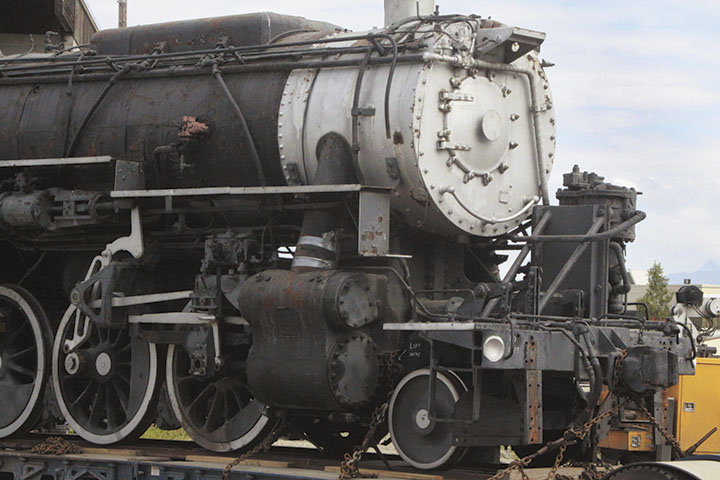
As an Alaska Railroad crew and movers from Alaska West Express slowly hauled the 162,500-pound No. 557 up the Parks Highway to its new temporary home in a Wasilla warehouse Friday, Jansen spoke from his Washington state home about how the historic engine found its way back to the 49th state.
It actually started all those decades ago in 1964, when Monte Holm purchased Engine 557 at that scrap sale. A scrap dealer in Moses Lake, Wash., Holm was also a history buff and instead of dismantling the locomotive and selling it off piece by piece, he placed it at his museum, Holm’s House of Poverty Museum.
Holm actually kept it in good order, Jansen said, and loved to observe school children learn about the large steam engine. He even kept it in good enough condition to start it up once in awhile.
When Holm died in 2006 at age 89, the Jansen brothers stepped in and took possession of Engine 557 so their friend’s grandchildren wouldn’t be burdened with trying to figure out what to do with an old locomotive, Vic Jansen said. Alaska Railroad had also expressed interest in bringing the engine back to Alaska.
Giving up No. 557 was a difficult decision, Jansen said, as the local community there had become quite attached to it over the decades. That it will be more than just a museum exhibit, though, tipped the scales. Having Engine 557 in service again pulling passenger cars would make Holm “very happy,” he said.
“He would get a twinkle in his eye whenever anyone would mention getting it up and running in Alaska again,” he said. “Monte was a major piece of our community. He died about a week before his 90th birthday, so it was a little bit of a sensitive issue taking it out of town.”
With the wheels in motion, what would his friend think if were he around Friday as the engine was on its way to its restoration?
“I think he’d just be smiling knowing that it’s being restored,” Jansen said. “He used to fire it up and blow the whistle, and he had about 300 feet of track. It was hard to see it leave town here, but people seemed to accept the fact that if it was to be restored and put back into service there, it was OK.”
Another provision in the agreement between the Jansens and Alaska Railroad is that the restoration happen within eight years, a timetable railroad spokesman Tim Sullivan said is expected to be accelerated.
“Hopefully, we’ll have it up and running by the end of next summer,” Sullivan said. “We’re hopeful we can get this cooking.”
A lot of that optimism is based on fundraising and restoration efforts of Engine 557 Restoration Co., which is tasked with raising money and doing the work, he said. Overall, the effort to restore the engine and a tender from the Museum of Alaska Transportation and Industry is expected to cost $600,000 to $700,000. A $350,000 matching grant from the Rasmuson Foundation will contribute about half if the other half can be raised.
“We thought this was a real great opportunity, not just for the railroad, but for Alaska,” Sullivan said. “This engine 557 and the sister engine 556 that sits on the Park Strop in Anchorage are a couple of really important pieces of Alaska history. It was sold for scrap, but left intact … which doesn’t happen often.”
As crews worked to get the engine off its trailer, Engine 557 Restoration Co.’s Pat Durand couldn’t hide his excitement. An admitted railroading buff, Durand said this project hits close to home.
“You’re talking to a guy who grew up never having worked for the railroad, but was a rail fan and making models,” Durand said.
In fact, after No. 557 was retired and before it was sold for scrap, it sat in Whittier, where Duran grew up.
“I actually played on that engine as a kid in Whittier when it was there,” he said. “I’ve already built a model of this locomotive, and the unique thing about this is there were 12 of this class that came to Alaska in 1943. There were 2,125 built, but they were all built to go to war.”
For the next year or more, Jansen said he’ll patiently wait for the restoration, but he’s already excited about riding on its first trip back in service.
“That’s part of the deal that we get to ride on it, along with Monte’s family,” he said. “I can hardly wait. I’ve never ridden on a steam engine before.”
Contact reporter Greg Johnson at greg.johnson@frontiersman.com or 352-2269.
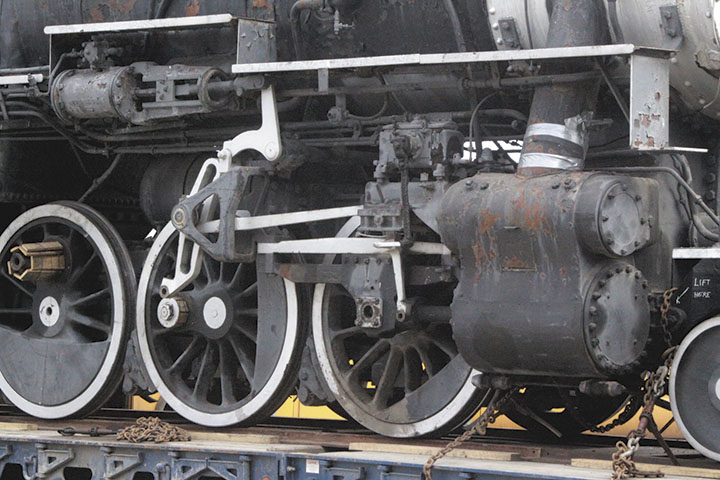
Facts and figures about Engine 557, the last steam locomotive to be in regular service in Alaska. After nearly 50 years at a museum in Washington state, the engine is back in Alaska and will be restored.
• Built in 1943.
• Weight of engine 162,500 pounds
• Weight of engine with loaded tender 189,000 pounds
• Cylinders 19-by-26 inches
• Driving-wheel diameter 57 inches
• Tractive power at 85 percent boiler pressure 31,500 pounds
• Boiler pressure 225 pounds
• Total heating surface 1,773 square feet
• Tender capacity 1,800 gallons of fuel
• Engine height 67 inches
Source: Alaska Railroad

By Barbara Hunt Palmer Buzz It was 6:43 on Friday morning and the Plant Owner was sound asleep when

By Kyle Wilkinson Frontiersman Memorial Day Weekend was filled with a variety of events in Willow. From live music to

By Kyle Wilkinson For the Frontiersman The Susitna Valley Emergency Preparedness Fair will be held at the Willow Community Center

By Barbara Hunt Palmer Buzz Green-Up happened at exactly 9:34 am on Saturday morning in Palmer. This was