Retiring teacher, coach urges Colony grads to ‘find their 68’
By Jeremiah Bartz Frontiersman.com A football coach using a hockey reference as the centerpiece for his keynote address may


Few things are as simple as an old barn. An old barn reminds us of self-sufficiency and neighborliness. An old barn conjures up images of barefoot children swinging from a rope in the haymow or men throwing hay bales on a hot summer’s day, sounds of softly lowing cows (bellowing, if they need milking), aromas of newly cut hay or the “country sunshine” of animal-produced fertilizer.
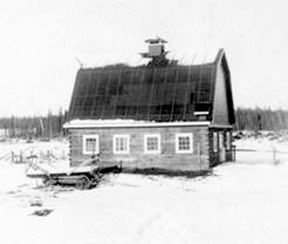
I’m fortunate to live across a country road from the Colony farm — and barn — of my youth. This summer, the old Hecker barn underwent a dramatic uplift. To the passing eye, the barn appeared in fine shape — the traditional red paint was uniform, the barn stood upright, and though the roof showed a tinge of rust, it was unbent by ravaging winds. To the eye of owner Dr. Vaughn Gardner, however, the old cement foundation showed progressive crumbling and the walls had begun to buckle and lean.
Tract No. 140 near Palmer-Fishhook Road was initially won by colonist Earl Barry and family; however, the four-bedroom house was overcrowded with nine children and the farm lacked sufficient tillable acreage. Soon after proving up Tract No. 140, the Barrys moved near Finger Lake where they would farm and develop Barry’s Lake Resort. By 1940, my grandparents, Earl and Kathreen Hecker, bought the Barry place. Fresh from World War II and newly married, my father, William Hecker, later took over the dairy farm operations and mortgage from his parents.
My dad maintained the barn conscientiously. Colony barns were built on small pilings of native spruce. He lifted the barn and laid a foundation of 4-foot concrete pillars. He replaced the tarpaper roof with strong trusses and metal roofing. To weatherproof exterior log walls, he plastered stucco over chicken wire. Once a new Grade-A milking parlor was built in the early 1960s, the old red barn sheltered calves and heifers. In 24 years under Dr. Vaughn and Karen Gardner’s guardianship, the barn has provided cover for sheep, llamas and alpacas.
In 2011, Dr. Gardner received a young man in his orthopedic practice with a particularly challenging broken leg. Dr. Gardner studied the bone alignment requiring surgery and pondered the possibilities to achieve fully restored strength and flexibility. He pondered architectural and structural concepts, and discussed these ideas with the family.
It became quickly apparent that the youth’s father, Mike Stitt, understood mechanical construction as well. As a fifth-generation barn saver, Stitt, with his forbearers, has rescued hundreds of barns in Michigan from blight, collapse or demolition by bulldozer or torch. Today, the young man’s leg is as good as new. Mike Stitt was brought on as “healer,” to return the old Hecker barn to prime condition.
For eight weeks, Stitt and his family crew tended to the Hecker/Gardner barn as lovingly and meticulously as an art restoration team handling a deteriorating masterpiece. Stitt’s workplace does not ring with the buzz and pings and twirls of pneumatic or battery-driven tools. His gear includes jacks, come-alongs, cables, saws, hand-hewn wooden mallets, two-man tongs, a hand adze and a drawknife — some that date to the mid-1860s. These tools require no electricity, but plenty of elbow grease.
Stitt jacked up the barn to remove the old concrete pillars and built a new foundation of cement bricks with reinforcing steel — the only contribution by today’s construction processes and materials that is an improvement over the original building methods.
Jacks pushed the log walls six- to eight-inches back into place. Rebar braces the inside walls against future assaults of wind. Paint, chicken wire, stucco and bark were peeled away from logs, revealing an amazingly intricate design of meandering insect trails. The beautifully blond, undamaged logs were left bare but for a Perma-Chink wood stain and durable sealant.
A new concrete floor was poured. Upper timber walls were repaired and repainted. Original pane windows were removed, repaired, cleaned and repainted, and replaced. The haymow was reinforced with a new floor. Eaves were boxed in. The metal roof painted. Gardner’s grand old barn has never been so beautiful — nor so prepared for another century of service and storm.
For those who want to preserve their old barns, Stitt has some interesting advice.
“Keep it alive,” he said. “Keep something in it, some animals. A barn dies if it isn’t used.”
When a barn is used, minor repairs are usually made as soon as needed, rather than being ignored.
“Foundations and roofs are two major problems,” Stitt says. “You let them go and you’re on the downhill slide, that’s a fact.”
Iconic barns jutting up across the flatlands of the Midwest are dubbed “prairie cathedrals.” In the Matanuska Valley, our Colony barns remind us of our great farming heritage as they stand, regardless the season, rates when we consider its future. About 130 barns were built 77 years ago as part of the Matanuska Colony project. Today, fewer than 40 Colony barns remain, echoing the trend of vanishing barns in the Lower 48. Barns in our landscape are sublime. Like a mountain or a river, they have existed for so long that you can believe they will last forever. Yet weather, disuse and neglect ravage our barns, while urban encroachment devours fields and farms. We can’t afford to think our “farmland cathedrals” are going to be around forever.
“They’re not,” Stitt said. “Not without some help. Once these barns are gone, they’re going to be gone forever.”
Barbara Hecker is a local writer and longtime teacher who writes Inky Visits, a regular history column for the Mat-Su Valley Frontiersman. Send suggestions for places, events and persons to visit and write about to InkyVisits@gmail.com.

By Barbara Hunt Palmer Buzz It was 6:43 on Friday morning and the Plant Owner was sound asleep when

By Kyle Wilkinson Frontiersman Memorial Day Weekend was filled with a variety of events in Willow. From live music to

By Kyle Wilkinson For the Frontiersman The Susitna Valley Emergency Preparedness Fair will be held at the Willow Community Center

By Barbara Hunt Palmer Buzz Green-Up happened at exactly 9:34 am on Saturday morning in Palmer. This was