Retiring teacher, coach urges Colony grads to ‘find their 68’
By Jeremiah Bartz Frontiersman.com A football coach using a hockey reference as the centerpiece for his keynote address may


MAT-SU — Thousands of Mat-Su home-school students could start using public money for private or even religious education if either of two proposed pieces of legislation become law.
Sponsored by Wasilla state Sen. Mike Dunleavy, Senate Joint Resolution 9 would amend the Alaska Constitution to allow public funding to flow to for-profit or religious education, but only if approved by a two-thirds majority of the Legislature and then by statewide voters in 2014.
Dunleavy on Saturday also introduced a bill that, if passed, would allow some correspondence students to spend public dollars on private or religious courses. Either would have a big impact in the Valley.
Nearly 3,000 students in the Mat-Su get public money to learn through correspondence, or roughly 20 percent of the 17,500 students in the Mat-Su Borough School District.
Nearly 1,500 attend Mat-Su Central School, the largest school in the district. Another 800 Mat-Su students use the Galena School District’s correspondence program, the largest in the state. Nearly 300 enrolled this year at the Mat-Su’s Twindly Bridge correspondence charter school.
A significant number of these families already incorporate religious materials into their schoolwork.
Right now, the state bans any public funding for private or religious education. Correspondence families who choose to educate their children with religious textbooks for core subjects buy them with their own money. They also can’t count the course for credit or a grade. And they can’t use state money to pay for materials — test tubes, calculators, counting gadgets — associated with a course for which they rely on a religious text.
“This is where it becomes asinine,” said Sharon Aubrey, a 40-year-old Sutton homeschooler of two children. “Because in all honesty, you’re not asking them to pay for religion. You’re just asking them to pay for the materials.”
Senate Joint Resolution 9 would change all that.
•••••
SJR9 is getting a lot of attention because it’s widely viewed as a first step to establishing school vouchers in Alaska.
But the resolution would also safeguard from legal challenge correspondence families who already are spending public money on courses from private or religious education providers, Dunleavy said during a visit to the Frontiersman in March.
He repeatedly pointed to the district’s established use of Sylvan Learning Center and Brigham Young University. His office has received conflicting legal opinions as to whether the practices are constitutional, according to an aide.
But if passed, SJR9 would allow homeschoolers like Aubrey and many others to start doing something they aren’t now: spending public money on religious materials as part of a recognized public curriculum provided there’s a “public outcome” as shown by graduation rates and testing.
Dunleavy’s new bill, SB100, does the same thing without requiring a vote of the people or the majority vote needed for a constitutional amendment. The crucial section reads, “A parent or guardian may purchase services and materials from a private or religious organization with a student allotment ... if the materials and services meet instructional needs of the student and support a public purpose.” A former Mat-Su School Board president and longtime educator, Dunleavy once served as principal of the Mat-Su correspondence school. One of his children attended the school.
“Let’s say Monroe Catholic is teaching a Latin course,” he said, posing a hypothetical question about the Fairbanks private religious school. “If a kid in high school, or correspondence, or even down the street at another school wants to take the Latin course, why can’t he?”
•••••
Why not? Because state money shouldn’t subsidize church-led instruction, critics of the change say.
Churches don’t pay taxes, for one, so it’s not fair to spend tax dollars there.
Supporters of public education say students in traditional schools would suffer because the flow of money to for-profit or religious institutions would drain already inadequate public education funds. They point to the fact that the state’s per-student allocation hasn’t gone up since 2011 and isn’t expected to rise this year.
The constitutional amendment would also violate the separation of church and state, an ideal that even deeply devout Alaskans hold dear.
Sarah Welton, a Mat-Su School Board member and pastor of an American Baptist congregation, castigated Dunleavy’s resolution in written public testimony.
“Make no mistake that SJR9 is an attempt to hijack the public education system in this state and across the nation by wealthy corporations and a few wealthy individuals,” Welton wrote.
If parents are already spending for public money going to private or religious schools, the state needs to stop the practice using existing regulations, she continued.
“Although we recognize our cultural foundations of religion, we also recognize and hold valuable our freedom of religion,” she wrote. “This freedom came to us from the past days of tyranny. Public money going to religious and private entities undermines this freedom.”
•••••
Correspondence school parents are, indeed, already spending education dollars at select private and religious vendors. But information from local and state officials suggests that’s not happening as broadly as Dunleavy suggests.
Here’s how it works:
The Mat-Su Borough School District pays 80 cents on the dollar for correspondence students because of lower overhead costs — staff, maintenance, operations — than students in brick-and-mortar schools.
Each student files an Independent Learning Plan to show their course work satisfies state requirements. A family receives $2,200 for a student from 10th grade down. Juniors and seniors on track to graduate get $2,500 and $2,700, respectively, because advanced or college courses cost more.
Parents enrolled at Mat-Su Central, for example, choose from a list of approved vendors for everything from biology and Algebra to electives like karate or sewing. That list includes many private businesses, including Sylvan Learning Center, a company that offers tutoring in subjects and study skills.
School district officials say it’s federal money that pays Sylvan. No Child Left Behind funds go to the district to help families at struggling schools pay for after-school tutoring, according to Gene Stone, the district’s assistant superintendent of instruction.
The list also includes a few programs with religious ties. One popular distance vendor is Brigham Young University, owned and operated by The Church of Jesus Christ of Latter-day Saints. A local professor on the list is affiliated with Alaska Bible College and includes “Bible/Religion” on his list of course offerings.
Families can use those vendors as long as the student spends no public dollars on faith-based materials or courses, according to local and state officials.
Any course involving faith-based materials for core instruction can’t be part of the student’s individual learning plan recognized by the state, according to Marian Svobodny, correspondence and charter schools program manager for the Alaska Department of Education and Early Development.
That would end if SJR9 became law.
•••••
For Jody Peck and her five children, the choice to home school came 10 years ago when her youngest was still in kindergarten.
That choice became a great comfort last year.
Peck’s 43-year-old husband died suddenly of a heart attack while hiking in the Chugach Mountains.
“My kids and I we’re learning to really enjoy each other and spend time together,” Peck said. “Not having to get up every day — we can sit and snuggle if we need a snuggle day, if we need some down time.”
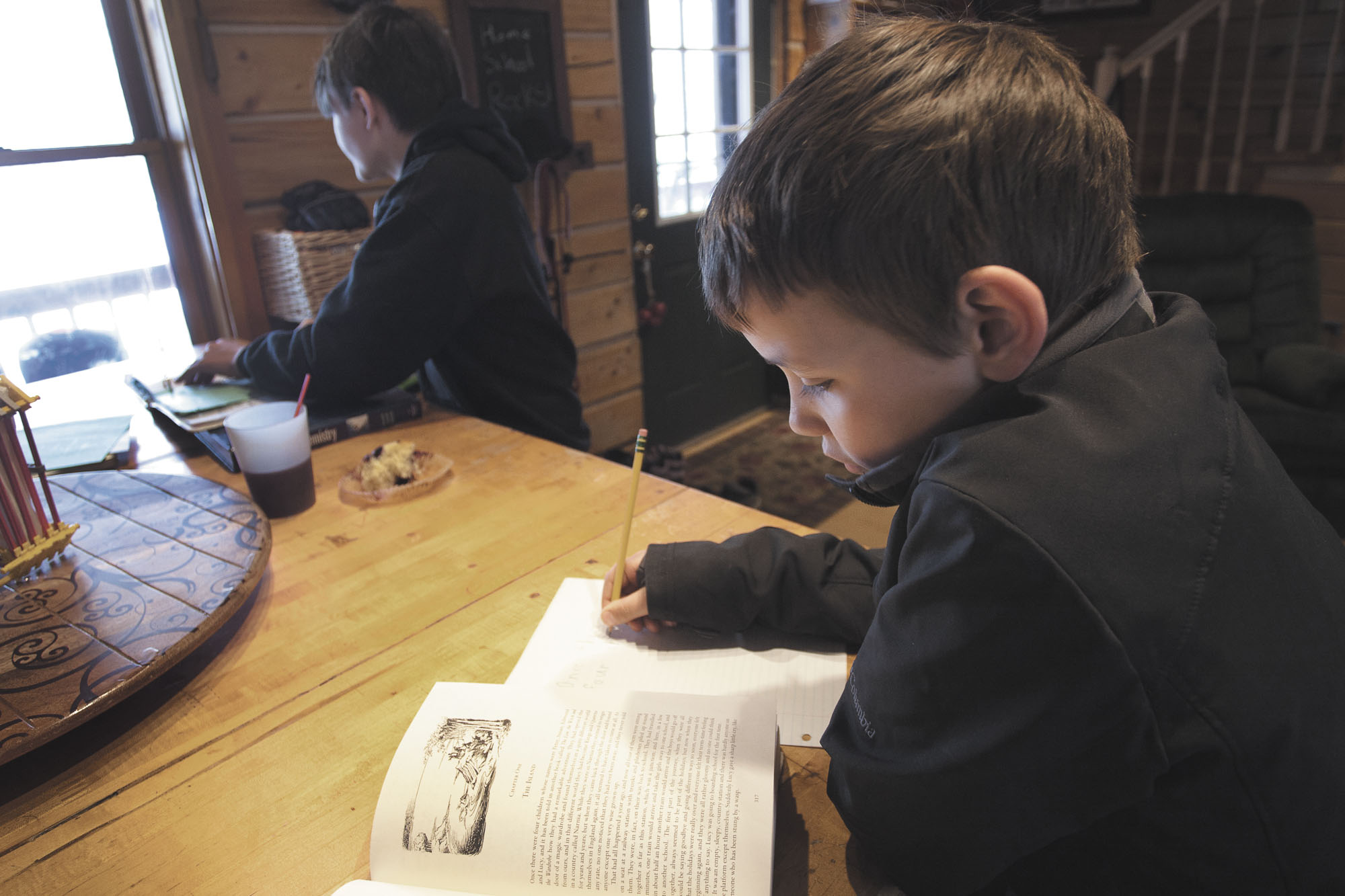
Peck, 37, spends four days a week making sure her kids do their math, reading and writing at the family’s “really big kitchen table” on Fairview Loop Road outside Wasilla.
A flexible school schedule gives the Peck children the chance to work at their own pace. It allows the family time to lead youth groups at Church on the Rock and participate in other community activities. Peck serves on Mat-Su Central’s advisory board. She also leads a home-school group for moms that meets twice a month.
But a devout family enrolled in public correspondence programs faces challenges under current state law.
The Peck family uses religious textbooks for history and science. The history texts allow her children to see “the true reasons of why our country was formed, what our founding fathers believed,” Peck said. The science texts allow them to “look at why God created things and how awesome they are.”
Peck’s strong desire to make sure God is represented in her family’s course work comes at a price.
She spends about $1,000 a year on religious texts not funded by the $2,200 per child every correspondence family receives for students in 10th grade and under. Students who use religious materials can’t count that course work for a grade.
“Which is why Mr. Dunleavy is very proactive in trying to get this all figured out,” Peck said.
It’s starting to look like Senate Joint Resolution 9 will not pass this legislative session. As a constitutional change going before voters, the amendment requires a two-thirds majority vote in the Legislature. Even state Sen. Mike Dunleavy, the bill’s sponsor, has called that “a heavy lift.”
More to the point, time is running out. Just days remain in the current legislative session and lawmakers are busy with oil-tax reform and gas line bills.
Senate President Charlie Huggins back in February pulled SJR9 out of the Senate Education Committee and referred it instead to Judiciary and Finance, where critics said it would get more favorable hearings.
The resolution on Friday was held up in Finance, where committee members were getting to work on the gas line bill. The oil tax reform bill is also taking up a lot of time.
SJR9 could still get to a vote if the gas line bill moves quickly, Dunleavy aide Bethany Marcum said Friday. But if not, “we’ll have to hold it ‘til next session. ... We’ve got two really huge energy bills.”
Dunleavy has said it would be easier to pass a “simple bill” like Senate Bill 90, the correspondence bill he introduced on Saturday. That bill would allow correspondence students to use public allotments to buy for-profit or religious courses. It would take effect July 1, 2014.
Dunleavy has also introduced tax credit legislation, Senate Bill 89, that would give taxpayers a credit if they donate money for “educational support purposes’ at public, private nonprofit or religious elementary and secondary schools.
—Zaz Hollander
ROBERT DeBERRY/Frontiersman.com

By Jeremiah Bartz Frontiersman.com A football coach using a hockey reference as the centerpiece for his keynote address may

Frontiersman.com With its headquarters in Wasilla, the Frontiersman has been a primary source of news for the Matanuska-Susitna

By Katie Stavick Frontiersman.com The next generation of leaders took flight this week as the Houston High School Class

By Kyle Wilkinson For the Frontiersman Keynote speaker and Carry the Cure President Bill Pagaran’s words boomed through the