Retiring teacher, coach urges Colony grads to ‘find their 68’
By Jeremiah Bartz Frontiersman.com A football coach using a hockey reference as the centerpiece for his keynote address may


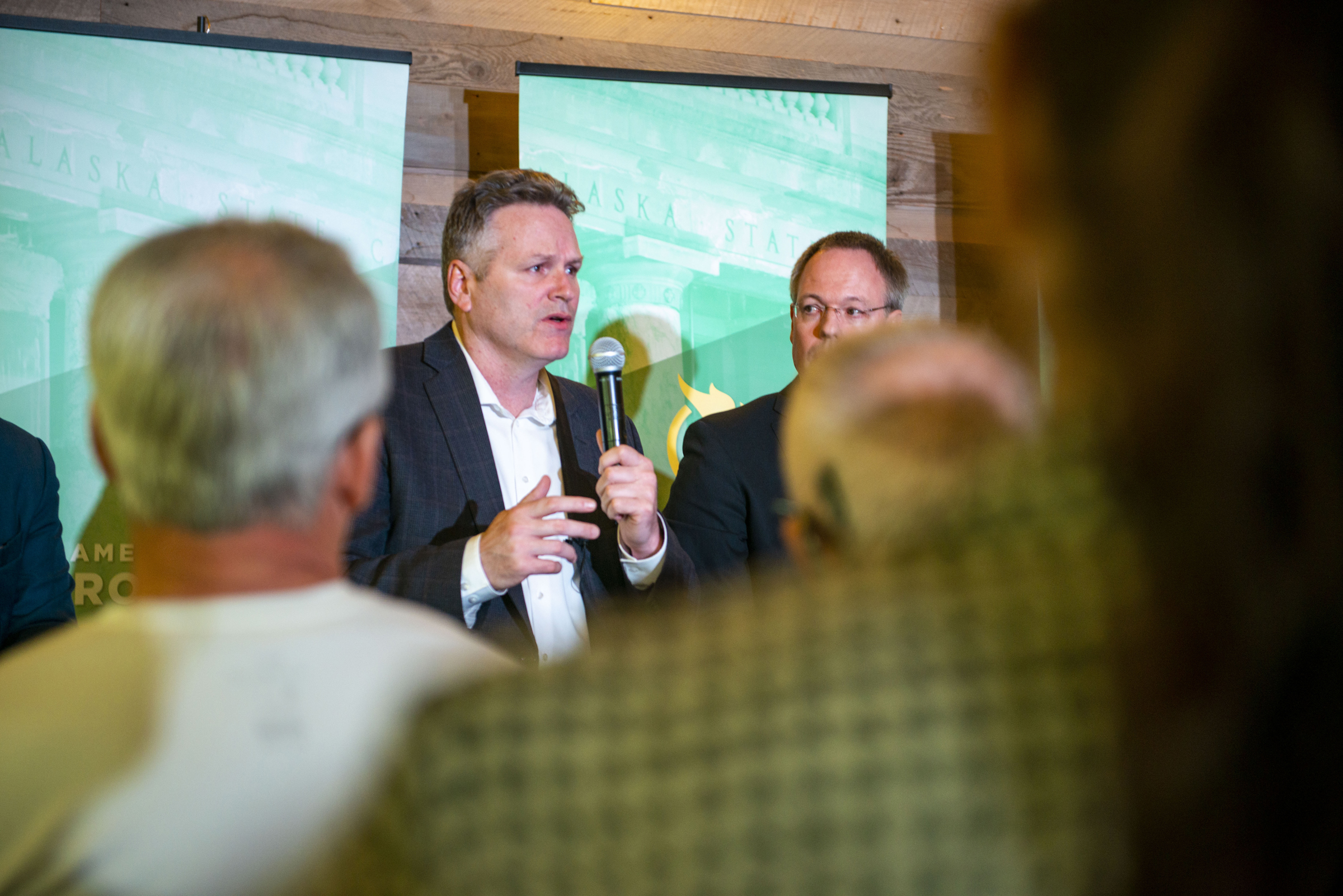
WASILLA — Gov. Mike Dunleavy made the final stop on his budget roadshow at Everett’s in Wasilla on Friday night.
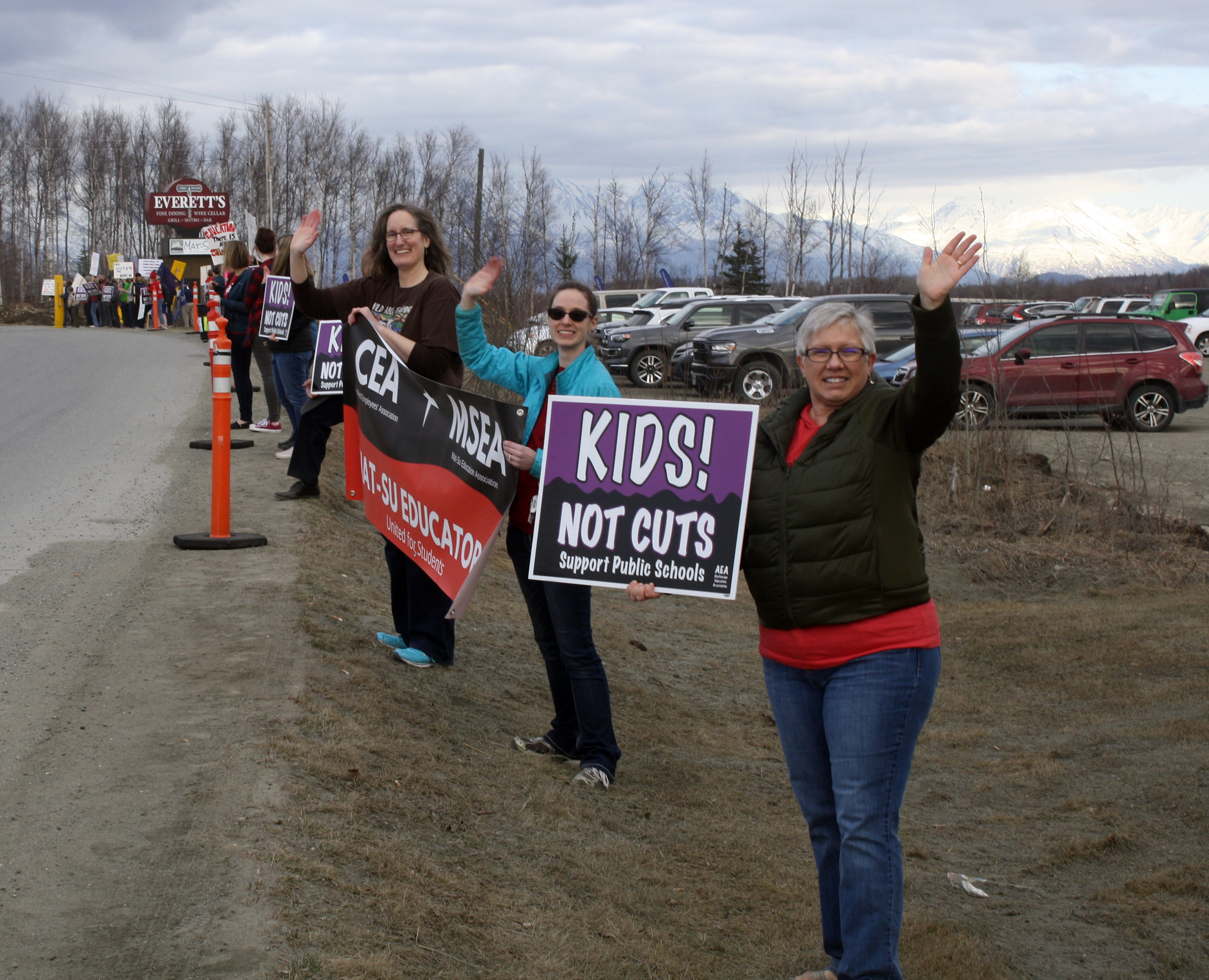
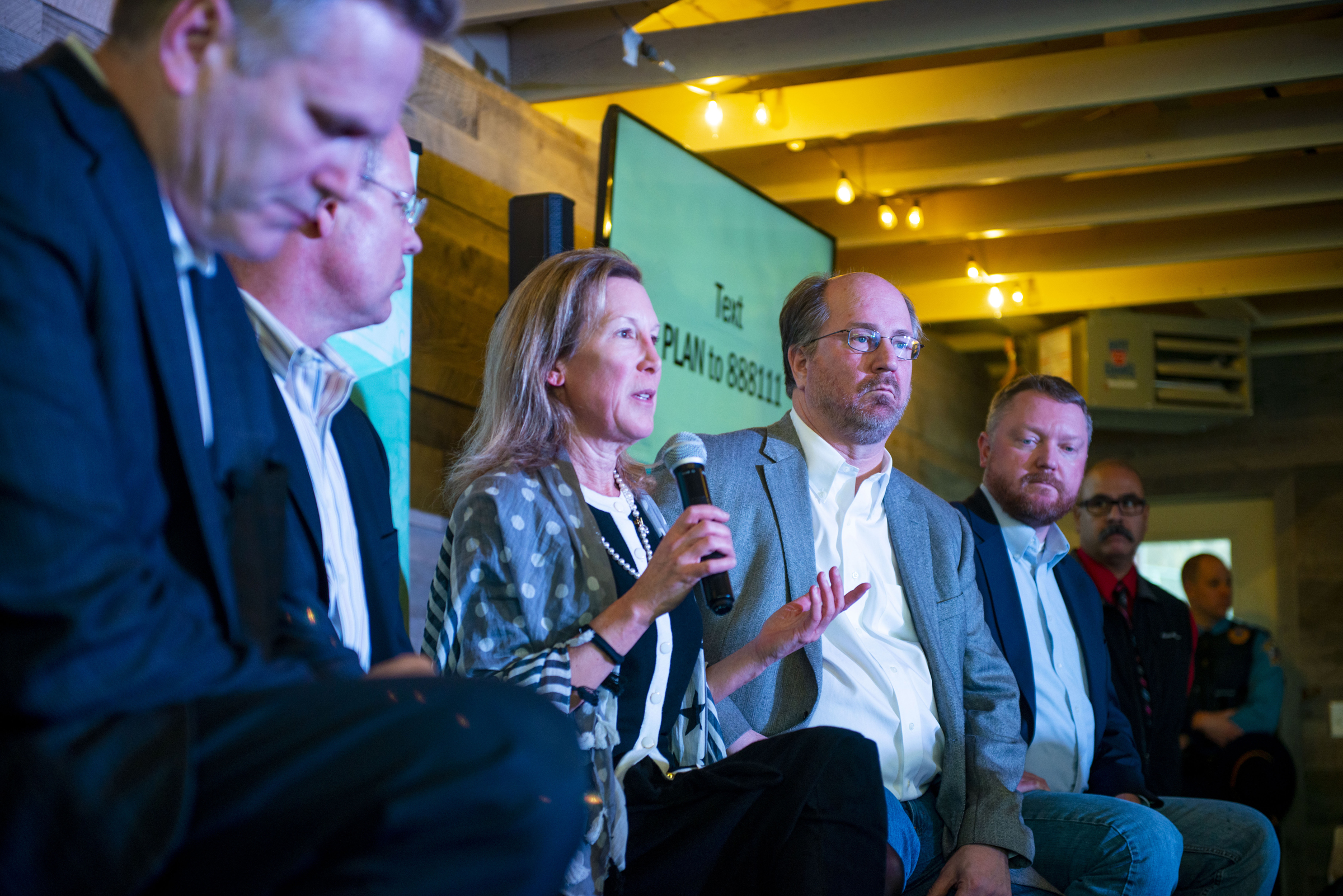
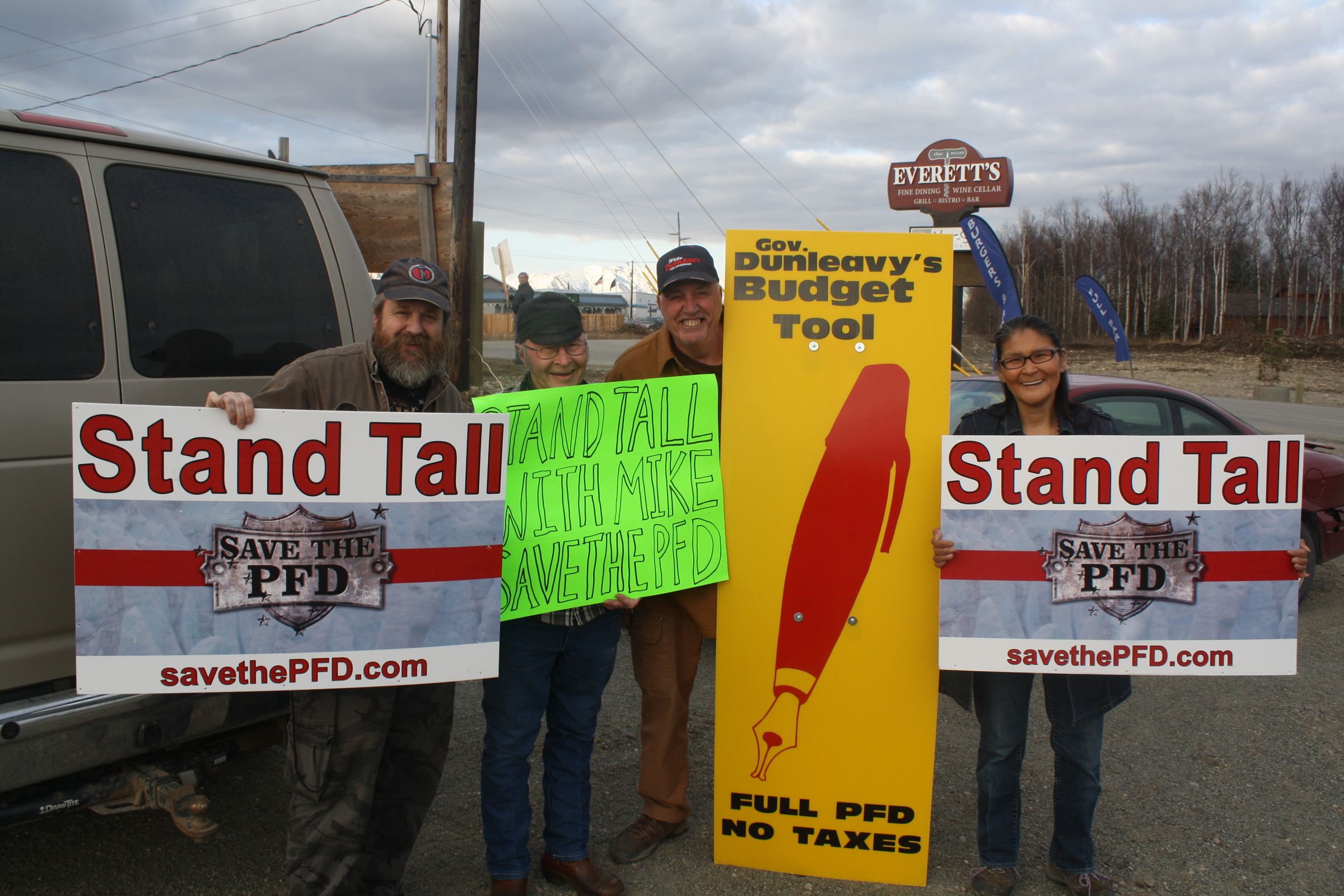
The budget discussion hosted by Americans for Prosperity was attended by 200 in the pavilion on Wasilla Lake. Dunleavy was joined on the panel by moderator Ryan McKee, President of Americans for Prosperity, Jeremy Price; Deputy Chief of Staff for Dunleavy and former AFP President, Office of Management and Budget Director Donna Arduin, Department of Revenue Commissioner Bruce Tangeman; Attorney General Kevin Clarkson and Alaska Policy Forum Director of Operations Larry Barsukoff. While Dunleavy and the panel went over his budget presentation, dozens more stood at the top of the driveway waving signs to traffic on Bogard Road. Mat-Su Education Association President Dianne Shibe wore red in protest of Dunleavy’s potential cuts to education funding.
“Our profession is being destroyed,” Shibe said.
Shibe noted that Alaskan educators lack defined benefits, as opposed to how teachers are paid in the Lower 48.
“Who’s going to be here to teach them?” Shibe said.
Dunleavy presented a slide show of the budget history of Alaska noting oil production ups and downs and budget expenditures along the way. Dunleavy noted the most affected areas as the university, Medicare, K-12 education and the Alaska Marine Highway System, and paused when he got to the slide about Alaskan schools.
“This is a slide that’s painful to me and painful to a number of others. My profession is education. I taught out in rural Alaska and also worked in the Mat-Su,” Dunleavy said.
Dunleavy pushed that kids must read by third grade and be proficient in algebra by eighth grade and noted traditionally poor NAEP testing scores.
“Not as an individual school, not as an individual school district, but as a system overall we’re performing worse than any other state system including states like Mississippi. What I really want to take a look at here is as the budget is going up it’s not necessarily corresponding into better outcomes, and this is really a discussion we need to have and this is what this budgetary process has kind of unmasked,” Dunleavy said. “We’ll fight like crazy to get the money put into programs. Once that’s accomplished, there’s less conversations about what the outcomes are. As we’re putting more money into the ferry system we need to have more of a conversation about what do we expect out of the ferry system in terms of schedules, efficiencies, etc.”
Dunleavy promoted his three Constitutional Amendments, one to prevent any new taxes without putting it on the ballot for voters, one not to alter the PFD without putting it on the ballot for voters and one to revise the appropriation limit.
“I’ve heard people say you don’t want the people of Alaska to vote, and my reply to them is they’re the very people we represent. The people in this room, this is your government. We’re your governor, I’m your governor, and you’ve got legislators. We represent you,” Dunleavy said. “I believe if you are given the opportunity to vote on these Constitutional amendments, you’ll vote for these constitutional amendments.”
While those who were not allowed into the Americans for Prosperity hosted budget discussion were not within shouting distance of the governor himself, there were those who boldly questioned the governor.
“Why must everything be cut instead of oil taxes,” Ryan Mckee read in questions submitted from the audience.
Slowly one person started timidly clapping when DOR Commissioner Bruce Tangeman gave his answer.
“We’ve talked about a lot of taxes over the last several years. Next to hockey, I think talking about oil taxes is the second leading sport in the state and our competitors love it when Alaska talks about taxes,” Tangeman said.
Dunleavy said that they have an institution working on a tax study, which will be presented next week.
“What we are really trying to find out through these studies that we’re going to get back here in a week is if you are taxed that amount, what will you do? Will you stay in Alaska? Because if you stay in Alaska and you want to pay such a tax, then that solves the problem. We tend to think given the economy is hot Outside and it’s not as hot here that folks will leave. Let’s look at the oil taxes and again, I think that’s a legitimate conversation as well. If you tax the oil companies $1.6 billion and close this, which we’re going to have to increase our revenues by about four, four and a half percent each year. The oil companies laid off thousands of fellow Alaskans. You know these are Alaskans too, not everybody works for the state in one form or another. There are some folks that work in the private economy,” Dunleavy said.
While opposition has resulted in massive crowds and even the arrest of 28-year-old Nome resident Brenda Evak, Dunleavy faced a crowd full of voters that cast their ballots overwhelmingly for him. Deputy Chief of Staff Jeremy Price kicked off the meeting by introducing Dunleavy.
“Folks let me lay out the problem, we’ve got a $1.6 billion deficit and there are only a few ways to resolve that crisis,” Price said.
“Oil taxes!” shouted a man over a cough from the front row.
UPDATE
Dunleavy was asked 59 questions through moderator Ryan McKee. McKee stated that any question did not go through a filtering process and that he read any questions written down on the cards. As the event wore on and questions were repeated, so were many of the answers given when asking specifics on the hot topics of education, health care and medicaid, with some Valley specific issues sprinkled amongst questions about any and every type of tax. Of the 59 questions, 11 questioned his cuts to education, and five received an answer with ‘$1.6 billion deficit,’ in the answer. Of the 59 questions, seven were about medicare specifically, seven about taxes, and another four about cuts specifically affecting the Mat-Su Valley. Dunleavy answered five tax questions by propping up his constitutional amendments and saying that a study coming out sometime next week will give them he and his administration the information and answers they are looking for regarding taxes.
EDUCATION
“Jackie asks why is it that more than 30 students in high school classes with no competitive early childhood program and no pension plan for teachers, you are not putting more money into the future of your children?” McKee read.
Dunleavy responded with a popular answer.
“We have a $1.6 billion deficit. We have a $1.6 billion deficit, that’s the reason,” Dunleavy said.
Dunleavy shifted the decisions onto the school districts themselves, repeating that he believes many school districts do not spend the majority of their funds on education. Multiple questions asked about how cuts to education would affect the ability to hire and retain good teachers, especially considering the lack of social security or retirement system. Dunleavy also noted that rural districts needed to have conversations on how to retain teachers as a response to a question about paying teachers.
“Mike asks what data informs the budget that school performances will improve with a 40% cut and why is oil tax credit a non negotiable item,” McKee read.
Dunleavy again noted the tax study that he is anxiously awaiting.
“We need to take a look at what will happen when we tax anybody or any entity and with regard to the schools,” Dunleavy said. “School performance did not improve with more money.”
APF Operations Director Larry Barusukoff also jumped in saying that it was absolutely fair to compare Alaska to other states. Another handful of questions were directed at testing and the numbers that the administration has used to back up their claims, especially when point to the high dollar amount spent per student in the state while comparing it to others.
“Christina asks how can you advocate for reading by the 3rd grade when your proposed budget of cutting education by 25 % puts Mat-Su primary numbers to 29:1 which could result to numbers of 35:1 in kindergarten?”
Dunleavy again said that these decisions would lie with the School District themselves.
“I don’t think under these circumstances and these conditions, we can’t do business as usual, but I would also say at the same time, I’m not talking about the Mat-Su as a particular school district, but as a state system, more money does not necessarily mean better outcomes,” Dunleavy said.
Dunleavy posed that for the most part, money is being added to education, and that the state would have to look at different ways of delivering education and partnering with the University to raise test scores. He said that rural districts that spend more on travel and programs would have to prioritize, but noted some school districts off the road system that are still high performing.
“It is not a direct correlation between dollars spent, it is a question of priorities. Any school district is going to have to decide where the priorities are,” Barsukoff said.
While the Mat-Su would not be as harshly affected by cuts to the University of Alaska, OMB Director Arduin said that the outcomes were not high enough for the amount of dollars spent and so the administration challenged the University to reduce its spending and increase its outcomes. Dunleavy noted that he received degrees from the University of Alaska and will have two of his three daughters attending campus in the state this fall. Dunleavy also noted that he felt the University could be more aggressive in asking for alumni donations.
VALLEY ISSUES
“Jennifer, your proposed cut to the school bond debt reimbursement will cost the borough 18 plus million. Our borough manager has said this cost will be put on the school district. How do you see the Mat-Su School District succeeding with these cuts along with other cuts to education you are proposing?” read McKee.
Though Dunleavy was on the School Board when the measure passed in 2011, he did not offer any specific guidance on how MSBSD would deal with the cuts.
“Again it’s a $1.6 billion deficit we have to deal with. It’s a difficult situation for all of us across the board, and again, I don’t take any of these reductions lightly, but we’ve got to contribute to closing this gap it’s not an easy issue,” Dunleavy said.
Dunleavy noted that he was working on trying to get a dairy inspector for Havemeister Dairy and a goat dairy operation in Kodiak.
“The division of ag constitutes .01% of the entire state budget. Why cut the division from the state that works to improve the Alaskan economy when it costs so little to run?” McKee read.
Dunleavy quipped that he was not cutting the ability to farm.
“Again it’s a $1.6 billion deficit and it’s across all sectors of Alaska,” Dunleavy said.
One of the more popular topics among legislators is an attempt to move the capitol out of Juneau. Several attempts have been made throughout state history to move the capitol into the Mat-Su Valley.
“Does the fact that our legislators work 600 miles away in Juneau impact the types of projects and programs our legislators keep spending money on?” McKee read.
Dunleavy began the meeting by saying how nice it was to sleep in his own bed in Wasilla.
“Most of the folks that you see in the halls of Juneau are connected with some type of group or some type of lobbying. You don’t see a lot of everyday Alaskans in Juneau, so quite possibly there would because i think if more Alaskans had access, especially to the Senate finance and some House finance meetings, there may be a different impression that the House and Senate finance members would get from real Alaskans,” Dunleavy said.
HEALTH CARE
“Janel: how will proposed cuts to early education, k-12 education, and university level education positively impact and improve the current statistics of children in Alaska who are and might become victims of sexual assault?
Dunleavy failed to find a connection.
“I’m not sure what the correlation is. I can’t answer that question,” Dunleavy said.
OMB Director Arduin said that the administration was working with the centers for Medicaid and Medicare to try to change the delivery method for health care, but that no one would have their coverage dropped. Barsukoff pointed at statistics that the expansion of medicaid resulted in more recipients who are not working. Barsukoff said that they wanted to encourage people to do something with their lives and get out of the trap of government dependency.
“On your list of priorities where would you place the health of Alaskans? how can your proposed cuts to children, seniors, and adult medicaid be reconciled to our moral compass to care for our brothers?” McKee read.
Dunleavy again connected this issue to the deficit.
“Again, this is a $1.6 bilion issue,” Dunleavy said. “If you take from here and fill over here somebody’s going to be left out or impacted and so it’s not an easy situation. It’s something that we have to be discussing but in the end, our approach is to try and close this for reductions.”
TAXES, TAXES, AND MORE TAXES
“Sabrena asks: a recent poll of Fairbanks with the House committee show 55% strongly oppose your budget and only 15% strongly approve. If that’s accurate, don’t you think it’s time to rethink it?” McKee read.
Dunleavy said that his favorite poll was a vote of the people and again promoted his constitutional amendments.
“If you want to take the PFD as well, I’m game, I say the challenge back to the House and Senate, do you want to do the same? If they do we’re good, we find out then if it’s really true that’s true, that the vast majority of Alaskans want to use their PFD for government, that’s terrific and move on,” Dunleavy said. “The ultimate poll is the people of Alaska being able to vote on the constitutional amendments, or at least a statewide advisory poll. I’d be willing to do that. Let’s see if the House and the Senate are willing to do that.”
“How can actions that will crush the Alaskan economy possibly be good for anyone but corporations and the super wealthy like your campaign contributors, who will come in and buy Alaska for pennies on the dollar while real Alaskans leave or go broke,” McKee read.
A combination of laughter and timid applause began halfway through the question and persisted after McKee was done reading. Dunleavy said he would do his best to answer.
“I’m not sure how taking more money out of the private sector, you guys remember we don’t have a printing press and I’m not trying to be a wise guy, but we don’t. I’m not sure the federal government, which by the way has a $23 trillion debt growing, but we won’t talk about that. In any event, I don’t see the solution taking more money out of the private sector. I don’t see how that helps the economy,” Dunleavy said.
A few audience members were permitted to have short dialogue to clarify their question.
“Pete says you referenced Norway’s approach in your presentation as being forward thinking, why did you advocate that approach?” McKee read.
Dunleavy said that he mentioned it, but he was not sure what he said. When pressed by Palmer Deputy Mayor Pete LaFrance, he recalled that he said they have a trillion dollars in their fund similar to the PFD.
“But they also have a huge tax,” LaFrance said.
Over chatter from the inquisitive crowd, Dunleavy joked that Norway also has $35 hamburgers to the delight of the crowd.
“They also have one of the most successful economies,” LaFrance said.
Dunleavy asked if LaFrance really wanted him to answer his question, to which LaFrance replied that he would love to hear Dunleavy’s answer. Dunleavy again questioned what exactly LaFrance was asking.
“I don’t believe in a Scandinavian model for Alaska. I don’t believe that we should be taxing at 30, 40, whatever the percentage is, but raise your hand if you want a Scandinavian model, 47%,” Dunleavy mocked.
A variety of questions asked about taxes of various types, to which Dunleavy usually replied that the administration was waiting on the study.
“From Casey, we need to have real impact evaluations about education and public services before we approve cuts. Have you planned for these types of evaluations before you implemented cuts?” McKee read.
Dunleavy said that our back is against the wall and the time for studies has passed.
“We’re going to end up with no money at all going into the PFD. it just doesn’t work that way anymore, I wish it did. I wish logic ruled the day but it doesn’t,” Dunleavy said. “If for some reason your legislator says to you no, you have to wonder why you even sent them down there and who they’re actually representing. These constitutional amendments will help fix this problem. If you get those in place, if you get those passed out, we have some opportunity to have discussions with the legislature on what this budget is going to look like, but in the end with less than $2 million left in the CBR, if there are no reductions to this budget or not substantial reductions to this budget, I’ll use every tool I have to get this budget in line.”
Dunleavy said that he was going to have be convinced of taxes by data and facts, not emotion.
“Marvin: why have you only focused on cuts rather than focusing on other income generating sources, ACES income tax sale tax for Anchorage?” McKee read.
Dunleavy disagreed with taxation given every opportunity, but said that if it was what people wanted he could live with it.
“Opening up the conversation from a different perspective, we’re taking a look at what do we really want, what do we need, what are vital services, what are we willing to fund, what are we not willing to fund? Again, I’m not a proponent of taxes at this time unless I’m convinced otherwise that they would be a good deed for Alaska and help grow the economy and make things better across the state,” Dunleavy said.
Dunleavy’s final question was a softball that he crushed, receiving a raucous applause at both ends of his answer. Dunleavy says that he plans to use his veto power if the legislature fails to pass his constitutional amendments. He received a standing ovation in a crowd full of supporters who were willing to cheer and skeptics hoping to get answers one 3x5 card at a time.
“And now the last and the big question for the Governor,” McKee read. “Do you have a big red pen?”
Frontiersman reporter Jacob Mann contributed to this article.

By Jeremiah Bartz Frontiersman.com A football coach using a hockey reference as the centerpiece for his keynote address may

Frontiersman.com With its headquarters in Wasilla, the Frontiersman has been a primary source of news for the Matanuska-Susitna

By Katie Stavick Frontiersman.com The next generation of leaders took flight this week as the Houston High School Class

By Kyle Wilkinson For the Frontiersman Keynote speaker and Carry the Cure President Bill Pagaran’s words boomed through the