Retiring teacher, coach urges Colony grads to ‘find their 68’
By Jeremiah Bartz Frontiersman.com A football coach using a hockey reference as the centerpiece for his keynote address may


PALMER — For many Valley residents, Gleo Huyck is a larger-than-life guy, even by Alaskan standards. He’s tall and robust with a striking appearance, a droll smile and wit, and a deep voice.
As the director for Mat-Su Concert Band, Huyck is the picture of professionalism in his tailor-made tails, white satin vest, and matching bow tie, baton in hand — that’s how most people see and know him.
Since beginning his career in the Mat-Su as a music teacher in 1970, Huyck has demonstrated his musical expertise as a conductor and musician of both instruments and voice. His resume includes a 2002 performance with a choral group that sang at Carnegie Hall.
But here, as ABC radio broadcaster Paul Harvey used to say, is the rest of the story:
Huyck is also a co-founder of the Iditarod Trail Sled Dog Race.
Raised in South Dakota with three younger brothers, Huyck nurtured a dream to travel north, inspired by the 1950s TV show “Sergeant Preston of the Yukon.” After graduating from Ball State University in Muncie, Indiana, in 1962, he taught music for the Kokomo School District and later Howe Military Academy. After completing his master’s degree at Vandercook College of Music in Chicago and marrying his wife, Pam, he submitted an application to each Alaska school district and received five offers for music teaching positions. He chose one in the Mat-Su Borough.
Huyck made his way to Alaska in his Pontiac station wagon, pulling a U-Haul trailer, without getting a single flat tire, he said.
But when he arrived, he found his job had changed. Originally contracted to teach at Palmer High School, he would instead cover several schools in a larger area that included Big Lake, Willow and Wasilla.
Pam and their 2-week-old daughter, Heather, flew in two weeks later. The family set up housekeeping in a trailer in Big Lake.
The Valley was sparsely populated then, with only about 6,500 residents. Huyck said he saw more moose than vehicles as he traveled about.
“I hunted in my subdivision,” Huyck said.
Through fellow teacher and musher Tom Johnson, Huyck said he met other mushers, including, eventually, Joe Redington, Sr.
Soon Huyck acquired his first dog, Comet, for $25. Unfortunately, Comet was rather old and died that winter.
“I got a bad deal on that dog,” Huyck said.
Redington contacted Huyck to ask if he could use a couple dogs. Huyck talked it over with Pam — the dogs were free, he said — and she said yes.
So Huyck drove his bright yellow Ford Bronco to retrieve what ended up being seven dogs. Over the course of a few weeks, Redington filled the Huyck lot with 45 dogs.
“Redington had like 300 dogs, you know,” he said.
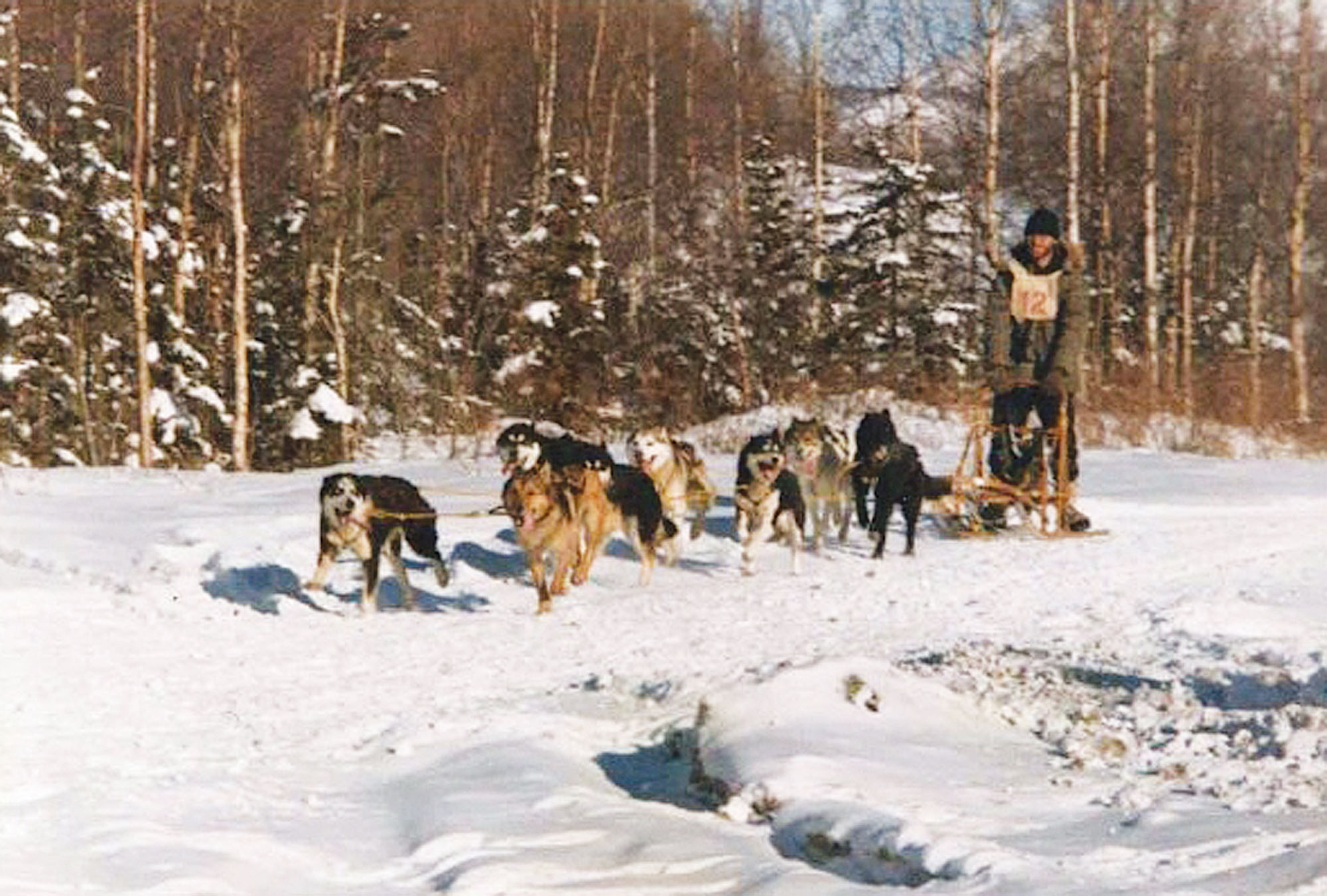
Huyck ran his dogs and participated in several sprint races. He joined the Valley mushing organization Aurora Dog Mushers — out of which came the Iditarod Trail Committee — and was elected president. The ITC and extended membership of Aurora Mushers discussed Redington’s dream of a long-distance sled dog race over a portion of the Iditarod Gold Rush trail from Knik. Despite lots of chatter, some avid trail clearing, and occasional publicity, no one jumped in whole-heartedly to help Redington organize such a race.
Except Huyck and Johnson.
Huyck and Redington worked side-by-side on a fish-buying scheme in Unalakleet in the summer of 1972. They bought whole fish, paid to have them cleaned, frozen in the round, and then flown to Anchorage to sell.
Which begs the question, can anyone spend a summer rubbing elbows with Redington and not come home with a head full of ideas about a long distance sled dog race?
The answer seems to be no. Huyck and Johnson were driving to Anchorage on a dog food run in October of 1972 and suddenly had an epiphany. The two teachers telephoned Redington to report they were ready to commit the time and effort necessary to organize the race.
Not until Huyck and Johnson joined Redington and took responsibility for the race, did the Iditarod gain real momentum, Huyck said. From that moment the race was on and these three Valley men embarked on a rollicking ride that begat the first Last Great Race of 1973.
The job was immense, the logistis mind-boggling.
Huyck claims organization was not Redington’s forte.
“Redington was the dreamer, we were the more pragmatic ones,” Huyck said.
Through the fall and into the new year, Huyck and Johnson spent their days teaching in Wasilla and driving to Anchorage a few times each week to attend endless meetings and organize volunteers.
“We wore ourselves out,” Huyck said.
In those days, the Glenn Highway was a two-lane road, lighting was scarce, and state maintenance wasn’t a top priority.
“There were times when we wouldn’t see a single car all the way to Anchorage,” he said. “We packed survival gear and hoped we’d make it home without problems, because it might be awhile before someone found us if we got into trouble.”
And they did. Whenever possible, all manner of things seemed to go wrong. Twice they acquired a substantial pot of money, only to have it “disappear,” for example.
Surprisingly, the most difficult hurdle to clear was the lack of support from fellow mushers and civic leaders. An ever-changing group of volunteers worked on race rules, trail clearing, and countless other tasks.
“We were so naïve,” Huyck said. “We are lucky we didn’t end up in jail.”
Despite all that, on March 3, 1973, the race began with a bang as mushers and dogs raced toward Nome. Race planners continued to “put out fires” and solicit donations for the purse as teams took a beating on the rugged trail.
Don Wilmarth crossed the finish 20 days later. The last musher pulled in 12 days after him.
As each musher crossed the finish line, the limelight shone more brightly on Redington.
Huyck and Johnson returned to their regular lives.
A few years later, after Pam calculated their family was spending more money on dog food than people food, the couple gave away their dogs. Huyck focused on his family and music.
He now lives in Palmer. His daughters, Heather and Marzieh, and granddaughters, Keira and Tabitha — “the loves of my life,” he said — also live in Southcentral Alaska.
Both Huyck and Johnson’s contributions to the Iditarod have faded into obscurity over the years. Most documentation gives the men just a passing recognition, though Rod Perry’s “Trailbreakers: Pioneering Alaska’s Iditarod, Volume II,” published in 2010, honored Huyck and Johnson as co-founders of the Iditarod. The book was dedicated to Huyck and Johnson.
“I have a very happy life,” Huyck said, “but there is nothing special about me.”
“Tom and I never did it to gain notoriety,” he said, of the Iditarod, “but we wanted our daughters — and now my granddaughters — to know the true story.”
Jenny Weaver follows the Iditarod Trail Sled Dog race from her home on Lazy Mountain.

By Jeremiah Bartz Frontiersman.com A football coach using a hockey reference as the centerpiece for his keynote address may

Frontiersman.com With its headquarters in Wasilla, the Frontiersman has been a primary source of news for the Matanuska-Susitna

By Katie Stavick Frontiersman.com The next generation of leaders took flight this week as the Houston High School Class

By Kyle Wilkinson For the Frontiersman Keynote speaker and Carry the Cure President Bill Pagaran’s words boomed through the