Retiring teacher, coach urges Colony grads to ‘find their 68’
By Jeremiah Bartz Frontiersman.com A football coach using a hockey reference as the centerpiece for his keynote address may


WASILLA — The 2016 Iditarod Trail Sled Dog Race is in the books.
The final musher in the field, Willow rookie Mary Helwig, followed her team down Front Street in Nome just before midnight March 19 to officially signal the end of the 2016 edition of the Last Great Race. Helwig was the 71st musher to cross the finish line, and the 22nd from the Valley.
The 2016 Iditarod featured the most mushers to finish the race in nearly a decade. This year’s 71 finishers is the most since a record 78 mushers finished the race in 2008. It’s also only the fourth time in race history that more than 70 mushers have finished the race. There were also 71 finishers in 2006 and 77 in 2004. In each of those four years, the race came on an even year, which features that northern route. The northern route sends mushers from Ophir north through Cripple, Ruby, Galena and Nulato before hitting Kaltag. In odd years, the race uses the southern route, which sends teams from Ophir south to the Iditarod checkpoint, and through Shageluk, Anvik, Grayling and Eagle Island before Kaltag.
A total of 85 mushers left the restart chute in Willow March 6. Of those 85, 13 scratched and another, Wasilla’s Ellen Halverson, was forced to withdraw by race officials.
Willow musher Dallas Seavey continued his domination of the Last Great Race, earning his fourth title in record time. Seavey logged a total time of 8 days, 11 hours, 20 minutes and 18 seconds, beating his own prior record time by nearly five hours.
Seavey’s dad, Mitch, the 2016 runner-up also clipped the old record this year, set by Dallas in 2014. It was the fifth time in race history the winner finished in less than nine days. This year, the top eight mushers finished in less than nine days.
Seavey’s first win came in 2012, with a time of 9 days, 4 hours, 29 minutes and 26 seconds. This year, the top 16 mushers in the field bested that time.
With his win, Seavey earned a record $75,000 of the purse. He was one of six Valley mushers to finish in the top 30, which guarantees a payout, depending on the finish, in a range from S2,025 for 30th place to $75,000 for first.
Seavey was one of three Valley mushers in the top net. Willow’s Wade Marrs scored $51,825 for his fourth-place finish. Willow’s Scott Smith grabbed $31,050 for placing 10th. Ray Redington Jr. of Wasilla earned $15,075 for placing 19th. Big Lake’s Kelly Maixner bagged $12,225 for a 21st place finish. Willow’s Linwood Fiedler was awarded $8,475 for finishing 24th.
In total, the Valley’s top 6 earned a combined $193,650. After the top 30, each musher who finishes the race gets their buy-in back, $1,049. Sixteen additional Valley mushers finished the race. That added $16,784 to the Valley earnings. In total, the 22 Valley mushers who finished the race earned a combined $210,434.
The total race purse this year was about $793,000. The 22 Valley mushers who finished combined to earn 26.5 percent of the total purse.
Among the Valley mushers, Smith, who has now finished the race five times in his career, made the biggest leap in the standings when the 2015 and 2016 race are compared. Smith improved 16 spots from his 26th place finish in 2015, which gave Smith a dramatic increase in the purse. Smith earned $5,700 last year, about $25,000 shy of his haul this year.
Fiedler also made a big jump in the standings. He improved 13 spots after placing 37th last year.
Marrs cut his finish in half for the fourth straight year. The 25-year-old was 32nd in 2013, 16th in 2014 and eighth last year. If the trend continues, Marrs could be in line for a runner-up finish in 2017. Heading into 2016, his career winnings in the Iditarod stood at about $53,600. He won $51,825 this year.
The Valley, Willow in particular, is a mushing mecca. There were 28 Valley mushers in the field, the most for any region. Of those 28, 22 finished. It’s the largest total of Valley mushers to finish the race, since 26 from the Valley finished in 1990. It’s also only the third time that more than 20 Valley mushers have finished the race in a particular year. Twenty-one Mat-Su mushers finished in 2008.
Valley mushers accounted for 33 percent of the field in 2016, and 31 percent of the mushers who finished.
The 2016 field included eight Norwegians, and seven finished in the top 30.
Joar Leifseth Ulsom led the Norwegian mushers with a sixth-place finish. Ulsom was one of two Norwegians in the top 8, three in the top 13 and seven in the top 30. The eight mushers from Norway combined to earn $123,524, about 15 percent of the total race purse.
A number of awards were handed out during the annual banquet Sunday in Nome.
In addition to winning $75,000 of the race purse, Seavey netted three awards at the banquet. The win also earned Seavey the Anchorage Chrysler Dodge Jeep Ram Official Truck Award, a 2016 Dodge Ram 1500, valued at $40,000. Seavey was also presented with the PenAir Spirit of Alaska Award, which goes to the first musher to reach McGrath. That award comes with $500 credit on PenAir toward travel or freight shipments, and a piece of art crafted by Alaska artist Orville Lind. Seavey was also handed the GCI Dorothy G. Page Halfway Award, given to the first musher to Cripple. With the award comes with $3,000 in gold nuggets and a commemorative trophy.
Eureka musher Brent Sass earned two awards, the First Musher to Ophir and the Wells Fargo Gold Coast Award
Sass earned one ounce of gold nuggets for reaching Ophir first, and $3,500 worth of gold nuggets for reaching Unalakleet first.
Jeff King was presented with the Lakefront Anchorage First Musher to the Yukon Award, and earned $3,500 and a five-course gourmet dinner served in Ruby. Mitch Seavey earned the Briston Bay Corporation Fish First Award, and netted $2,000 in addition to 25 pounds of Bristol Bay salmon.
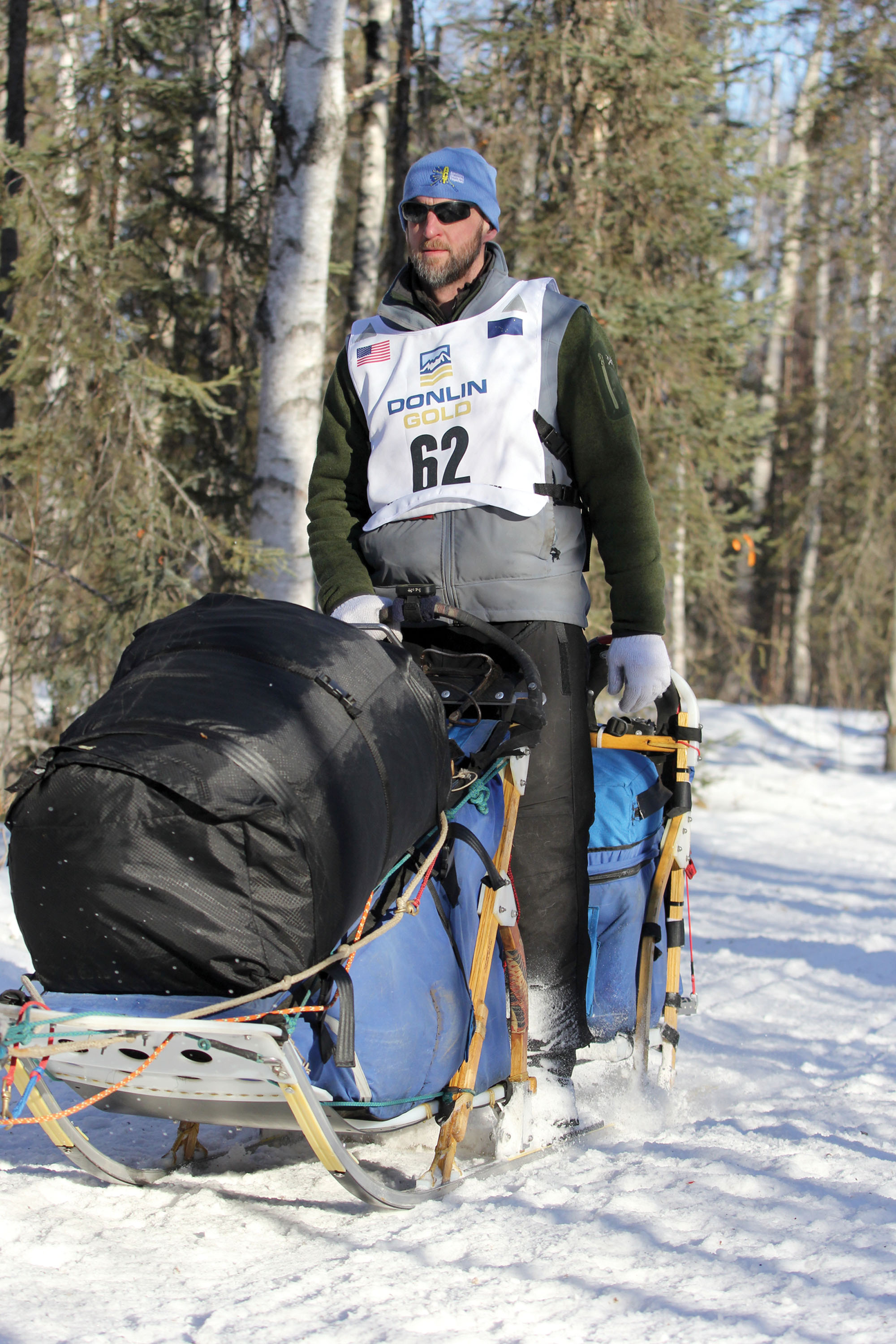
Nicholas Petit won the Nome Kennel Club’s fastest time from Safety to Nome, and the $500 check that goes along with it. Geir Idar Hjelvik won the Jerry Austin Memorial Rookie of the Year Award, and a $2,000 prize. Noah Burmeister won the Matson Most Improved Musher Award, and $2,000. Burmeister improved 44 places from when he last raced in 2006. The Donlin Gold Sportsmanship Award and a $3,500 check went to John Baker. Matt Failor was named Most Inspirational. Aliy Zirkle earned the Alaska Airlines Leonhard Seppala Humanitarian Award.
Contact Mat-Su Valley Frontiersman sports editor Jeremiah Bartz at sports@frontiersman.com.

By Kyle Wilkinson Kyle in the outside Our spring bear hunt was bittersweet this year. We’re heading home without

Frontiersman.com Valley athletes earned titles during the Region III Championships track and field meet last week at Colony High

Leila Petersen Palmer Moose Leila Petersen, a member of the Palmer track and field team, has been named a Frontiersman

By Jeremiah Bartz J’s World August would have been the start of my 25th year as an editor at