Retiring teacher, coach urges Colony grads to ‘find their 68’
By Jeremiah Bartz Frontiersman.com A football coach using a hockey reference as the centerpiece for his keynote address may


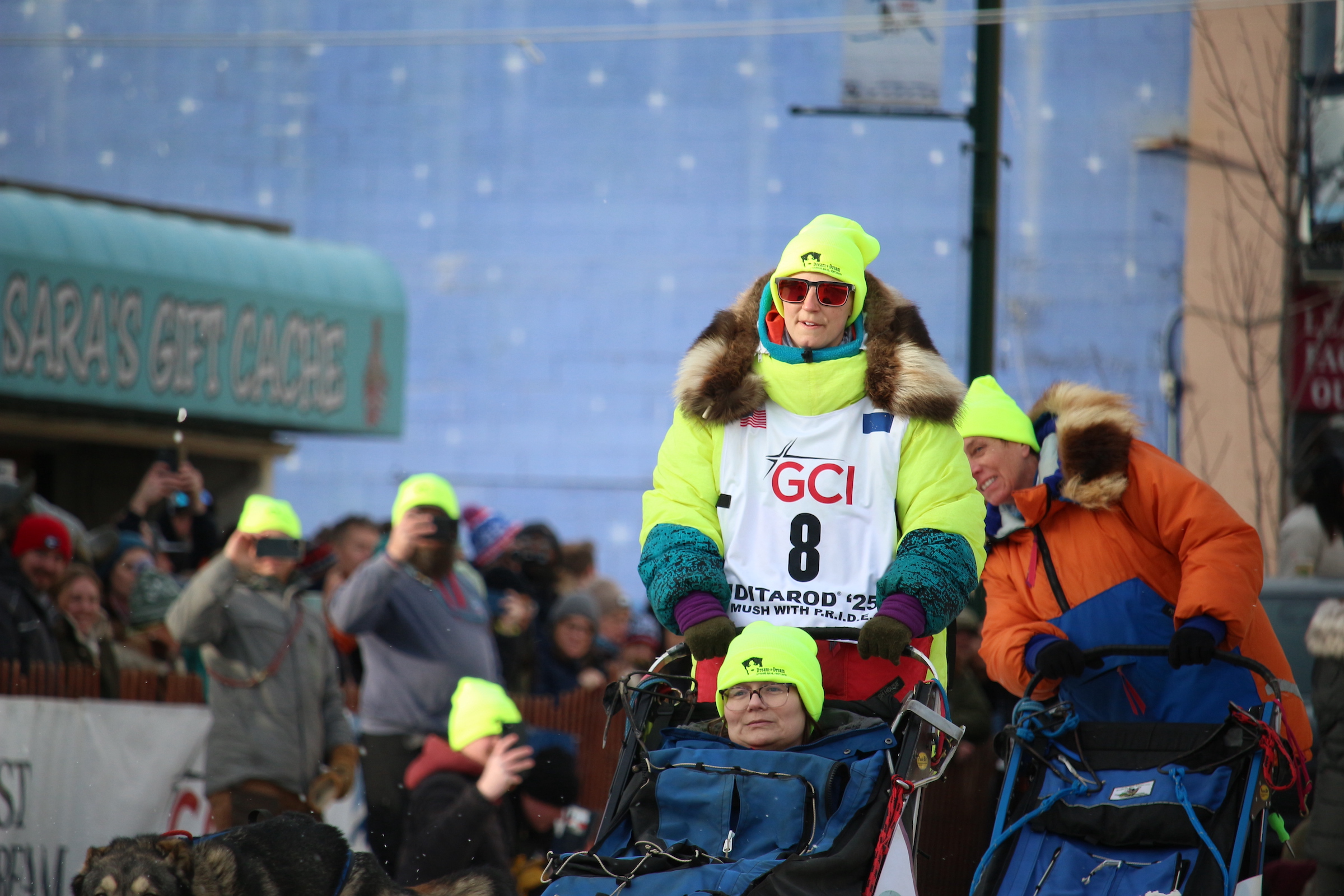
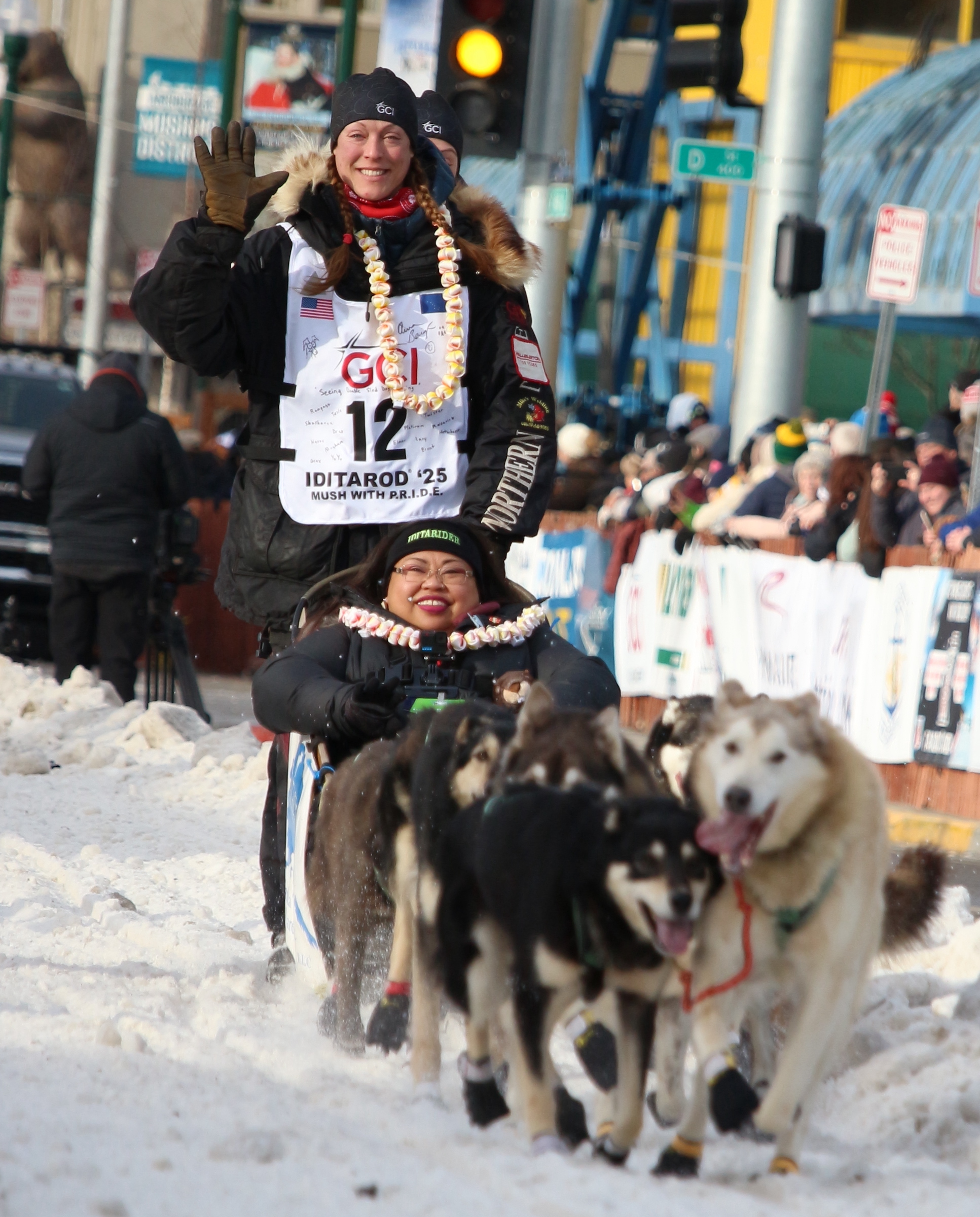
The Ceremonial Start for the 53rd Iditarod kicked off on a warm, sunny Saturday morning in downtown Anchorage. There were 33 teams, with special appearances including four-time Jr. Iditarod Champion Emily Robinson that raced their way along a shortened route that terminated at Sullivan Arena. A crowd of people that stretched across several city blocks cheered on the mushers as they sped by.
Mushers were laid back and enjoying the break from months of preparation as they conversed with fans, fellow mushers and their dogs before taking off on what most considered a joyous part of the Iditarod experience. Teams will make the trip to Fairbanks for the Official Restart on Monday March 3 at 11 a.m. The morale was positive, as many Valley mushers welcome the snowy trails and a respite from less-than-ideal snow conditions in the Mat-Su this winter.
Knik musher Ryan Redington, 2023 Iditarod champion, said he felt confident going into this year’s race. Redington said his team of dogs from Redington Mushing is one of the best he’s ever brought to Iditarod. He believes his team has a good shot to compete for the championship again this year.
“I'm feeling very good,” Redington said. ”It's a really nice dog team that we have and it's going to be a tough race. I'm looking forward to the challenge of it, and the competitive side of it as well.”
Redington’s roots run deep in Iditarod history. His late grandfather Joe Redington Sr. is known as the “Father of the Iditarod” and a pioneer of the race. He continues to carry on the family tradition to this day.
The weather was colder the last time Redington raced from Fairbanks in 2017 he said. At -63 degrees Fahrenheit, Redington explained he received severe frostbite on his face as he pulled up a photo on his phone. To combat it this year, he’s invested in a better parka with a wolverine-fur ruff, known for its resistance to the elements. The Yukon River is wide and open and could act as a wind funnel, Redington said.
This year’s additional 100 miles will be something that all mushers will feel, Redington anticipated. He said that sleep deprivation will take it’s toll but is the price to pay for racing in Iditarod.
“Sleep deprivation will be a challenge for sure, but we all gotta deal with it,” Redington said.
Redington has raced this winter in the Knik 100, Kuskokwim 300, Copper Basin 300 and the Knik 200, where he took second place. He said he’s been racing his dogs conservatively all season, preparing them for this year’s Iditarod.
“Hope all the mushers the best of luck and looking forward to racing,” Redington said. “I think it's gonna be a good one.”
Gabe Dunham from Evermore Adventures is returning to Iditarod this year with her veteran status after finishing the race in 2024. She said she is confident this year knowing what her team is capable of and getting them to the finish line.
Based out of Willow, Dunham said she is looking forward to better racing conditions further north. Dunham was born and raised in Fairbanks and is looking forward to going home. She believes the restart in Fairbanks is “positive.”
“I'm looking forward to miles of snow,” Dunham said. “In Willow, our trails got decimated around the middle of January, and we've been on hard pack ice or having to travel to get to snow.”
Dunham also brought up the weather as a major factor, especially while traveling hundreds of miles on the Yukon River. New country and a new trail will also be a challenge for her this year.
“No matter what the terrain is, the dogs are going to have fun,” Dunham said. “And I do this because I enjoy running my dogs, so we're going to have fun.”
Nicolas Petit, from Big Lake and Alaska Dogstead and Team Petit, said he was happy to be taking what he expects will be a much easier trail on both him and his team. The traditional southern route, run on odd-numbered years, is devoid of snow in some sections making for a rough and bumpy ride.
“I'm glad we’re not going to bounce around on the tussocks,” Petit said.
Preparation this year required more travel for many Valley teams, and Petit’s was no exception. This will be the 14th Iditarod that he has run, and he came in third place in 2017 during the last Fairbanks Restart.
Petit explained that the course from Fairbanks will be different this year by adding miles on the Yukon River to make up distance. When Petit had raced along the route from Fairbanks in previous years, the course had taken them from Galena north to Huslia and back down the Koyukuk River to Koyukuk. This year, the route will take mushers downstream on the Yukon River to Anvik before doubling back to Kaltag and then to Unalakleet.
The ride will require less running on Petit’s part, he said. To accommodate, Petit prepared his sled so that he can straighten out his legs and keep them from getting cold. He said he looks forward to having a good run and seeing his friends at the finish line in Nome.
Dane Baker, originally from Royal Oak, Michigan, is racing in his rookie year with a team from Willow-based Alaskan Husky Adventures and the 17th Dog Kennel. Baker said his team may be the youngest dogs in the race this year, with roughly half of them being less than two years old.
Standing next to his truck with the support of coworkers Jaren and Kaci and his girlfriend, Mary, Baker said everything was starting to feel real as the barking of happy sled dogs echoed through the downtown streets.
“Now I'm like, ‘we got this, we'll figure it out,’” Baker said. “Now we're in it, it's a lot. But I'm feeling pretty confident and excited.”
Baker explained that he has been considering his race strategy and timing. He plans to just run his race from checkpoint to checkpoint and break the 1100+ mile journey into smaller segments.
He hopes to be on the trail for 12-14 days and see his parents in Nome.
Baker said he is most excited to meet new mushers and build relationships with them along the trail this year.
“I think I'm looking forward to getting to the coast, but I'm also looking forward to developing relationships with some of the other rookie mushers and becoming friends with them throughout the race,” Baker said.
Baker greatly appreciates the honor to race a team of dogs from Matthew and Liz Failor’s kennel this year and thanks them for all of their support.
Riley Dyche from Dark Horse Racing Kennel in Big Lake said he felt that the Ceremonial Start of the race is relaxing and fun. He said it was a good break from the months of preparation and thousands of miles of travel to train this year.
Dyche believes that the delayed restart in Fairbanks to Monday provides mushers with the chance to return home to pack and rest. He said he won’t be changing anything last minute and is dialed in with all of the traveling he’s done this year.
“We're more ready to go than I've ever been,” Dyche said. “Usually, night before the race, you're up till midnight getting stuff all figured out and done, but I think we're pretty prepared and should be able to have a pretty relaxed evening tonight.”
Dyche is wearing a parka with a wolf fur ruff with beaver trim, sewn for him by Pam Redington from Manley. He explained that a lot of her dogs’ genetics build up his team and he looks forward to seeing her when he gets to Manley.
The six weeks of downtime after the race is something that Dyche looks forward to before hosting sled dog tours at Iditarod Headquarters in May.
“I love the Iditarod and I love being able to participate, it's a pretty special thing,” Dyche said.
Sydnie Bahl from Wasilla and Dream-a-Dream Sled Tours is excited to hit the trail for her rookie year. With the poor trail conditions around Willow, she too has had to travel to Petersville, Eureka and the Denali Highway to train her dogs.
Bahl has been racing for three seasons now and has participated in Iditarod-qualifiers like the Goose Bay 150, Copper Basin 300 and Yukon Quest Alaska 300. She decided that it was the right time to try for the Iditarod and had great training races this year.
“I'm excited to be out there with these 16 dogs and see what we can do out there,” Bahl said.
Her goal is to get to Nome. Bahl said her team is strong and that her and the dogs are ready to hit the trail. Once she crosses that finish line, she looks forward to showing her dogs how much she appreciates them.
“Just loving on these dogs and thanking them for all their hard work, they're amazing athletes,” Bahl said.
Mitch Seavey from Seavey’s Ididaride in Seward is a three-time Iditarod Champion. He set a speed record in 2017, the last time the race started in Fairbanks. He is the father of Dallas Seavey, who holds the record for Most Iditarod Wins with six championships.
Mitch, at 65 years of age, said he will be relying on his years of experience and knowledge on the trail to get from Fairbanks to Nome.
“We got to go do our job and what we did in past races doesn't really matter, other than experience and hopefully recognized situations,” Mitch said. “I'm 65 years old, I feel real good, my health is real good, and [I’ll be] relying on my experience and hopefully wisdom.”
Mitch doesn’t think his past championships provide him with any particular advantage. He said he’s just happy that the route was moved to Fairbanks to avoid traveling over miles of snowless trail.
A major challenge that Mitch foresees is running on the wide, open, featureless Yukon River for hundreds of miles. He explained that this can become boring for both musher and dog team. Getting a healthy team to Nome is his main goal and acknowledges the added mileage to this year’s race.
“It might be the longest race we've ever run,” Mitch said.

By Kyle Wilkinson Kyle in the outside Our spring bear hunt was bittersweet this year. We’re heading home without

Frontiersman.com Valley athletes earned titles during the Region III Championships track and field meet last week at Colony High

Leila Petersen Palmer Moose Leila Petersen, a member of the Palmer track and field team, has been named a Frontiersman

By Katie Stavick Frontiersman.com In a direct response to public outrage over a horrific animal neglect case, the Matanuska-