Retiring teacher, coach urges Colony grads to ‘find their 68’
By Jeremiah Bartz Frontiersman.com A football coach using a hockey reference as the centerpiece for his keynote address may


MAT-SU — The three shallow graves behind Mat-Su Regional Medical Center were far from Kathy Decker’s first such crime scene.
Decker is a deputy sheriff with the King County, Wash., sheriff’s office.
“King County, unfortunately, has a lot of serial killers,” she said, speaking from at least 18 years of experience. “We get a lot of outdoor scenes.”
But while finding bones in a field might be something she’s used to, these were no ordinary bones. She and her fellow instructors had planted them there as a tool to teach Alaska investigators what to look for and how to document a crime scene.
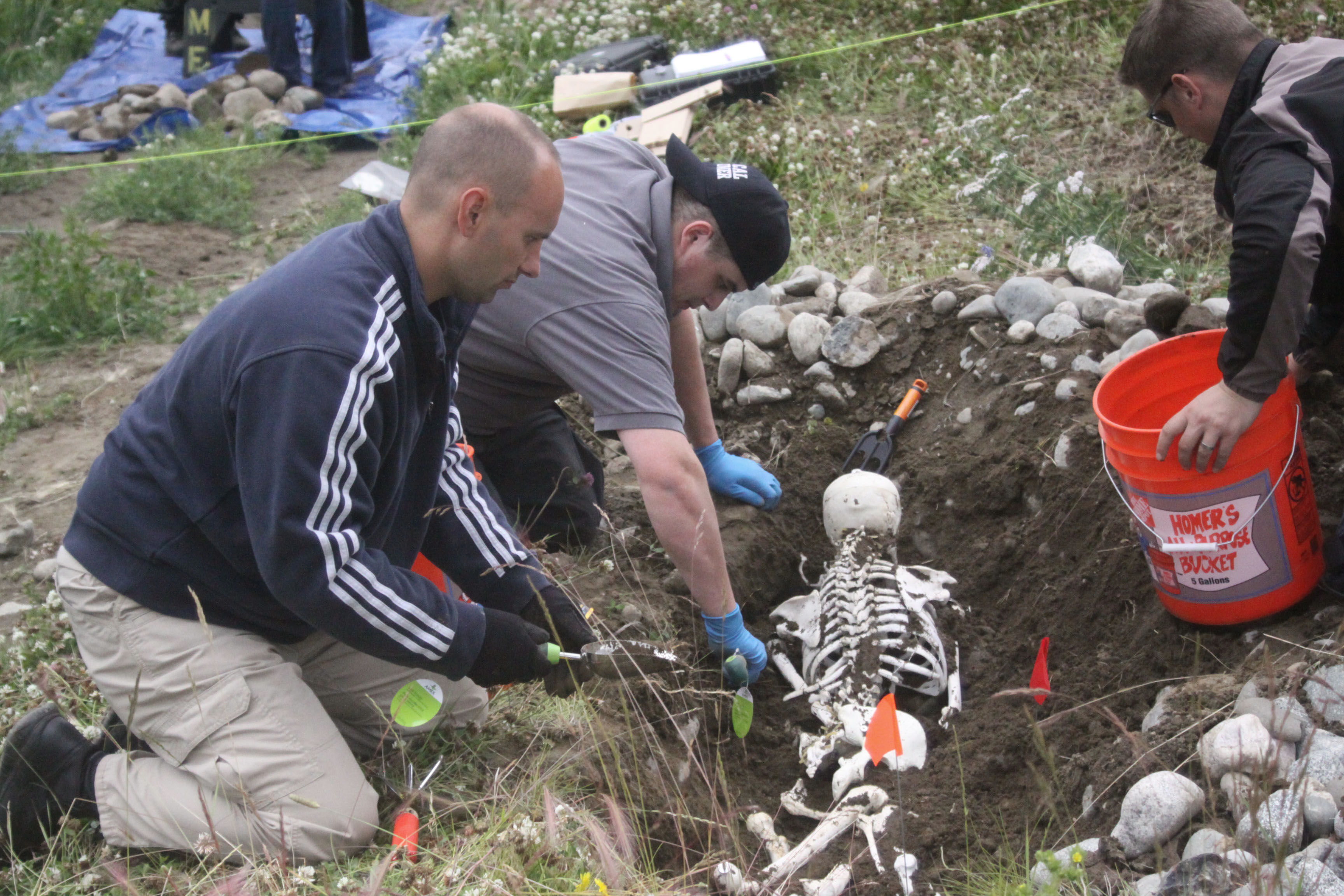
Over by one of the three graves, a body with its hands bound was under a pile of rocks. Two Anchorage cops and a man from the State Medical Examiner’s office slowly removed the dirt around it.
“Cause of death? Screw to the head,” APD detective Mark Huelskoetter joked, indicating the bolt in the top of the skeleton’s skull by which it would hang if it were being used in an anatomy lecture.
“Did you guys find a footprint?” Decker asked.
The men said they had. A couple of them, even.
“Nice job you guys!” Decker said.
Decker said the class had two parts. Monday’s session was a classroom lecture with PowerPoint presentations.
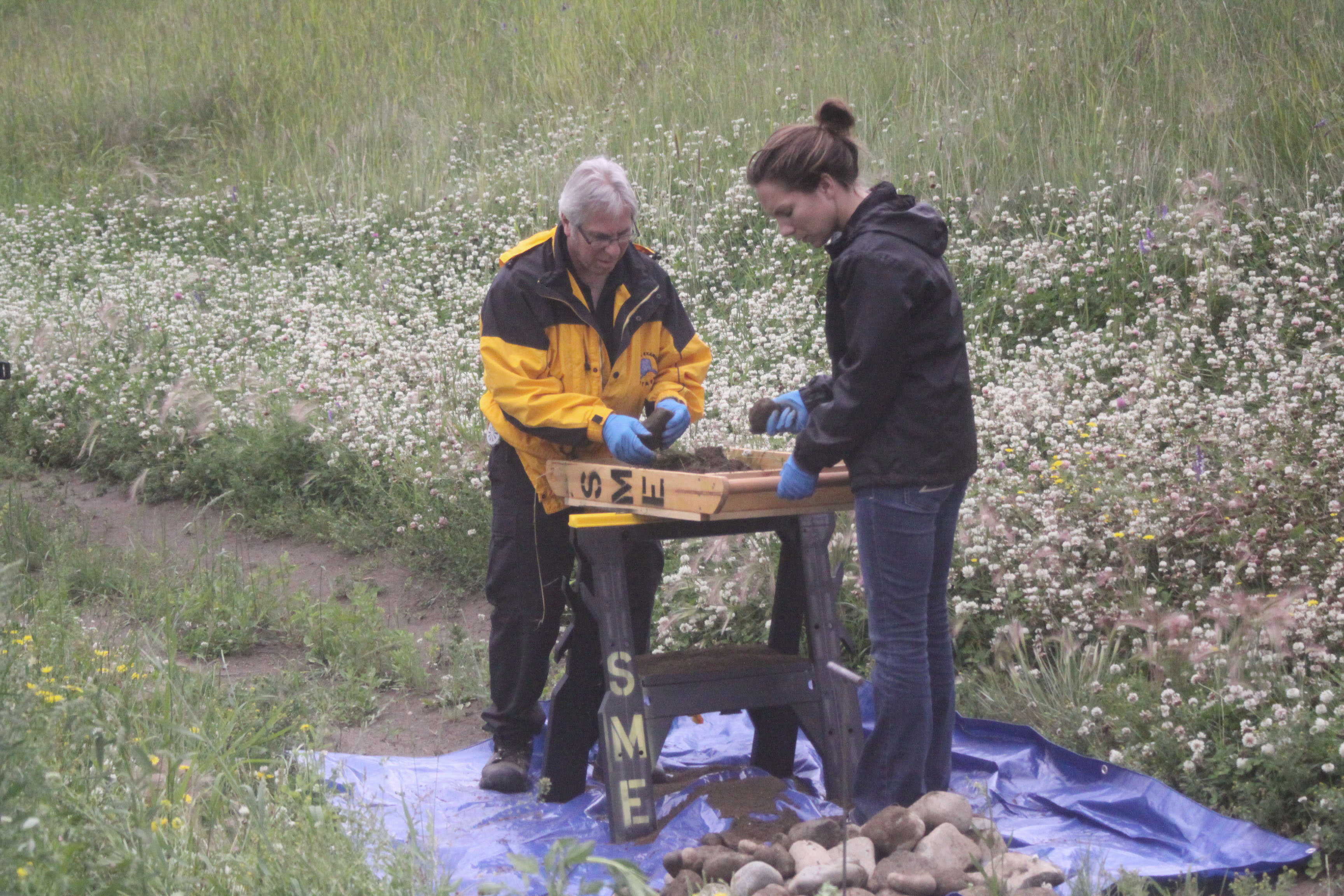
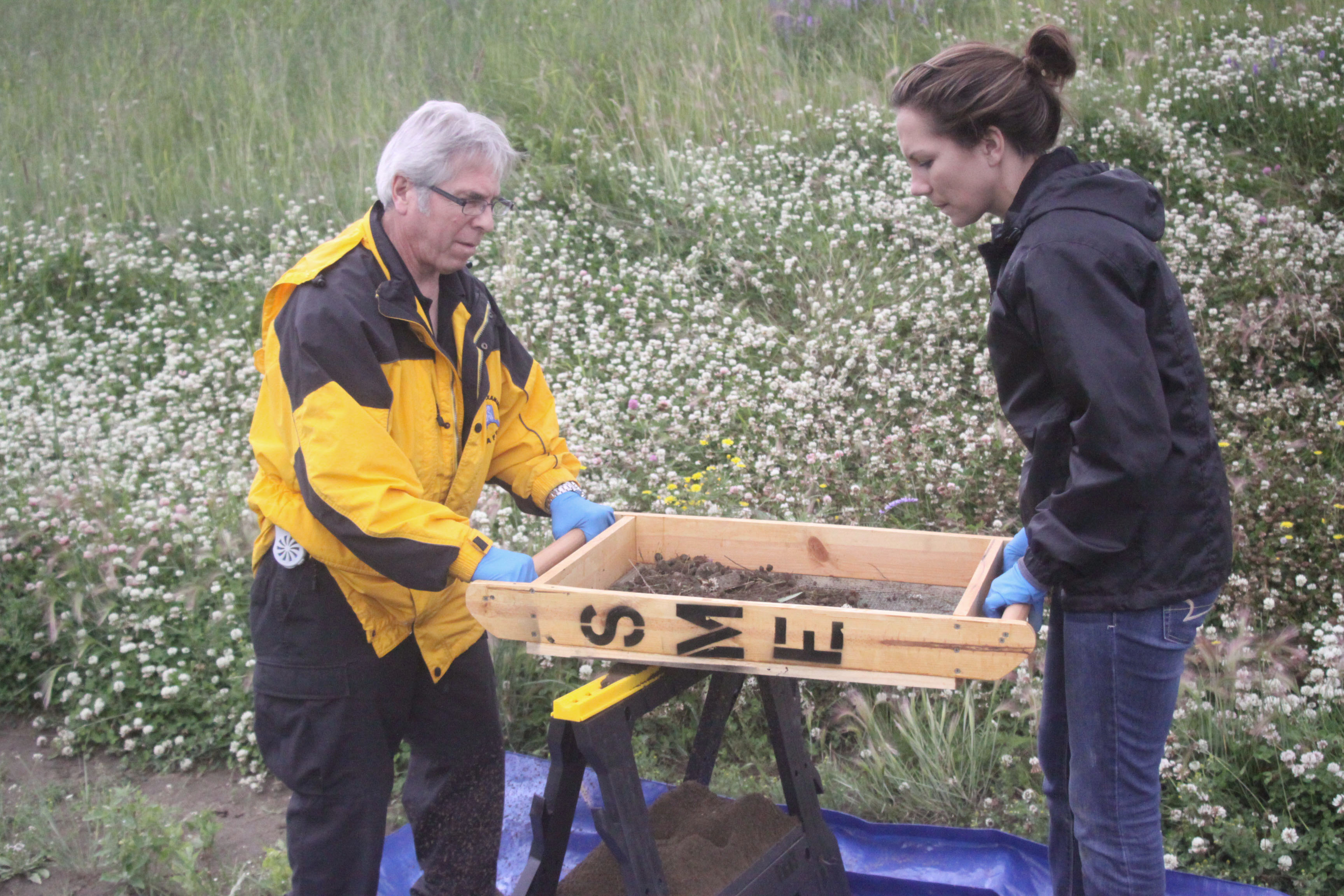
Tuesday was the practical portion. She and her fellow instructors buried the bones, but also smaller things like teeth, buttons, zippers and necklaces. A lot of that won’t be found with trowels and brushes. That’s what the sawhorses and mesh screens are for.
“Screening is part of how they process a scene,” Decker said.
Dirt is removed — always digging horizontally rather than vertically so as not to override tool marks suspects might have left — from the grave bucket by bucket. Each bucket is documented as to which part of the grave it came from. Then it’s sifted through the screen to find small pieces of evidence.
At one sifting station, Bridget Cabrera with the U.S. Army’s Criminal Investigation Division said this was the first time she’d done anything like that. Her sifting partner, Laury Bye, said he’d been on a few body recovery scenes, but this was his first formal training. On previous scenes, he’d take direction from trained colleagues.
Did they find anything?
“A bone chip,” Bye said. “It was a little obscure, but that’s why we sift everything.”
Decker’s King County colleague, forensic anthropologist Kathy Taylor, said it can be pretty time-consuming. But, as a student pointed out, the scene’s not going anywhere.
And, Taylor added, once the gravesite has been disturbed, “You can’t go back.”
She led a brief discussion on what types of things work for landmarks in describing the location of a gravesite.
“If 15 years from now somebody tells you, ‘Yeah, I buried a body right next to this guy,’ you better be able to find that grave,” Taylor said.
Roads work because they’re unlikely to move. Rebar planted by investigators using surveying tools are good, too, though a new housing development would obliterate it. Lamp posts? Probably not. Who’s keeping track of which one is where and whether it’s been moved? But power poles would probably work since utilities keep pretty meticulous records of those.
Taylor said that as an anthropologist, when a body is found in King County she’s usually the one on hands and knees with a trowel. She said she enjoyed teaching this class.
“It’s quite a treat for me because I’m not the one digging,” Taylor said.
The students seemed to be learning quite a bit and moved very quickly through the practical class.
“We’re going to grill them in a second to make sure they didn’t miss anything. Did they go fast because they had an easy grave or because they took shortcuts?” Taylor asked.
Contact reporter Andrew Wellner at andrew.wellner@frontiersman.com or 352-2270.

By Jeremiah Bartz Frontiersman.com A football coach using a hockey reference as the centerpiece for his keynote address may

Frontiersman.com With its headquarters in Wasilla, the Frontiersman has been a primary source of news for the Matanuska-Susitna

By Katie Stavick Frontiersman.com The next generation of leaders took flight this week as the Houston High School Class

By Kyle Wilkinson For the Frontiersman Keynote speaker and Carry the Cure President Bill Pagaran’s words boomed through the