Retiring teacher, coach urges Colony grads to ‘find their 68’
By Jeremiah Bartz Frontiersman.com A football coach using a hockey reference as the centerpiece for his keynote address may


Ask most students what their favorite class is and the likely answer? Lunch. Maybe recess, art, or physical education. Whatever the preferred subject, math is usually low on the list of favorite classes. For most adults too.
It’s a subject that Dr. Randy Trani, the Matanuska Susitna Borough School District (MSBSD) Superintendent is working hard to improve, and it is starting to pay off, but there is still room to improve.
During his Superintendent update at the January 11 MSBSD school board meeting, Dr. Trani presented an update in mathematic achievement, and where he would like the district to go.
“I thought it was really important to talk about math achievement,” he told the board.
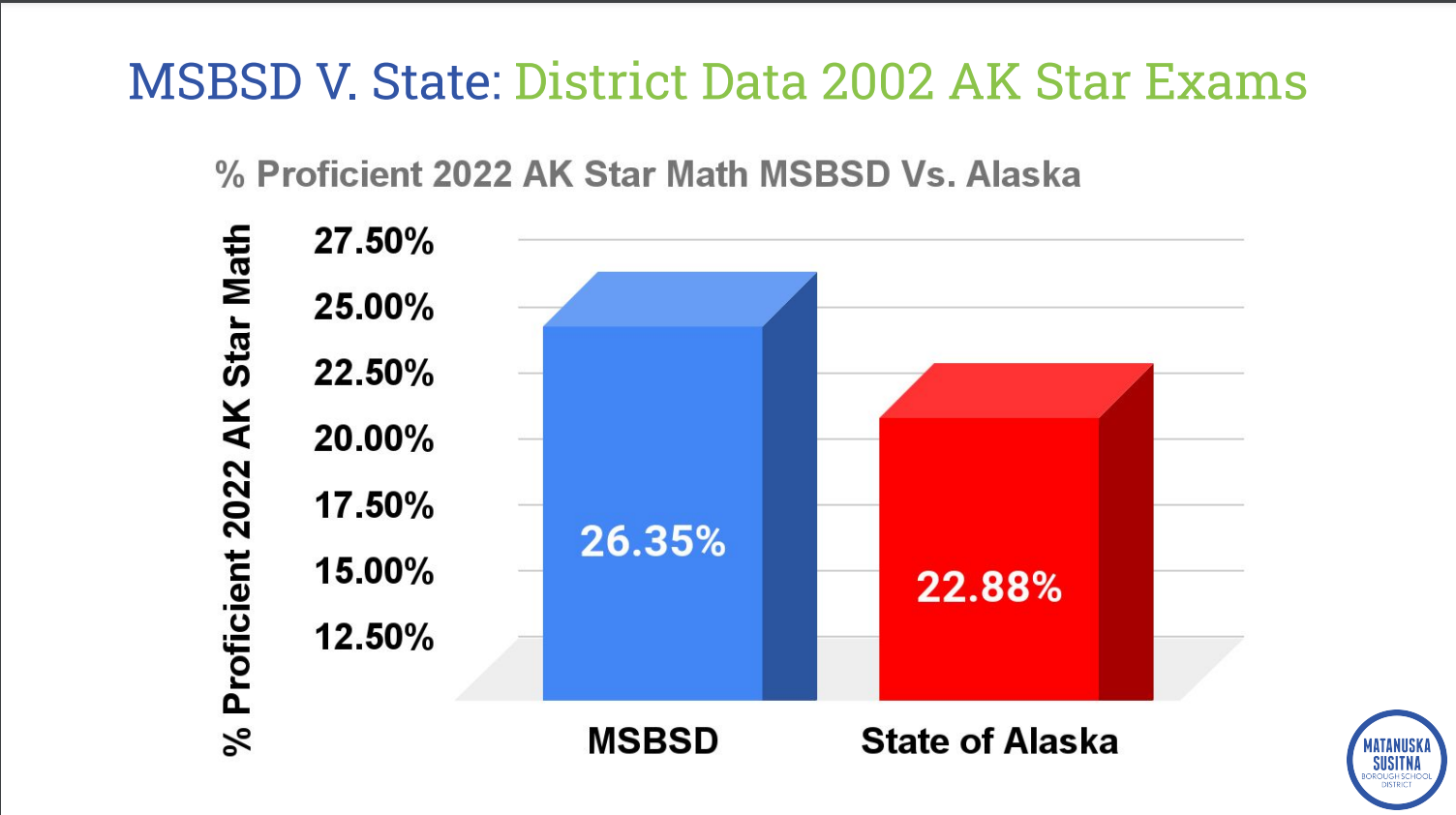
“We got the Alaska STAR data for last spring’s Alaska STAR test for the entire district, and the MSBSD outperformed the entire district, with overall 26.35% math proficiency, compared to the state, which measured 22.88%,” Dr. Trani reported.
“We outperformed the entire state, so that’s a great thing,” Dr. Trani told the board members. But there was also a downside to the numbers.
“You can also see that only 26% of our kids are a little more than proficient at math, which isn’t a great thing.”
Dr. Trani told the board that the Alaska STAR is decidedly harder and more difficult, explaining that one of the reasons the state uses this test is to try and raise math standards across the board.
Alaska's Department of Education and Early Development partnered with NWEA to implement a creative approach to balanced statewide assessment that would better reflect learning throughout the school year and help teachers target instruction to students’ individual needs. Out of that partnership, the Alaska System of Academic Readiness (AK STAR) was designed to streamline the testing experience for grades 3–9 in the areas of English language arts (ELA) and mathematics. This approach connects fall and winter interim assessments and the Alaska spring summative assessment to provide a comprehensive assessment system that work to improve efficiency and cohesion, driving student outcomes by prioritizing teaching and learning.
Dr. Trani would like to see the MSBSD improve in all areas, but specifically targets math, a subject he knows will be a challenge.
“I’m one of the proponents that if you ask kids to jump higher, they will. But it takes time to respond. It takes time for adult behavior to change to get those kids scores up.”
Dr. Trani presented a target pathway for math that includes 6th, 7th, and 8th grade math, Algebra in the 9th grade, Geometry in the 10th, followed by Algebra II in the 11th grade and finally, Pre-Calculus once students reach the 12th grade. He also noted that there are special needs that will need to be met outside of the recommended pathway. There are also advanced math options for students excelling or needing a challenge.
“This would be the general pathway we’d want the kids to get through. Of course, some are going to arrive at Algebra 1 as 7th or 8th graders, and equally, some will take a little longer,” said Dr. Trani.
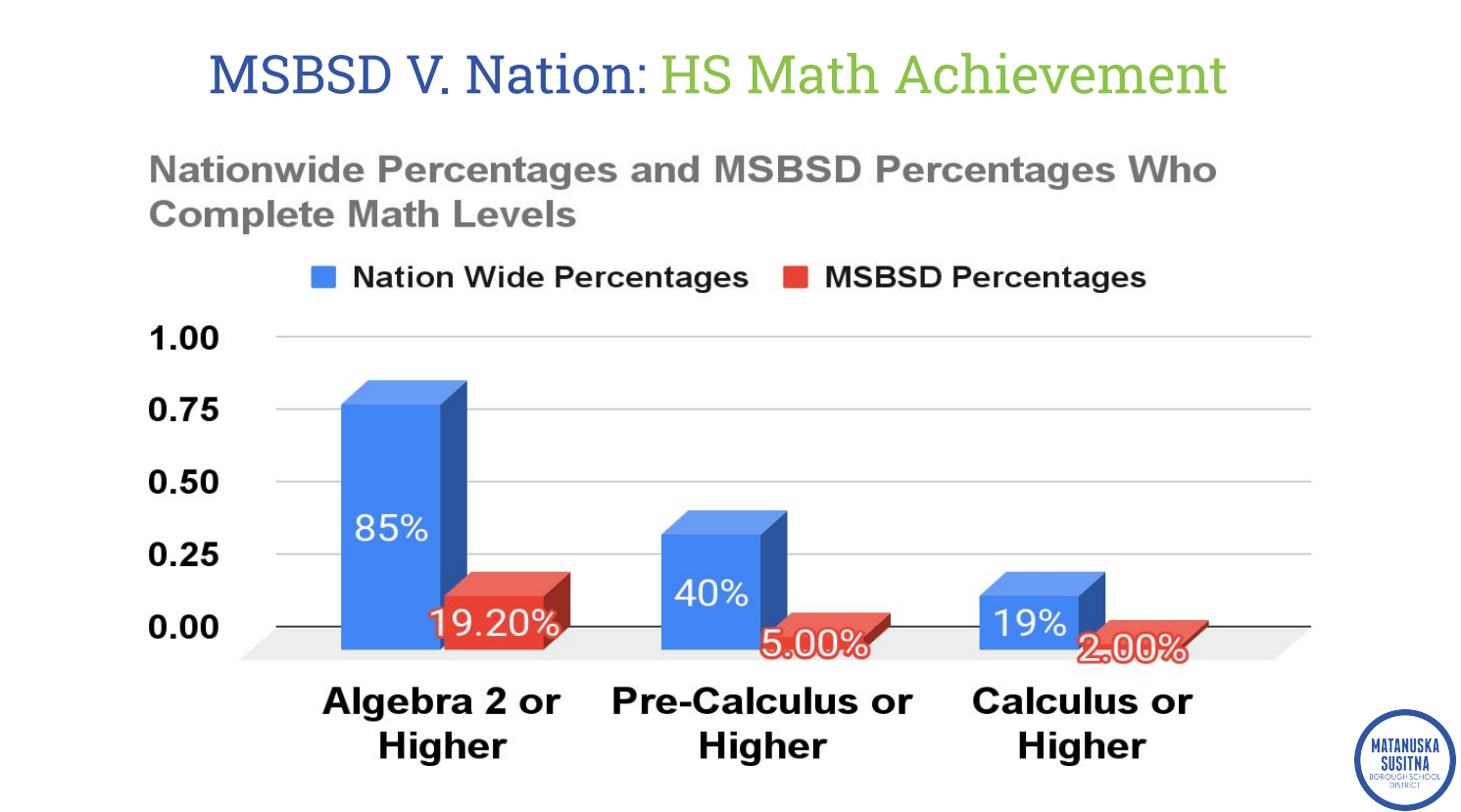
While the district is doing well in the state, Dr. Trani worried about how MSBSD ranks against the national average.
“In the nation, 85% of kids when they have graduated have gotten through Algebra 2 and 40% will go through Pre-Calculus, and 19% are in Calculus,” the superintendent reported, while in the Mat-Su, the percentages are far below the national numbers. For example, only 19% of the graduating students have gone through Algebra 2, 5% through Pre-Calculus, and only 2% get through Calculus.
“We aren’t competing very well.”
Dr. Trani told the school board that changes are needed to get students up to
“So we have to change things. And we are; we are in the middle of a big change movement. It takes a long time to get 19,000 people going in a different direction with 2,000 employees.”
Dr. Trani then went on to present his expected enrollment in the general math pathways classes versus the actual enrollment. Across the board, 1450 students were his expected number at each level, and for the 9th, 10th, and 11th grades, the actual students were at least half of the expectations. For 12th grade Pre-Calculus, the numbers of the actual enrolled students are at 311.
So why the deficiency in math? There is not one specific issue, but rather a multi-faceted K through 12 problem, according to Dr. Trani.
“With the young students, we are very, very grade level. We really restrict you to the grade level you’re in,” he said, adding, “And we shouldn’t be doing grade level work because we’re ahead of that. At MSBSD, we did a really good job of doing the same thing at the same time, after decades of being everyone being hodgepodge, and every school was doing whatever they wanted. Well, we’ve gotten better than that, which is probably why we are doing better than the rest of the state. Now we need to take the next step and let kids move forward.”
One of the possible solutions Dr. Trani presented is compressing 3 years of instruction into 2 years for those students who are ready for it.
Another suggestion, the “soft bigotry of low expectations at the graduation requirement levels,” which translates to the current requirement of 3 years of math to graduate.
“I hinted earlier in September that we might be coming to you asking for a fourth you. I’m re-hinting that that might be coming,” he said.
“High school students don’t look very far into the future in general… they pick the path of least resistance. They come home and say Mom, I’m done with all my math requirements.” This causes concern for Dr. Trani, who worries that students, even students who do well in math lose some of the knowledge and those that do go on to college will take math, some which will be the hardest math they have been exposed to at that point.
“More than 60% of our kids, when they get to college at the University of Alaska, have to take remedial math, because we’ve let our best and brightest off the hook for taking math.”
Dr. Trani also pointed to structural deficiency with regards to core sequence.
“We give them a million choices, and they will take the easiest one,” he said, adamant that students will pick less-challenging coursework that may not be in their best interest. With the desired pathway courses he would like to see, there would be 10 math courses. There are currently 21 math courses offered from 6th grade until graduation.
His belief that kids pick the easy courses leads him to conclude that is why MSBSD is so far behind in math.
Dr. Trani did offer some glimmers of hope, including where 8th graders are as far as taking Algebra. The national average for students enrolled in Algebra is currently 362; MSBSD is nearly there with 305.
“It’s not all the way there, but it’s pretty good.” He is hopeful that those students hold strong, and according to his pathway model, that would put 20% of those students, as seniors, in Calculus.
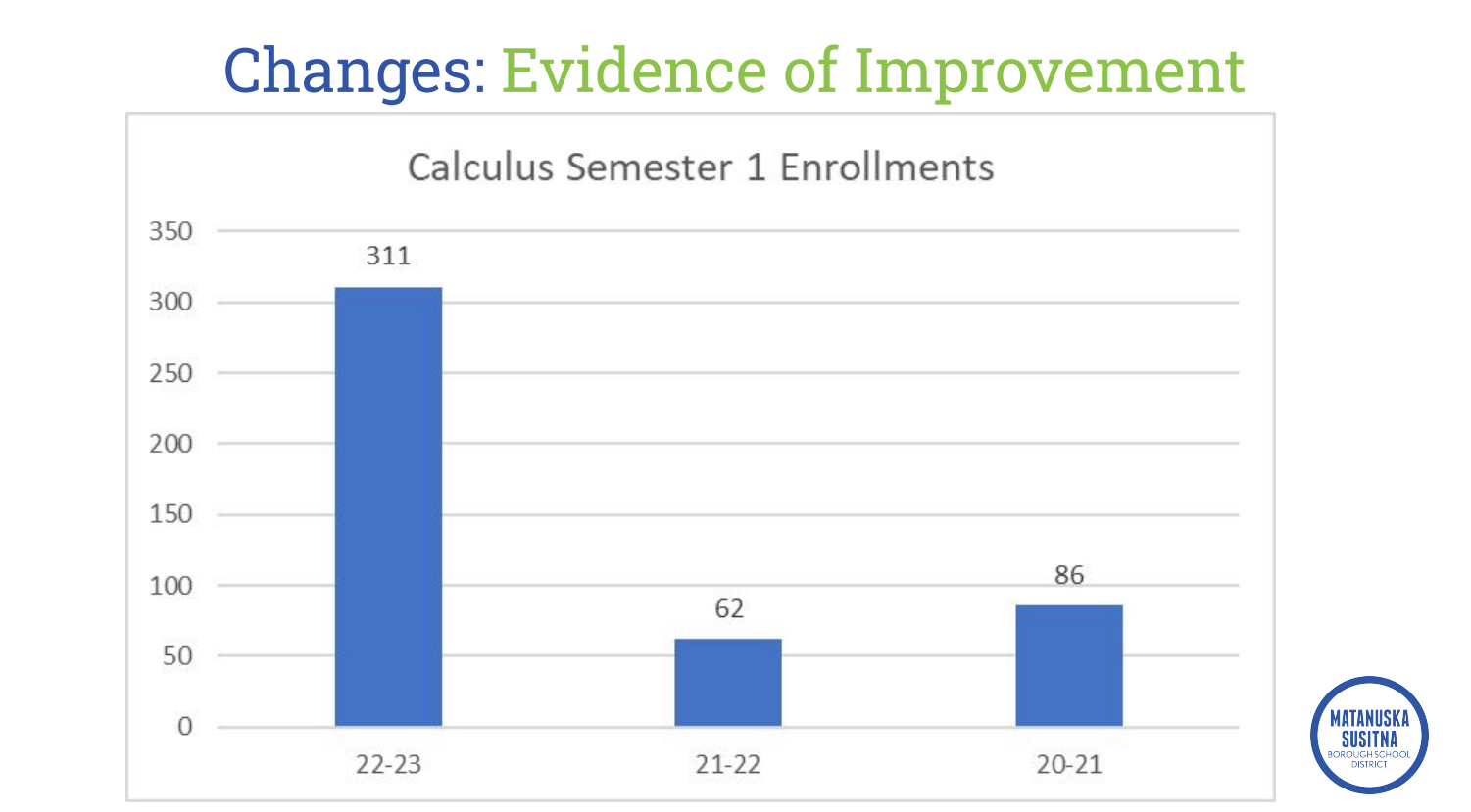
He also showed that Algebra 2 enrollments have also gone up, from 377 two years ago, to 507 enrolled during the first semester of the current school year. And with Calculus, he cited a dramatic improvement in enrollment, from under 100 during the previous 2 school years to 311 students currently enrolled in Calculus.
“This is really counselors and principals who’ve done this. We’ve had adults having really meaningful conversations with college-bound kids, saying ‘dropping out of math your senior year, your easy year, is the worst thing you could do right now.’ And you can see those conversations are having a dramatic effect.”
“I think Alaska kids are better than average, so I’m not going to be happy when we get to the average, but we’re trending in the right direction.”

By Jeremiah Bartz Frontiersman.com A football coach using a hockey reference as the centerpiece for his keynote address may

Frontiersman.com With its headquarters in Wasilla, the Frontiersman has been a primary source of news for the Matanuska-Susitna

By Katie Stavick Frontiersman.com The next generation of leaders took flight this week as the Houston High School Class

By Kyle Wilkinson For the Frontiersman Keynote speaker and Carry the Cure President Bill Pagaran’s words boomed through the