Retiring teacher, coach urges Colony grads to ‘find their 68’
By Jeremiah Bartz Frontiersman.com A football coach using a hockey reference as the centerpiece for his keynote address may


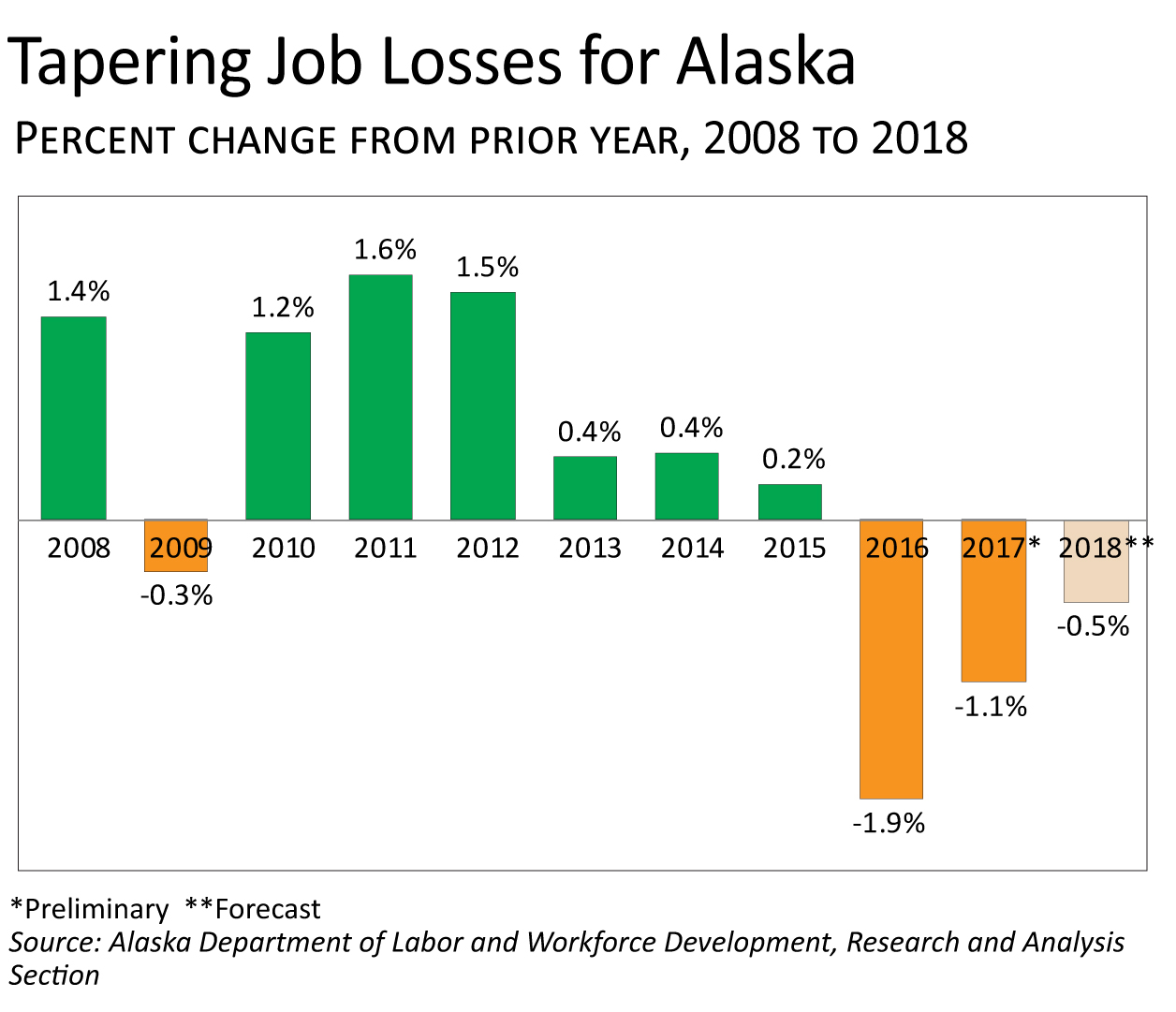
Alaska is expected to lose jobs again in 2018, although the losses appear to be tapering. Total employment is forecast to decline by 0.5 percent in 2018 (-1,800 jobs) falling 1.1 percent in 2017 and 1.9 percent in 2016. Losses were deepest in 2016 when the state’s economy shed 6,300 jobs, primarily in oil and gas and in state government. Then in 2017, Alaska lost an estimated 3,600 jobs. If it hadn’t been for strong health care growth, the overall job loss would have been deeper. If employment follows the forecasted pattern this year, that would put Alaska’s total loss from 2015 through 2018 at 11,700 jobs (-3.5 percent).
One reason statewide losses are slowing is that oil and gas, state government, professional and business services, and construction have already taken significant hits over the last couple of years and their job counts are stabilizing at lower levels. However, the impact from those losses will reverberate into stores, bars and restaurants, and a variety of other employers that depend on consumer, business, and state government spending.
When oil prices plummeted in late 2014, state government was the first to feel the pinch as falling tax revenue from the oil and gas industry decimated state revenues. State government began to cut jobs in early 2015 as pressure mounted to reduce expenses, including its payroll and capital projects. The oil and gas industry was able to maintain record high employment levels through most of 2015, but the losses that came in 2016 were swift and deep.
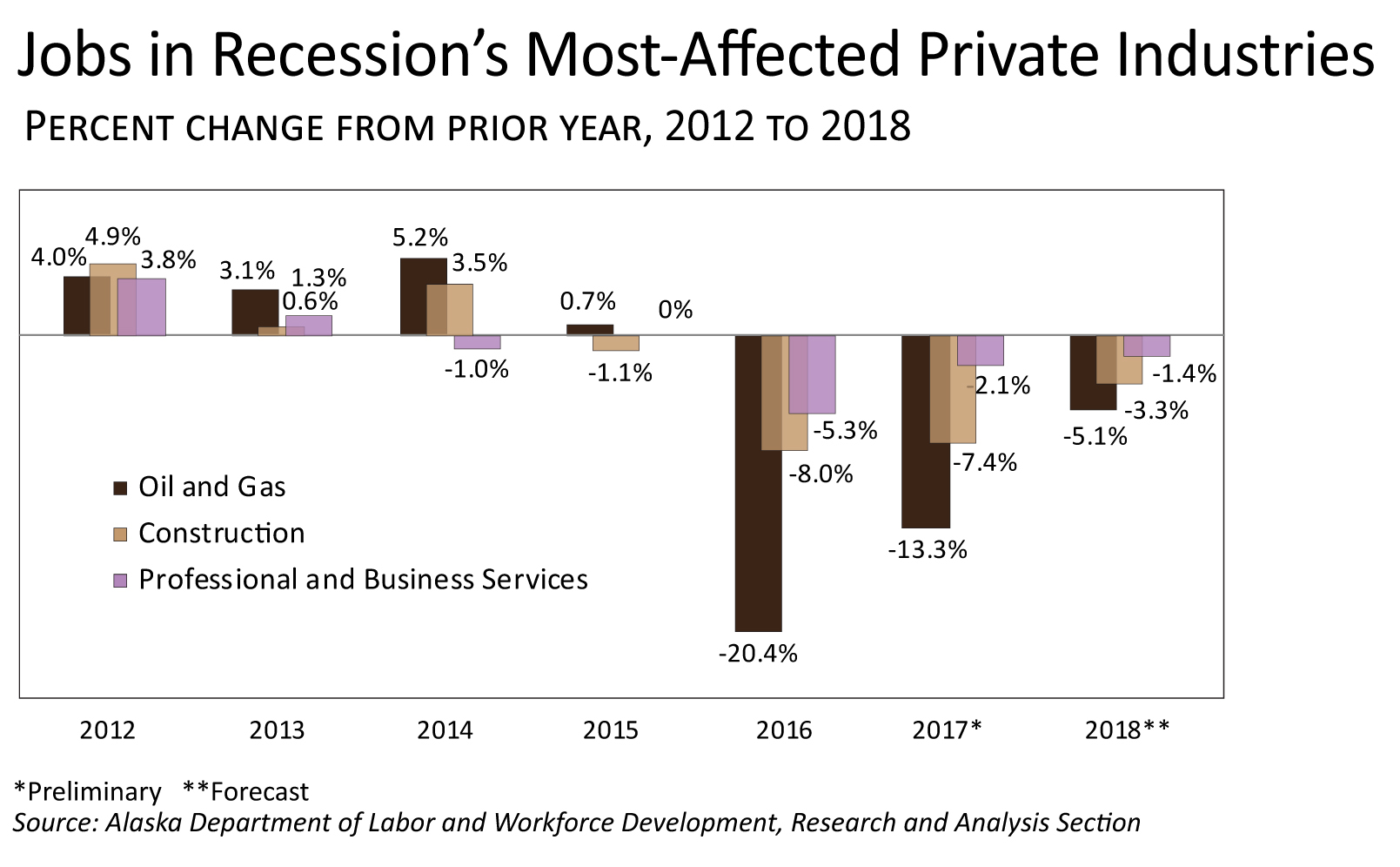
Oil and gas lost a whopping 2,900 jobs in 2016, followed by state government at 1,200 jobs, professional and business services (such as engineering, geological, and architectural firms) at 1,600, and construction on at 1,400. Alaska’s oil and gas industry is expected to lose an additional 500 jobs in 2018. Although the industry is still losing jobs, the pace is nowhere near what it was in 2016. This forecast loss, representing 5.1 percent of the industry’s overall employment, would be a third of what it lost in 2017.
While multiple future projects have been announced, they are longer-term and the employment boost in 2018 from any resulting hires would be minor. State government is likely to lose another 500 jobs in 2018, or 2.1 percent. Like oil and gas, state government declines hit early and hard, with losses of 700 jobs in 2015, 1,200 in 2016, and 800 in 2017. Although there were a handful of layoff s, the bulk of state government job losses were through attrition.
The second wave of job losses came from industries that depend heavily on the first two giants. When the oil and gas industry cut projects, construction on employment began to fall. Similarly, when the state capital budget dropped, the construction on industry absorbed much of the blow. Projects that were already funded continued, but the last couple of capital budgets have been bare bones, which has meant less construction on work.
Construction on losses are forecasted to continue in 2018, at 500 fewer jobs. While losses are tapering, that’s partly because the bulk of the losses have already happened. The construction industry sustained a small decline in 2015 (-200) but was hit with big losses in both 2016 (-1,400) and 2017 (-1,200). The state’s capital budget is down again in fiscal year 2018, and oil and gas-funded construction on projects are unlikely to increase this year. Professional and business services, which is closely tied to construction on and to oil and gas, also suffered from the lack of projects and is forecasted to lose 400 jobs this year (-1.4 percent) due to continuing low demand for engineering, design, and accounting services. The job losses in 2018 will be milder than in previous years, however. While this industry’s employment began to fall in late 2015, the deepest plunge came in 2016 when it lost 1,600 jobs. In 2017, ongoing downward pressure on projects funded by oil and state government reduced demand for services again, leading to a smaller loss of 600 jobs.
Substantial upstream losses eventually reached the industries that depend on local demand and expendable income. Job loss in a local or state economy means less spending, which affects employers such as shopping centers, theaters, nonprofits that depend on donations, and bars and restaurants.
Retail trade, which lost 500 jobs in 2017 and 200 in 2016, is expected to lose another 200 jobs in 2018 as consumers spend more cautiously. Increased visitor spending over the last couple of years has offset some of that reduced local consumption. Areas such as Southeast are particularly sensitive to visitor traffic and would have sustained deeper retail losses without strong tourism seasons. The same factors that hurt retail have also weakened wholesale trade. The wholesale sector doesn’t require as much labor as retail, though, and after two years of small losses, it is forecasted to hold steady in 2018. The information on sector is forecasted to lose 100 jobs in 2018, fewer than in 2017 when it shed 300. This sector includes newspapers, movie theaters, radio and television broadcasting, and cable and Internet providers. In addition to the recession dampening spending, this sector is feeling the squeeze of technology-driven changes to how they provide services. Online streaming is cutting into demand for cable television, newspapers are available online, and with online content frequently free, some companies face declining subscription on and ad revenue. The leisure and hospitality sector encompasses accommodation and food services as well as arts, entertainment, and recreation.
Demand for these services comes from both locals and visitors. Visitor spending has mostly buoyed this sector, and it grew slightly in 2016 and then held steady in 2017. A minor loss of 100 jobs is forecasted for this year.
Some industries have remained relatively unscathed by the state recession. Manufacturing employment in Alaska is about 70 percent seafood processing, with the balance in breweries, bakeries, and manufacturers of wood products, boats, printers, cement makers, and petroleum and coal products. While some of these rely on local demand, outside forces such as commodity prices and national or international demand are larger industry drivers. Seafood processing depends on the size of yearly catches and seafood prices, and almost all of the final products are exported. Health care growth has been robust for the last three decades and stronger than expected in recent years due to the increased health care needs of the state’s aging population, Medicaid expansion, and broader health insurance coverage. Health care employment increased by 2,900 from 2015 through 2017 and the industry is forecasted to add an additional 700 jobs in 2018. With increased coverage comes increased demand for and access to medical services. Medicaid and the Children’s Health Insurance Program, or CHIP, have expanded coverage by 60 percent under the Affordable Care Act, providing insurance for an additional 73,600 Alaskans, according to the Henry J. Kaiser Family Foundation. The financial sector, which was decimated during the 1980s recession, has remained stable during the current contraction. In the 1980s, an overheated housing market and the resulting foreclosures hit the financial sector hard — but foreclosures have remained at historic lows. Employment has been stable for three years and is expected to continue that trend in 2018. Local government employment, which includes tribal government and public schools, has grown by small amounts throughout the recession. Its funding comes from a variety of sources including property taxes, sales taxes, and state and federal appropriations. Although local government grew by 300 jobs in 2017, state financial constraints will likely lead to the loss of about 100 jobs in 2018. Federal government, the smallest piece of Alaska’s government sector, shed 100 jobs in 2017 after gaining 300 the year before. Federal employment is forecasted to remain flat in 2018, as no indicators of change are on the horizon and the next federal budget is uncertain. The big challenge this year While job losses will almost certainly continue in 2018, some industries that have been losing jobs appear set to resume adding them later in the year. Alaska has been able to absorb some of the initial blow of low oil prices by spending from its savings, but that’s a short-term solution. A longer-term fix that will balance the state’s spending with revenues is still pending, and that creates uncertainty and hinders growth.
Karinne Wiebold is an economist in Juneau. Reach her at (907) 465-6039 or karinne.wiebold@alaska.gov.

By Jeremiah Bartz Frontiersman.com A football coach using a hockey reference as the centerpiece for his keynote address may

Frontiersman.com With its headquarters in Wasilla, the Frontiersman has been a primary source of news for the Matanuska-Susitna

By Katie Stavick Frontiersman.com The next generation of leaders took flight this week as the Houston High School Class

By Kyle Wilkinson For the Frontiersman Keynote speaker and Carry the Cure President Bill Pagaran’s words boomed through the