Retiring teacher, coach urges Colony grads to ‘find their 68’
By Jeremiah Bartz Frontiersman.com A football coach using a hockey reference as the centerpiece for his keynote address may


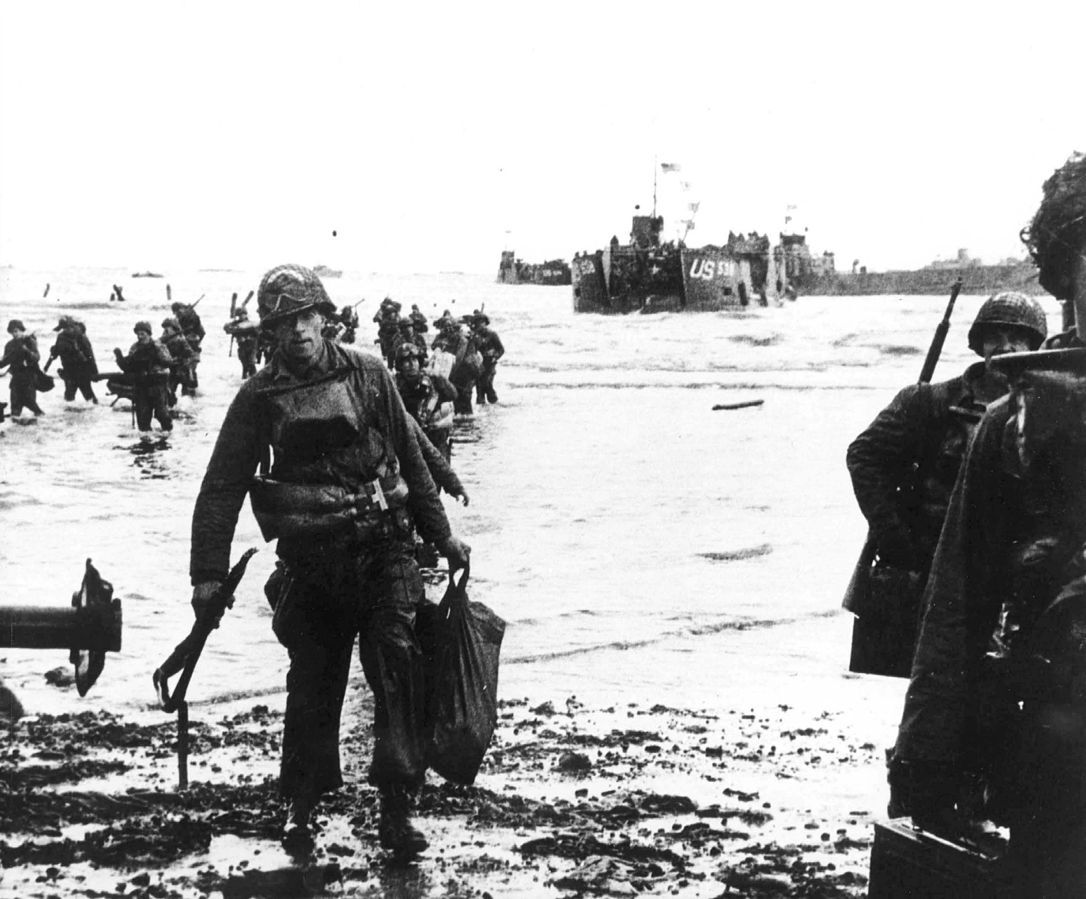
June 6, 2024 marked the 80th anniversary of the Allied invasion of Normandy, France.
The invasion, also called the D-Day invasion, brought together the land, air, and sea forces of the armies of the United States, Canada, and the British Commonwealth in what became known as the largest amphibious invasion in military history.
D-Day cemented its place in history as one the most ambitious and consequential military campaigns in human history. In its strategy and scope—and its enormous stakes for the future of the free world—historians regard it among the greatest military achievements ever, helping to bring about an end to World War II.
Leading up to the invasion, Germany had invaded and occupied northwestern France beginning in May 1940. The Americans entered the war in December 1941, and by 1942 they and the British (who had been evacuated from the beaches of Dunkirk in May 1940 after being cut off by the Germans in the Battle of France) were considering the possibility of a major Allied invasion across the English Channel.
After almost five years of war, nearly all of Western Europe was occupied by German troops or held by fascist governments, like those of Spain and Italy. The Western Allies’ goal: to put an end to the Germany army and, by extension, to topple Adolf Hitler’s barbarous Nazi regime.
Leading up to the invasion, victory was not guaranteed. British Prime Minister Winston Churchill had pleaded with Command Allied General Dwight D. Eisenhower and President Franklin Roosevelt for two years before D-Day to avoid Normandy and instead pursue a slower, less dangerous strategy, putting more troops into Italy and southern France.
However, the Germans had killed tens of millions of civilians and soldiers in the Soviet Union, and the Soviets desperately wanted the Allies to bleed the Germany army by opening up a second front of battle.
The Allies had long planned the invasion for a narrow window in the lunar cycle that would provide both maximum moonlight to illuminate landing places for gliders—and low tides at dawn to reveal the German’s extensive underwater coastal defenses. Poor weather forced Allied troops to delay the operation a day, cutting into that window. But in a stroke of luck, German forecasters predicted that gale-force winds and rough seas would deter the invasion even longer, so the Nazis redeployed some of their forces away from the coast.
On the night before the invasion, General Eisenhower penciled himself an “In case of failure” note, to be published if necessary: “If any blame or fault attaches to the attempt, it is mine alone,” he wrote.
General Eisenhower ordered hundreds of thousands of American, British, Canadian and other troops to ship across the English Channel and come ashore on the beaches of Normandy, on France’s northern coast. Code-named Operation Overlord, it was launched on June 6, 1944, with nearly 156,000 Allied soldiers on the beaches of Normandy by the end of the day.
Allied forces delivered five naval assault divisions to the beaches of Normandy, France. The beaches were given the code names UTAH, OMAHA, GOLD, JUNO, and SWORD. The invasion force included 7,000 ships and landing craft manned by over 195,000 naval personnel from eight allied countries.
German machine-gunners mowed down hundreds of Allied soldiers before they ever got off the landing boats onto the Normandy beaches. But General Eisenhower overwhelmed them with 160,000 assault troops, 12,000 aircraft and 200,000 sailors manning 7,000 sea vessels. The Americans lost 8,230 of the total.
While the “D” in D-Day means simply “Day,” as in “The day we invade,” to those who survived June 6, and the subsequent summer-long incursion, D-Day meant sheer terror. The invasion lasted weeks, and by June 30, over 850,000 men, 148,000 vehicles, and 570,000 tons of supplies had landed on the Normandy shores. Fighting by the brave soldiers, sailors, and airmen of the allied forces western front, and Russian forces on the eastern front, led to the defeat of German Nazi forces. On May 7, 1945, German General Alfred Jodl signed an unconditional surrender at Reims, France.

By Jeremiah Bartz Frontiersman.com A football coach using a hockey reference as the centerpiece for his keynote address may

Frontiersman.com With its headquarters in Wasilla, the Frontiersman has been a primary source of news for the Matanuska-Susitna

By Katie Stavick Frontiersman.com The next generation of leaders took flight this week as the Houston High School Class

By Kyle Wilkinson For the Frontiersman Keynote speaker and Carry the Cure President Bill Pagaran’s words boomed through the