Retiring teacher, coach urges Colony grads to ‘find their 68’
By Jeremiah Bartz Frontiersman.com A football coach using a hockey reference as the centerpiece for his keynote address may


PALMER — What do you use to wash a sheep?
Woolite, of course.
Secrets of animal washing are just one of the many things students pick up in 4-H, a program that ranks among the most iconic of any state’s fair. Among the numerous activities, amusements, rides, and venders at the Alaska State Fair, the 4-H animal judging competition is perhaps the “fair-est.” It lacks the high-profile celebrity glitz and dynastic drama of the cabbage weigh-in. However, for the students involved, it’s the culmination or continuation of a months- or potentially years-long effort at an education stretching beyond simply feeding and watering animals to economics, small business, public speaking, mathematics and biology.
Kristen Beams — one of the animal-happy Beams sisters — is a good example. She’s hoping her pig, “Momma,” will take home a ribbon at the showmanship and conformation judging this weekend.
Ribbon-winners generally garner more money on the hoof at the auction. Ultimately, though, the goal is educational, not financial – though some animals can and do bring in hundreds of dollars. The rumor is that one pig once garnered $12 per pound on the hoof at the fair, though 4-H participants agreed that might be an urban legend. The highest confirmed price for the Beams sisters knew of was $10 per pound for a grand champion porker.
This year’s Jr. Market Livestock Auction will be held in the Farm Exhibits building on Saturday, September 5 at noon.
While some people might be tempted to use bacon to go to Bermuda, Kristen and her sisters – Aria, Carlie-Mae, and Lindsey round out the foursome – a lot of the money is already budgeted.
“We have a process at the end where we put all our money in the middle, and we first pay off our parents, and then we pay our tithing for our church, which just goes back and helps pay for churches and stuff, and then we pay for our project next year, and then we set aside money for savings and college, and then we have some money for spending, but my mom obviously encourages us for saving,” she said. “I think overall it’s a great experience to know how to raise animals, but also knowing how to have an income on something. It’s like junior businessing.”
For Kristen, the idea is to educate the public at large as much as it is to gain practical experience.
“What we do in 4-H is we get the animal and we raise it for the best quality that we can get, so we can show people around the community where the meat actually comes from,” she said.
The educational component of 4-H extends beyond raising animals. Members are required to display their animals, speak publicly, calculate food ratios and memorize anatomy. During judging, points can be removed from their score if they can’t answer questions in the display ring. While 4-H pushes students beyond the pen, Kristen sees 4-H as a hook into her future plans, which don’t necessarily include becoming a farmer.
“I like gardening with my family, I like eating stuff out of the garden, but I like the whole anatomy part of it because I want to be a forensic scientist,” she said. “I think part of 4-H is helping me gain experience and learning about different parts and raising something and determining if something’s successful. I think that that will help me in the future, because it will help me seek something I need to do and follow through.”
The program is as much about educating the public as it is about her own plans, Kristen said.
“What we do in 4-H is we get the animal and we raise it for the best quality that we can get, so we can show people around the community where the meat actually comes from,” she said.
The program also teaches participants to deal with the loss of animals who have, in some cases, bonded with their owners. The animals sold at auction Sept. 5 generally go to slaughter. Later, children will view the bodies of their animals hanging in a meat freezer at McKinley Meats.
“It’s pretty sad,” Kristen said. “I get really emotional at the end. But I know we gave them the best life possible, to run around outside, and to give them quality food, and that’s better than being crammed up in a big huge pig barn where they don’t see people for their whole life.”
For example, sheep are generally viewed for meat or breeding. Carlie-Mae, Kristen’s younger sister, has just two sheep now but hopes to eventually raise her own flock.
“Last year at the auction, a veteranarian bought my sheep and then donated her back to me so that I could start a breeding project,” she said. “I bred her, and she had a baby, and her baby’s name is Lindy-Mae. So after I sell Lindy-Mae this year, I’m going to breed her (Lindy-Mae’s mother, Melinda Mae) and then next year she’ll hopefully have two or three little ones, and then I’ll be able to keep some and then sell one, and then over the years I’ll breed more and more of the sheep that I keep, so I’ll be able to have a whole sheep flock and it’ll be so cool.”
The ultimate plan is to have a self-sustaining flock and enough animals to sell them to future 4-H members, Carlie-Mae said. Pigs don’t earn as much as sheep, but they’re cheaper to produce. It’s a path pioneered by previous members of 4-H, some of whom have sold prize-winning sheep to younger students.
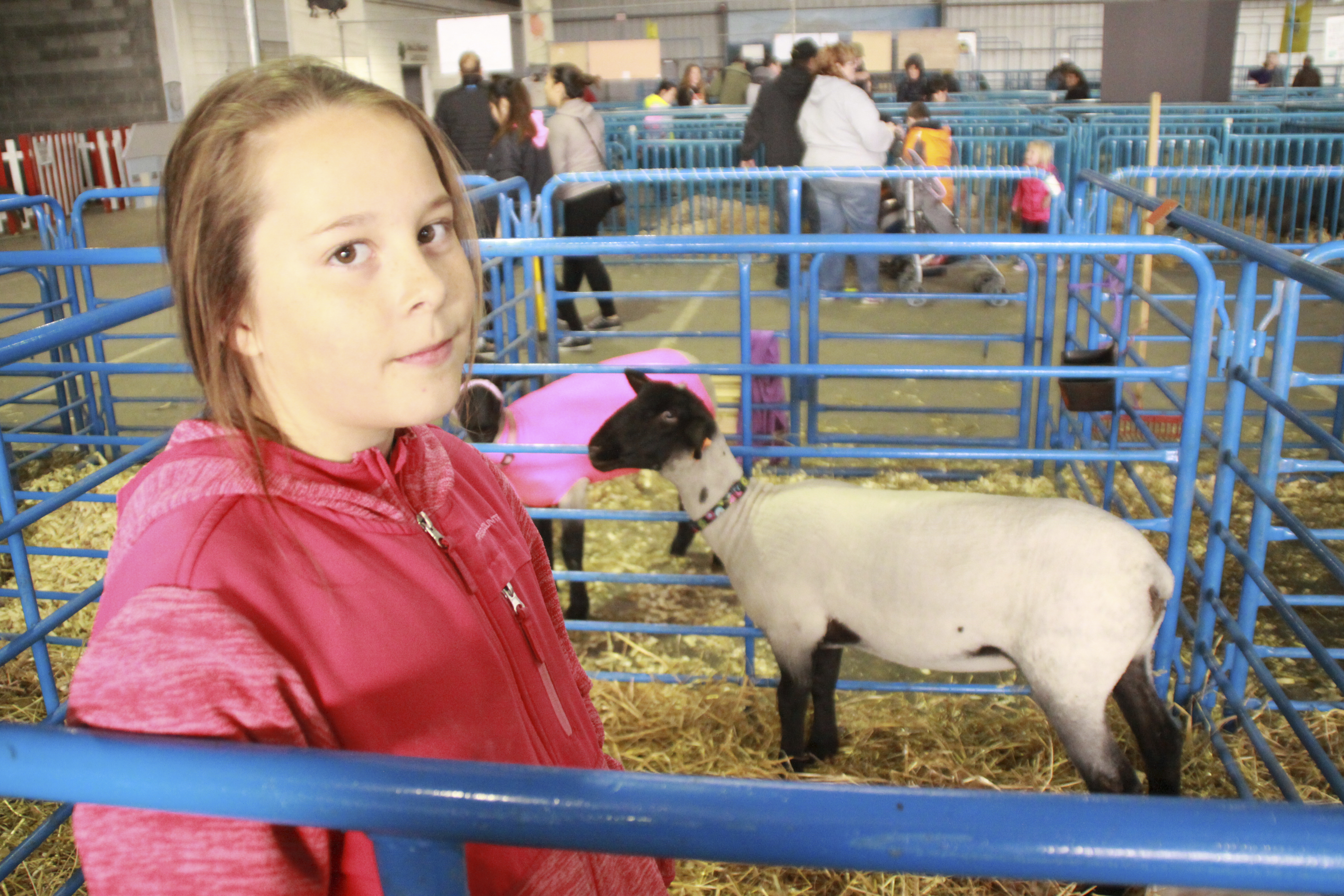
Numerous sheep, some of them wearing dazzling Valley-made Lycra “sheep socks” made from discarded ballet tights mill around blue pens on the floor of the animal exhibit. Each animal on the floor undergoes a distinctive beauty regime to ready for showmanship judging, which brings us to the Woolite.
Maria Beck hauls her cow Oscar out of his pen, and over a metal grate (Oscar is visibly upset and pulls at his halter when they get to the grate, though he is ultimately coaxed over it) and out to the animal washing station in the back of the display barn. She takes the Woolite and carefully rubs it over Oscar’s white legs, particularly dirt patches where he’s lain on the pen. Then she rinses him off with a hose and leads him to a small metal pen off to one side, where she uses a livestock dryer – which looks a little like a leaf blower – to dry him off. In the next metal pen over, a black steer is getting a once-over with a large buzz clipper.
Beck — who also has sheep in the show — runs Oscar through his washing regime twice per day. Each time, she gets together a few people to help warn the crowd there’s a cow coming.
She and Kristen Beams are usually distraught when they say goodbye. Oscar will be among those animals judged a second time after death.
“We always cry together,” she said. “It’s so much fun, though. Around three weeks after they’re slaughtered, we go and see them and their carcass and everything, and it’s actually really fun. Sometimes they’ll place better at the slaughterhouse.”

By Jeremiah Bartz Frontiersman.com A football coach using a hockey reference as the centerpiece for his keynote address may

Frontiersman.com With its headquarters in Wasilla, the Frontiersman has been a primary source of news for the Matanuska-Susitna

By Katie Stavick Frontiersman.com The next generation of leaders took flight this week as the Houston High School Class

By Kyle Wilkinson For the Frontiersman Keynote speaker and Carry the Cure President Bill Pagaran’s words boomed through the