Retiring teacher, coach urges Colony grads to ‘find their 68’
By Jeremiah Bartz Frontiersman.com A football coach using a hockey reference as the centerpiece for his keynote address may


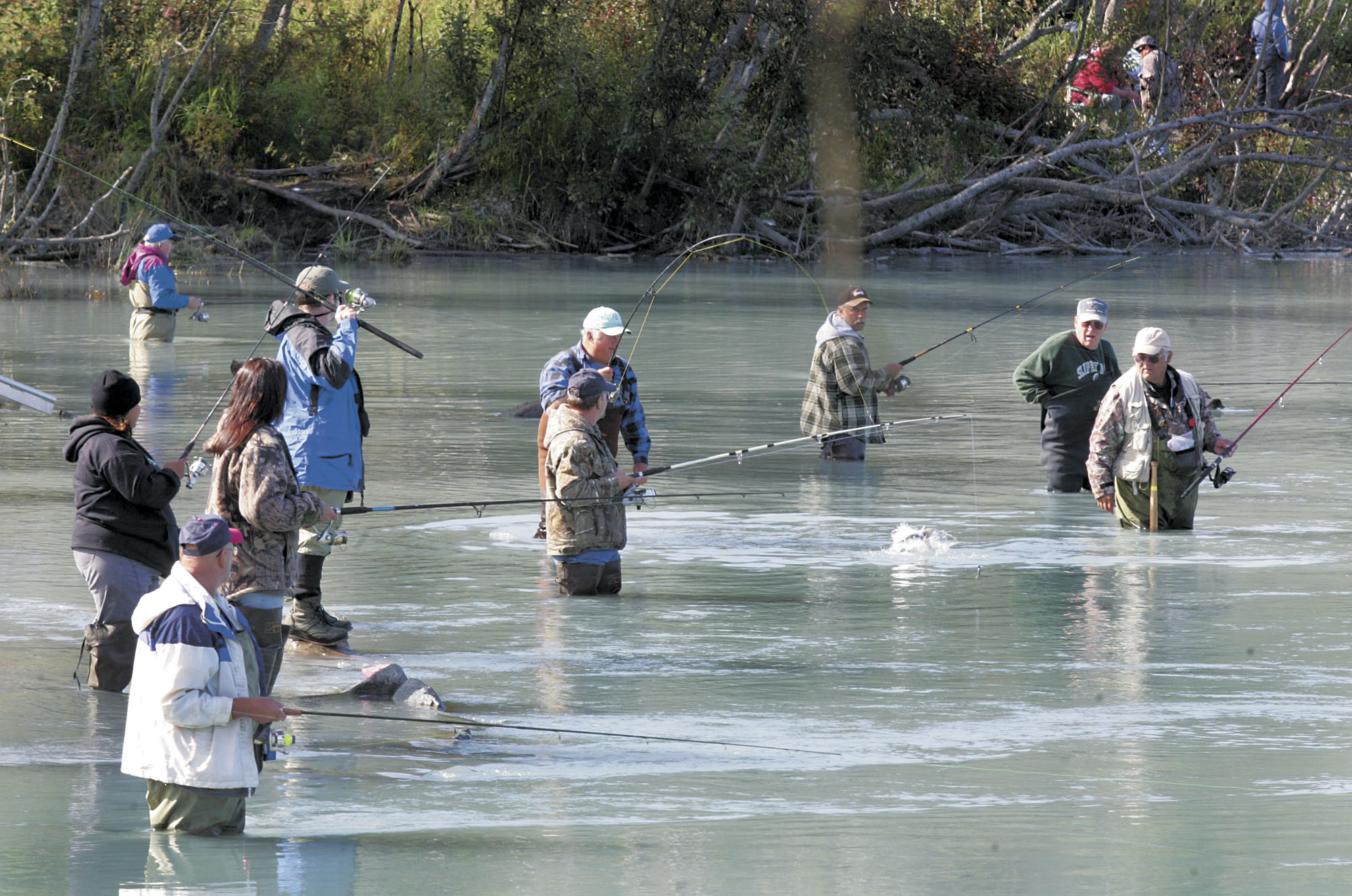
MAT-SU — An effort to significantly curtail the harvest of king salmon in the Cook Inlet area has prompted early sport fishing restrictions from the state Department of Fish and Game.
For resident and visiting sport fishers in the Valley, the emergency orders — issued Thursday to go into effect May 15 — reduce the annual limit of kings taken from local waters from five to two, along with a laundry list of other restrictions.
“This is something we’ve been working on throughout the winter,” said Sam Ivey, Mat-Su area management biologist for the Division of Sport Fish, about what he’s calling a “conservative approach” to managing this year’s king salmon returns.
“We tried to develop a comprehensive strategy to deal with the downturn in king salmon we’ve been seeing specifically in our area,” he said. “We want a strategy to provide as much opportunity in our area as possible, while trying to achieve as many escapement goals as possible.”
Poor escapement numbers of kings in the Susitna and Little Susitna river drainages over recent years has prompted several emergency orders to deal with the low returns, including harvest limits and closing the season early in 2012.
“To give you and idea (of how kings have been faring locally), we have 17 (escapement) goals in the Northern Cook Inlet,” Ivey said. “Prior to the downturn, we’d achieve 93 percent of those goals on average for the five years preceding the downturn in 2007. Since 2007, we’ve achieved a little under half, on average, about 41 percent. That’s area-wide.”
Along with limiting harvest to two kings for the season, which runs through July 13, Thursday’s emergency orders place the following restrictions on area river drainages:
• Although the limit of kings from the fresh waters of Cook Inlet remains at five, no more than two may be taken in combination from the Susitna River and Little Susitna River drainages. Kings taken before May 15 also count against the two-king limit.
• Only one unbaited single-hook artificial lure is allowed in the drainages, including the Deshka River.
• Harvest in Unit 4 is restricted to Fridays, Saturdays, Sundays and Mondays, with catch-and-release only allowed Tuesdays, Wednesdays and Thursdays. Harvest is still allowed seven days a week on the Deshka, but bait is not allowed.
• Taking kings in Unit 1 (except the Deshka River), on Parks Highway streams within Unit 2, the upper Susitna (Unit 3), Talachulina River (Unit 4), Talkeetna River (Unit 5) and Chulitna River (Unit 6). For these areas, catch-and-release fishing only is allowed during days and times normally open to king salmon fishing.
• King harvest in the Little Susitna River is allowed only on Saturdays, Sundays and Mondays. Only catch-and-release is permitted on other days.
• The Eklutna Tailrace is excluded for all restrictions.
Coming off a 2012 season that saw significant restrictions on area river drainages, Thursday’s move by Fish and Game is a disappointing way to start this season, but not unexpected, said Mike Hudson, owner of 3 Rivers Fly and Tackle in Wasilla.
“I’ve been watching a steady decline in the salmon return numbers for about the last six years,” Hudson said. “I kind of saw this coming. At the end of the day, there’s a lot of blue sky out there and I think there are some problems. You look at the king salmon fishery, the entire West Cost, it’s been falling for awhile.”
For local business and charter owners that cater to the sport fishing industry, the prospect of another lean season is something most are willing to accept to protect the resource, Hudson said.
“It’s going to be tough on us, there’s no doubt about that,” he said. “However, it’s the department being proactive on forecasting some weak salmon returns. By the department going ahead and putting some restrictions in early will also help reinforce the need for the commercial industry to carry some of that fishing restrictions as well.”
By acting now, state officials hope being conservative will allow the season to proceed without closures, Ivey said.
“Overall, the annual limit reduction means different things for different areas,” he said. “We need more than just an annual limit reduction by itself. That’s why we have more stringent cuts to harvest in certain areas.”
Along with allowing only single hooks and various catch-and-release schedules, the two-king limit is expected to reduce the harvest in the Little Su drainage by about 80 percent, Ivey said.
“That’s the comprehensive strategy we want,” he said. “Some systems are more prone to overharvest and we’re making those catch-and-release only.”
For the Little Susitna River, “we’re looking for around a 75 percent reduction in harvest on that river alone, and that’s about what we had last year when we put restrictions in early, then closed the river. The main thing is to provide opportunity — whatever that may be — through the whole season through July 13,” Ivey said. “What impacts most users out there is if we have to close down a whole season.”
Another below-average sport fishing season isn’t what Deshka Landing ordered, but if that’s what it takes to help protect kings in the drainage, that’s what he supports, said Joseph Wright, president of the Deshka Landing Board of Directors.
The restrictions “just confirms what I had an idea was coming,” he said Thursday. “When it comes to restrictions, we’ve got to protect the fishery and it’s a crisis. I’m rather pleased they restricted the bait on the Deshka, that’s a good move. … It’s a conservative approach. … I firmly believe the fishery should be closed to bait until you know what the escapement is going to be. If you have a poor escapement, it’s too late (by that time) to do anything about it.”
For Hudson, the last five or six years of lean king returns is indicative of a more wider-reaching problem. It’s not just that kings aren’t passing local weirs, it’s that they’re not making it back to Alaska waters in the first place, he said.
Pollock fishing along the West Coast is catching thousands of kings in its nets.
“Being an astronomically huge industry — because pollock is basically a cod and it’s a global thing and a big money maker — it’s hard to regulate those fishermen,” he said.
One study Hudson said he saw found that the pollock harvest was catching up to 150,000 kings.
“That’s a lot of fish,” he said. “The problem isn’t just in the Upper Cook Inlet. If you look at the bigger picture, it’s the entire West Coast.”
Until there’s more comprehensive data showing what is causing the poor return of salmon to local rivers and streams, the sport fishing industry will be hurting, Hudson said.
“It’s tough, and it’s not just me this affects,” he said. “People cancel trips and they won’t go. They won’t pay guides and spend a lot of money to come up here and not be able to take fish home. It’s a huge ripple effect. There are millions of dollars spent across this state, and in particularly this roadside fishery, that just goes away.”
In the end, Hudson said he’s concerned about the future of the fishery, one he calls unique in all the world.
“You can’t go anywhere else in the world that you can fly into an international airport, rent a car, drive 45 minutes and fish for five species of wild salmon,” he said. “It’s that unique.”
Contact reporter Greg Johnson at greg.johnson@frontiersman.com or 352-2269.

By Kyle Wilkinson Kyle in the outside Our spring bear hunt was bittersweet this year. We’re heading home without

Frontiersman.com Valley athletes earned titles during the Region III Championships track and field meet last week at Colony High

Leila Petersen Palmer Moose Leila Petersen, a member of the Palmer track and field team, has been named a Frontiersman

By Jeremiah Bartz J’s World August would have been the start of my 25th year as an editor at