Retiring teacher, coach urges Colony grads to ‘find their 68’
By Jeremiah Bartz Frontiersman.com A football coach using a hockey reference as the centerpiece for his keynote address may


CAITLIN SKVORC/Frontiersman.com
PALMER — Palmer High School finally has a Japanese language program, and for the next two years will enjoy a special partnership with Japan.
Although the City of Palmer has had a sister city in Saroma, Japan for 36 years — and an active sister city organization, Palmer Saroma Kai, for the last five — the local high school has never had a fully-fledged Japanese language program. The school has offered Japanese classes in years past, but never for more than a couple years at a time.
Palmer High School Assistant Principal Paul Reid said part of that has to do with enrollment, which (in addition to state funding) dictates how many teaching positions a school can offer. Because Palmer was able to add one this year, and the core subjects were covered well enough, the school decided to reserve that new slot for a Japanese teacher.
Reid said the decision was also based on “enriching” the school’s International Baccalaureate (IB) program with a third foreign language, in addition to the Spanish and French classes already offered. Though Palmer is only offering Japanese I this year, Reid said the administration and faculty expect to see it advance to the IB level as student interest develops further — which should happen fairly quickly, he said, given who’s teaching the class.
After 19 years of teaching at Wasilla High, Palmer High alumna Carla Swick is “coming home,” she said, to grow a Japanese program in her hometown.
“It was a hard decision, ’cause I loved Wasilla High … (but) I really want to see what we do here go beyond the classroom and really tie it into the sister city (program),” Swick said in her new classroom last week.
Though Wasilla got its own Japanese sister city, Uchiko, last summer, the Palmer sister city relationship is much more developed, and relevant to Swick as a Palmer resident and president of Palmer Saroma Kai.
“It was just a perfect fit,” Reid said.
Reid added that it wasn’t the school’s intention of “stealing” Swick away from the thriving Japanese program she started at Wasilla — they were both glad to see new teacher Alicia Tweet pick up where Swick left off.
The only “casualty” of Swick’s departure, she said, was that the Wasilla program was cut down from four levels of Japanese to two levels, though she expects it will be built back up in a couple years.
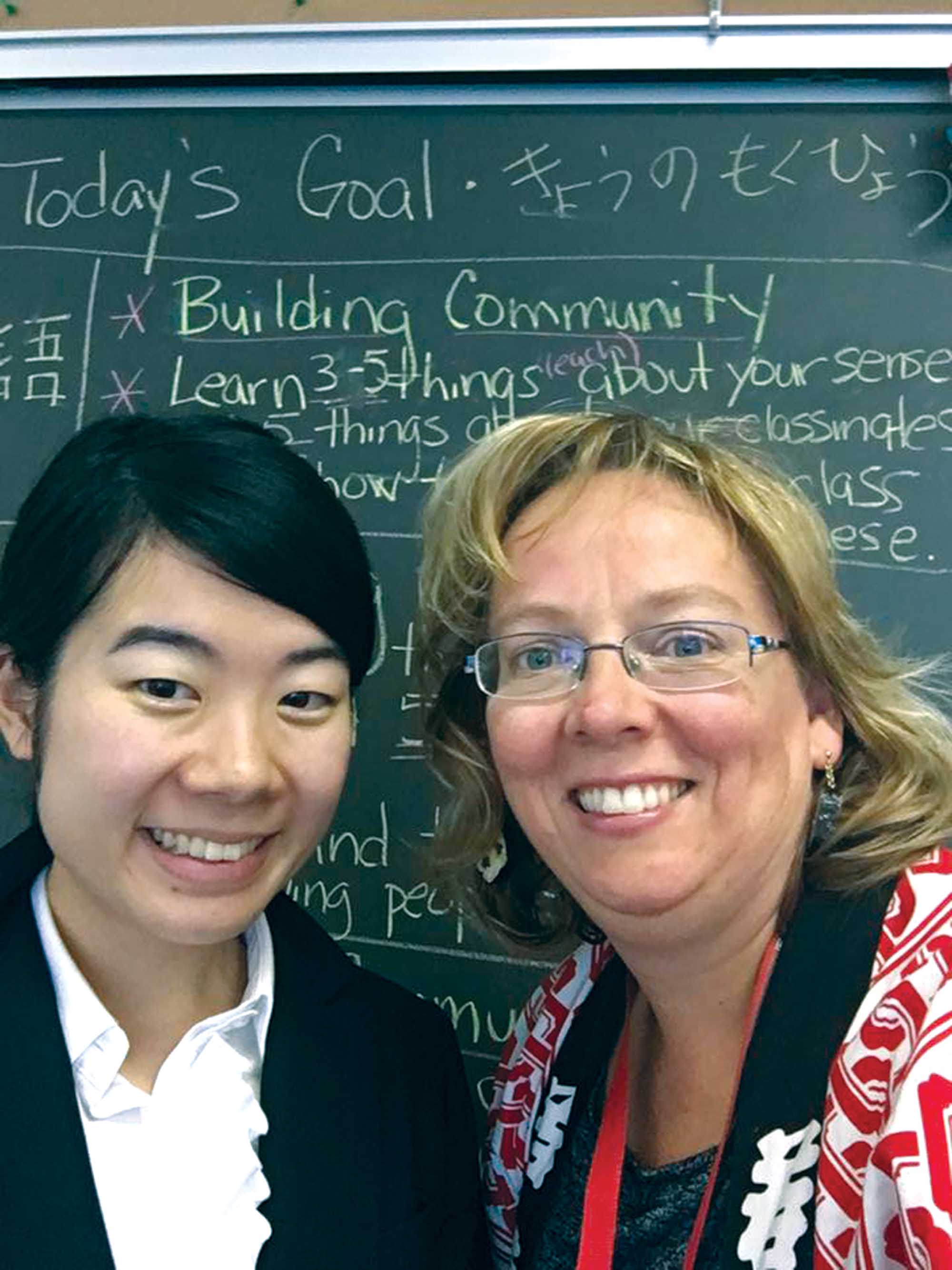
In addition to starting Palmer’s Japanese program, Swick was recently awarded the rare opportunity of being able to team-teach with a young teacher from Japan for the next one to two years.
As a successful applicant of the Japanese Language Education Assistant Program (J-LEAP), Swick was partnered late this summer with Miharu Hayazaki, a native of Shiga prefecture and 2016 graduate of Nagoya University of Foreign Studies.
According to the J-LEAP website, the program grew out of a 2010 conversation between former Prime Minister Naoto Kan and President Barack Obama, during which the national leaders determined a need for enhanced mutual understanding and increased international exchange between the U.S. and Japan.
Only about a dozen teachers from each country are selected each year. Each U.S. host school receives a $1,000 grant for teaching materials and Japan-related activities in the local community, plus professional development credit for the host teacher.
Hayazaki’s stay with Sherrod teacher and Palmer-Saroma Kai treasurer Tanya Lang is completely covered by The Japan Foundation and supported by the Laurasian Institution, the program administrators.
Swick said the program came highly recommended from a fellow educator in Anchorage.
“She said, ‘this is the best professional development I have ever done in my entire career. Yes it’s a lot of work, but the payoff for you and your students is huge,’” Swick recalled.
In the U.S., the application process involves essays, videos, unit planning and interviews with program administrators, packed into just a few weeks. In Japan, Hayazaki said applicants were also require to do interviews, as well as write essays in English and Japanese.
Hayazaki said coming to teach Japanese in the U.S. has been a big dream of hers for some time.
“I am so happy to be here,” she said.
When Hayazaki applied for J-LEAP, she had hoped to be placed somewhere warm — similar to Georgia, where she studied abroad as a student, and home. Three other applicants were hoping for Alaska, but only she was selected to brave The Last Frontier.
She attempted an appeal, but administrators told her it wasn’t so much the location that mattered to them in the partnerships — it was the people.
“(They said) personality is more important than anything,” Hayazaki said.
“It’s like a marriage — what two are gonna work together,” Swick added.
Now that she’s been in Alaska for a few weeks and the people of Palmer, Hayazaki said she feels much more comfortable.
“I love Alaska so much, so far,” Hayazaki said, still a little leery of the coming winter.
But there are still some American customs, she said, that take some getting used to.
At the end of her first week at Palmer High, Hayazaki made a list of her top 10 bikkuri, or surprises, regarding American culture in Alaska’s schools and homes. The list included comments on meals, laundry, the lack of school uniforms and students and staff behaviors.
Hayazaki was shocked, for example, when Palmer’s top administrators — all male — made pancakes for the rest of the staff one morning the week before school started.
“In Japan, generally, men (don’t) cook, especially (a) principal,” she said. “They usually just sit and the women will serve green tea or something.”
Hayazaki said she liked the Alaskan way.
“I feel like, so welcome, I feel so good and I love this system so much,” she said.
This semester, Swick and Hayazaki are teaching three Japanese I classes, plus one “outreach” period at the end of the school day every day except Tuesday. During this period, Swick and Hayazaki will work in other classrooms at Palmer High, Palmer Junior Middle and Swanson and Sherrod elementary schools, as well as out in the community to spread awareness about the language, culture and sister city program.
Swick said she hopes to host free community classes on various aspects of Japanese culture, in addition to her work in the classroom with Hayazaki. Hayazaki said she might like to start a culture club at Palmer High also, or help expand the current anime club to encompass a broader range of Japanese interests.
For more information about J-LEAP, visit www.laurasian.org/jleap/
Contact Carla Swick at carla.swick@matsuk12.us.
Contact reporter Caitlin Skvorc at 352-2266 or caitlin.skvorc@frontiersman.com.
CORRECTION: This story has been corrected to reflect that Carla Swick taught at Wasilla High for 19 years, not 20, and that Palmer High has offered Japanese classes in the past. The spelling of Paul Reid's last name has also been corrected.

By Jeremiah Bartz Frontiersman.com A football coach using a hockey reference as the centerpiece for his keynote address may

Frontiersman.com With its headquarters in Wasilla, the Frontiersman has been a primary source of news for the Matanuska-Susitna

By Katie Stavick Frontiersman.com The next generation of leaders took flight this week as the Houston High School Class

By Kyle Wilkinson For the Frontiersman Keynote speaker and Carry the Cure President Bill Pagaran’s words boomed through the