Retiring teacher, coach urges Colony grads to ‘find their 68’
By Jeremiah Bartz Frontiersman.com A football coach using a hockey reference as the centerpiece for his keynote address may


Since the recent presidential election, Republicans have a solid hold on all branches of the federal government, and will maintain it until at least the 2018 midterm congressional elections.
Concurrently, the G.O.P. has a stranglehold on half of the states’ governments. An article in the New York Times last week pointed out, “Republicans have top-to-bottom control in 25 states now, holding both the governorship and the entire legislature, and Republican lawmakers are acting with lightning speed to enact longstanding conservative priorities.”
But that’s not the case in red-state Alaska, or the Municipality of Anchorage.
Former Republican Bill Walker won the governorship in 2014 by leaving the party and running on a “unity ticket” backed by the Democrats, who didn’t put up a candidate, resulting in the defeat of incumbent Governor Sean Parnell.
In 2015, Ethan Berkowitz, a former Democratic representative in the state house, succeeded termed-out conservative Dan Sullivan as Anchorage’s mayor in a commanding victory over conservative Assemblywoman Amy Demboski. The next year, Anchorage voters endorsed Berkowitz’s liberal administration and cemented a progressive-leaning municipal government by electing a liberal majority to the Anchorage Assembly.
Even in Alaska’s House of Representatives, where Democrats only hold 17 of 40 seats, a coalition with two independents and three Republicans has given moderates and progressives a majority, putting conservatives in the minority in that body for the first time in more than 20 years.
Also, Alaska voters legalized recreational marijuana.
A tectonic political shift to the middle—if not to the left—in the state that gave Sarah Palin to the country only nine years ago? It seems so.
But why? “I think the effective stewardship of governance by socially progressive, fiscally responsible officials has created more opportunity for similarly minded people in parts of Anchorage that, previously, were less inclined to consider candidates of that background,” says Patrick Flynn, the rational progressive assemblyman for downtown Anchorage who’s termed out after 9 years and will be replaced in the April 4 municipal election.
Downtown is the only district of Anchorage represented by a single assembly member, while the other five have two. And the downtown district—which encompasses Fairview, Mountain View, Government Hill and South Addition—has been reliably liberal for decades (a counterpoint to the Eagle River/Chugiak district, where conservatives are deeply entrenched).
Allan Tesche, a progressive firebrand who also served the max three three-year terms allowed by municipal charter, preceded Flynn. Before Tesche, Alaska Dispatch News columnist Charles Wohlforth, also a lefty, held the seat for the six years prior to Tesche’s election.
Though having a liberal downtown assembly member won’t be a new phenomenon, the current ideological makeup of the assembly along with the progressive Berkowitz administration will theoretically allow Flynn’s successor a degree of cooperation and influence that certainly wasn’t possible just three years ago when conservative budget-slasher Dan Sullivan was entering the last year of his reign as mayor.
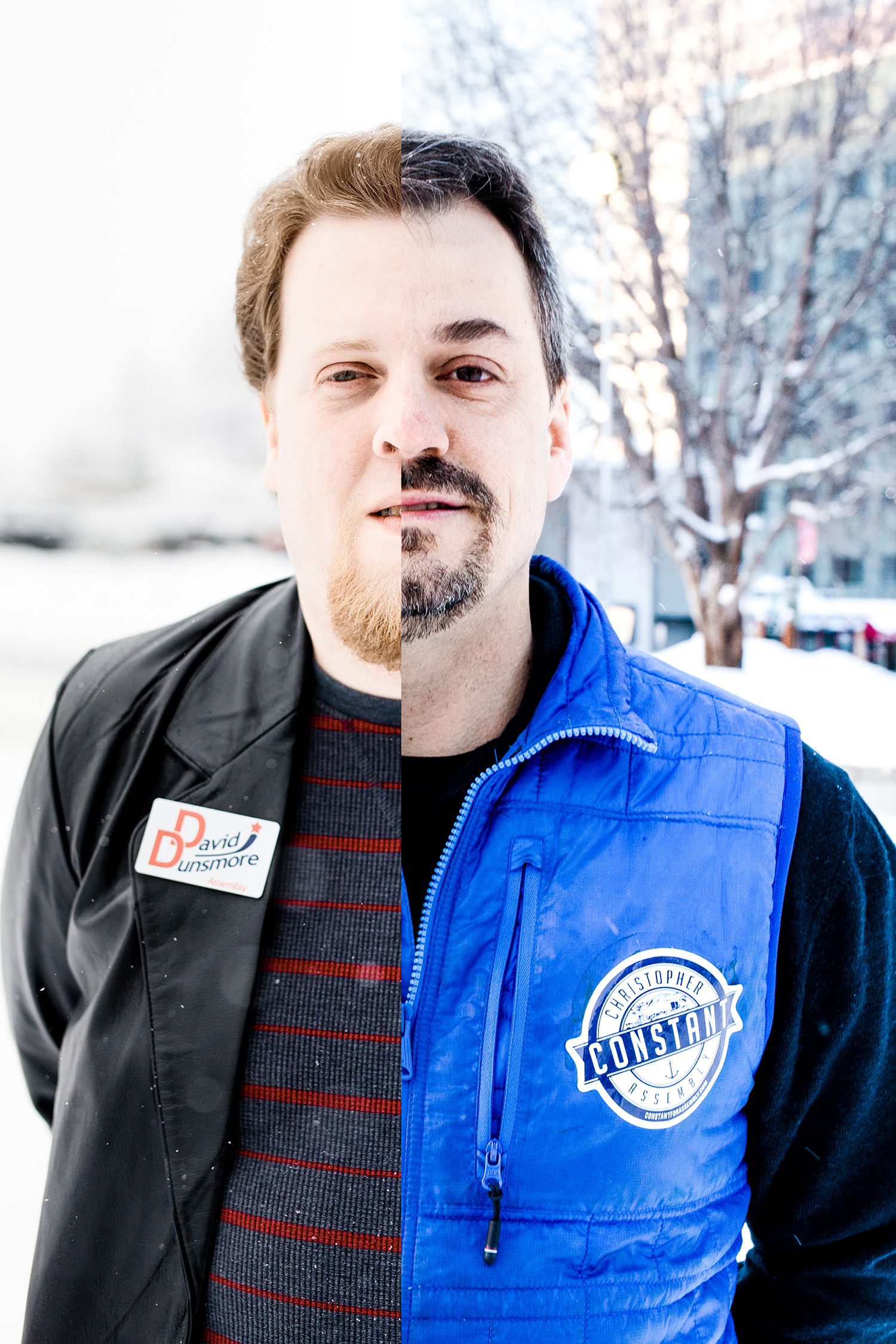
There are six candidates who will appear on the ballot for the downtown assembly seat in April. But only two of them have the bona fides and fundraising apparatuses to win. With somewhat insincere apologies to Mark Martinson, Albert Swank Jr., Warren West and Chris Cox, the four candidates not covered in this article, meet the two progressive candidates with an actual shot at becoming downtown’s next representative on the Anchorage Assembly.
***
David Dunsmore first ran for office at age 18 in 2003, attempting to become mayor of Anchorage on the same ballot as then-Assemblyman (and future U.S. Senator) Mark Begich. Begich prevailed, of course, ousting incumbent George Wuerch and beating out former Mayor Rick Mystrom as well. Dunsmore received 488 votes, 0.77 percent of the vote.
Dunsmore wasn’t deterred by the loss though, and Begich appointed him to Anchorage’s Health and Human Services Commission. Dunsmore calls it “a really great intro into seeing how politics works,” and after two terms on the commission, he put his name on the ballot again in 2008 for a school board seat.
Again, Dunsmore didn’t win, but he found more success, earning 3,475 votes, for 9.54 percent of the total. His ambition didn’t go unnoticed. Democrat Pete Petersen—currently an East Anchorage Assemblyman, who’ll also be on the April ballot defending his seat—tapped Dunsmore to manage his successful 2008 campaign for state house. “It turned out great,” Dunsmore says of his failed school board run.
Dunsmore accompanied Petersen to Juneau to serve as his chief of staff for two terms, then worked for a legislative session as caucus director for the Alaska Democratic Party. Dunsmore’s connection to the party runs deep—he was a point man for the 2013 effort to repeal SB 21, the hated-by-liberals oil tax restructuring that eliminated progressivity and increased incentives for production by oil companies.
He established a reputation as a behind-the-scenes operative in state Democratic politics, managing both local and state campaigns (he managed Petersen’s 2014 run for assembly and Fairbanks Representative Adam Wool’s state house campaign, after which he served as Wool’s chief of staff in Juneau).
Dunsmore is not the most eloquent orator, but seems to grasp complex policy details and definitely knows his way around Alaska political campaigns. So why put his name on the ballot when he’s found considerable success out of public view?
“I gave a lot of thought to whether I should run or not and I decided there are a lot of issues I want to work on,” he says. “For the downtown seat, because we’re the only district that only has one assembly person, it’s important to have someone with experience working in the legislative environment, because they don’t have a backup like in other parts of town. I think that’s going to be a very valuable experience I can bring to the assembly.”
Dunsmore cites homelessness as one of the primary policy points in this campaign, and also says the issue was what got him into politics in the first place, back in 2003. “Nobody on the political level was really doing anything about it. That’s really the issue that made me decide somebody had to get up and be speaking about taking affirmative action to try to reduce and end homelessness rather than continuing to have support services provided by the private sector and treating it like a problem that is never going to be solved.”
He’s a supporter of Housing First, getting the homeless and addicted into permanent housing without requiring them to address their substance abuse issues beforehand, but providing access to mental health and substance abuse treatment—the philosophy has manifested in facilities like Karluk Manor in Fairview. Dunsmore also touts the need for more detox facilities in Anchorage, along with more options for substance abuse treatment.
Another of his primary goals is improving public transportation in Anchorage—a battle that seems perpetual. “One of the main problems we’ve had is every couple of years they do a new study and completely redo all the routes and kind of start over,” he says. Dunsmore is thinking beyond re-drawing bus routes and talks of streetcars and a permanent transportation network.
When it comes to the municipal budget, where a $15 million budget deficit is projected in 2018, along with headlines like the recent ADN story “Snowplows or more police? That’s the choice, says Anchorage mayor” highlighting the severity of the situation, Dunsmore believes raising the charter-mandated tax cap—which requires the approval of 60 percent of Anchorage voters—may be the only answer. “The bottom line is the current situation isn’t sustainable. It will require strong political will from the people on the assembly to actually tackle the issue, because nobody likes to be seen as raising taxes,” he says.
Dunsmore’s platform pretty much encompasses the breadth of what you’d expect from a candidate for local office, LGBT rights included (and featured prominently on his website, despite a 2015 ordinance by the Anchorage Assembly which enacted laws against discrimination based on sexual orientation and gender identity). There are no surprises here, so let’s meet the other candidate who’s got a shot to win the downtown seat.
***
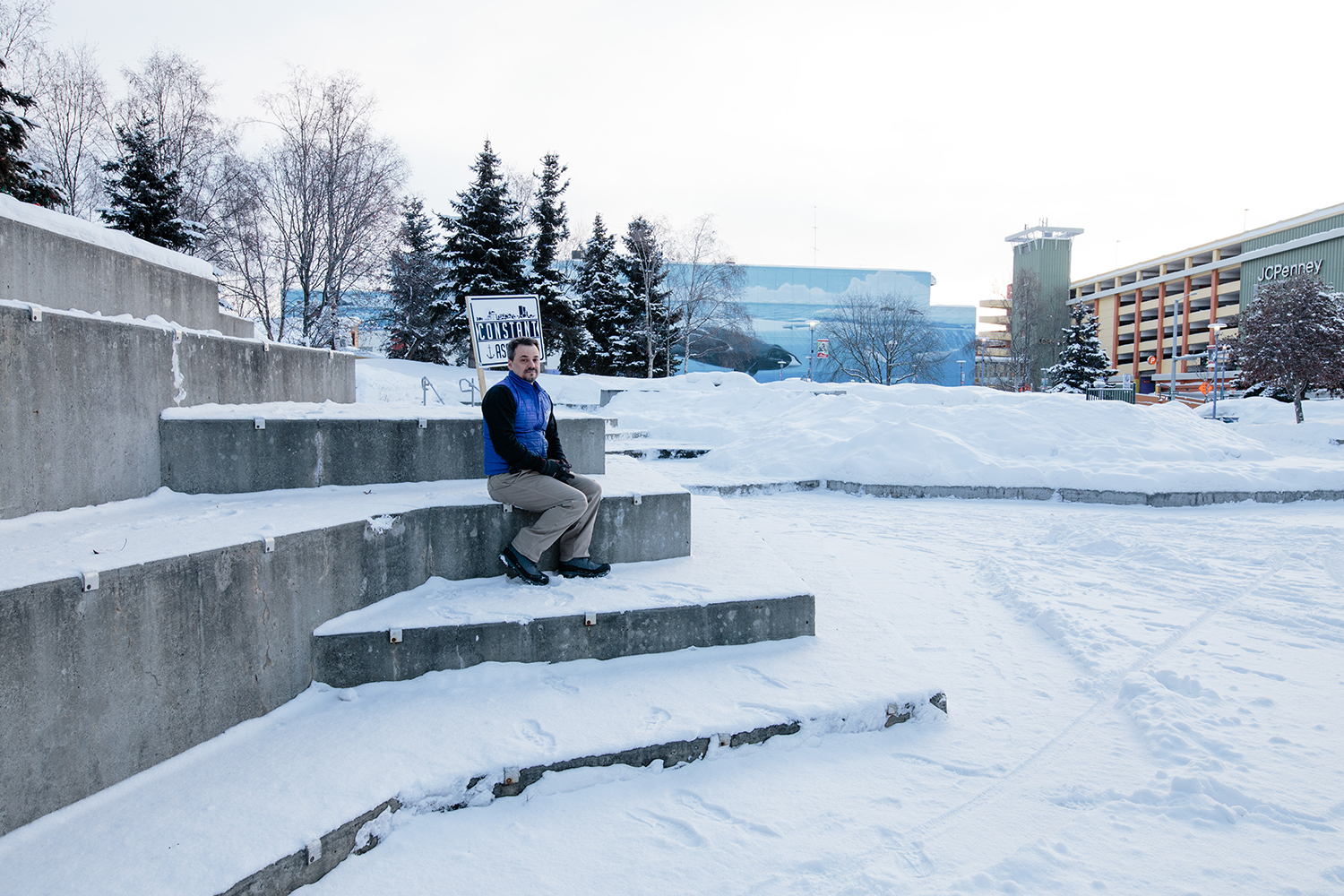
If you live in Fairview, you’re likely familiar with neighborhood activist Christopher Constant. Constant’s entrée to politics and public policy came in 2010, when he worked to transform a blighted park popular with homeless chronic inebriates where two women were found dead in an off-leash dog park. His effort to remake King Park, on A Street north of 13th Avenue, close to his Fairview home, ultimately failed, but it inspired his future activism.
“I realized, of course, that the deeper issue there wasn’t the use of the park, but the fact we have people dying in our parks and no one’s doing a thing,” he says.
Constant was a member of the Fairview Community Council’s executive board from 2009 to 2016, and is its immediate past president, and he’s passionate about the neighborhood. He was a driving force behind creating the Fairview Block Party and was instrumental in the closure of the Spirits of Alaska liquor store, a hub for criminal activity on Gambell Street.
On the community council, Constant worked on both the Fairview Neighborhood Plan, to guide development in the neighborhood over the next 20 years, and a Gambell Street Redevelopment and Implementation Plan, to address transportation and housing needs as well as keeping the corridor pedestrian and traffic friendly.
Constant also served on the Municipal Ad Hoc Committee on Alcohol and Drug Abuse, and Mayor Berkowitz’s Homeless Transition Team. He was an outspoken opponent of the Karluk Manor Housing First project, but not because he opposes the Housing First concept, he says. His objection was to the concentration of social services for the homeless and addicted in an area already home to the Anchorage jail and many homeless camps.
As to his motivation for running for the soon-to-be-vacated downtown assembly seat, he explains, “We moved a whole slate of amazing projects as far forward as you could as a small group of community members [with the community council], and it became apparent that the very next step in order to move the vision we’ve been working on is we actually need a vote on the assembly.”
Constant filed to run for the seat in October of 2015 and has been campaigning practically nonstop ever since.
If elected, Constant would be among the first—if not the very first—openly gay Alaska elected officials (Felix Rivera, running for the midtown assembly seat on the same ballot, is also openly gay). While Anchorage now has workplace and housing protections for LGBT people since the 2015 assembly ordinance, Constant believes Anchorage needs to take the lead in encouraging statewide non-discrimination legislation, as well as defend the equality achieved thus far.
Constant also cites the homeless issue as among his main priorities, though he’d like to see the social services for the homeless and addicted spread evenly across Anchorage. He also envisions transforming the old Native Hospital site at Third Avenue and Gambell into a ten-acre working farm for the homeless and individuals fresh out of jail, with agricultural programs to perpetuate the progress made by other far North food producers.
When it comes to Anchorage’s budget difficulties, Constant doesn’t foresee 60 percent of voters approving a hike in the tax cap. “It’s a practical reality that we are in an age of prioritization and that’s what we’re going to have to do. We don’t want to say we cut other departments to make [the budget] work, but that’s the heavy work of leadership in determining what priorities we’re going to set for this year or the next year. Our budget is a statement of our values and where we put our resources and what we believe in.”
And again, Constant presents no surprises for a progressive candidate for the downtown Anchorage Assembly seat. He’s a reliable lefty with solid policy and community organizing experience under his belt, with extensive knowledge of the district and its needs.
***
So what’s the difference?
Ask David Dunsmore how he differentiates himself and his policy goals from Constant’s and he’ll point out his support of Karluk Manor, the Housing First project in Fairview that Constant opposed. “This is an awfully naïve position to take, saying that we don’t need to locate services downtown, because we already have. We desperately need housing, we need people off of the streets and it’s going to be programs like that that are benefitting everyone,” he says.
Constant points out his previous work tackling the homeless issue. “You’ll never meet another person in this town who, on their own, with their friends, fought like hell and raised four million dollars that’s now being used by the service providers in the neighborhood to provide intensive case management and community treatment.”
In fact, Constant says of Dunsmore’s campaign, “You know your platform is a good one when your opponent adopts it as his own. I’m running for a vision and I appreciate that he’s adopted my platform because it’s complimentary. I look forward to any debate on the merits of any of the issues related to the platform that I’ve established long before he came along and had a platform.”
Downtown voters should look forward to any such debates in the future as well, and hear from the candidates themselves. As the race now stands, Constant appears to have an edge in both fundraising—his February 15 report to the Alaska Public Offices Commission claims over $74,000 in donations, while Dunsmore’s weren’t available at press time, though Dunsmore says he hasn’t focused extensively on fundraising thus far—and establishment support. Constant has a fundraiser scheduled for Feb. 21 featuring Mayor Ethan Berkowitz, former Governor Tony Knowles, former U.S. Senator and Mayor Mark Begich and former Lieutenant Governor Fran Ulmer.

By Christian Hartley Now You Know If you have ever wondered what the borough attorney actually does, you are not

By Katie Stavick Frontiersman.com In a direct response to public outrage over a horrific animal neglect case, the Matanuska-
By Frank Murkowski Opinion Is the threat to Alaska real? I believe it is. The continuing conflict involving Iran is

Farmers markets set to open June marks the beginning of freshly grown Alaska produce showing up around the Mat-Su