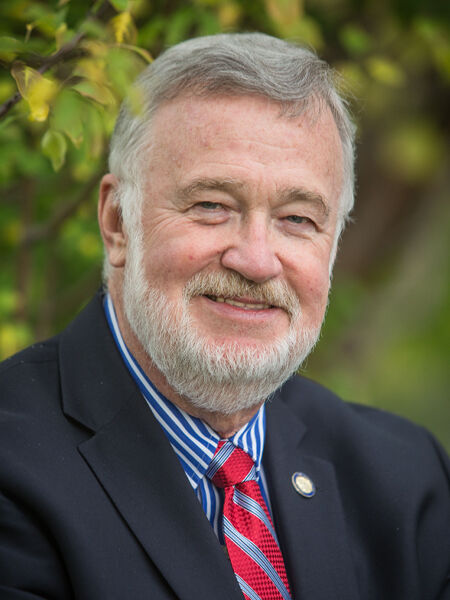
Retiring teacher, coach urges Colony grads to ‘find their 68’
By Jeremiah Bartz Frontiersman.com A football coach using a hockey reference as the centerpiece for his keynote address may


Monday was the 70th day of the state Legislature’s 2024 session. Legislators are more than half way to the 120 -day limit set in the state Constitution.
Already there are more requests on the table than money available to meet them, it appears. That’s one problem. Another is just the time-crunch in passing bills as the Legislature nears its end game.
With about 50 days left it might seem like there’s time to deal with a series of difficult issues including the budget, energy and funding for schools, but the reality is that this is the second year of a two-year Legislature in which all bills not passed by the 120th day perish.
That means mounting pressures from legislators and the governor to get bills moving through committees as the days click by and increasing chances that many will fall by the wayside in the late-session scramble.
There’s no guarantee that even important legislation will make it through. Only the budget is assured because it’s required by the Constitution. But that doesn’t guarantee what’s in the budget. Much of it is yet to be decided.
In a Monday, April 25 briefing by Senate leaders, Senate Finance Committee cochair Sen. Bert Stedman, R-Sitka, said he’s worried that there isn’t enough money for everything and that there appears to be only $150 million left for a state capital, or construction, budget. Mean many desired projects won’t make the cut.
Stedman ticked off a list of spending items still to be decided, including an extension of senior benefits, at about $23 million, the required state “matching” funds for the $206.5 million federal grant to upgrade the Southcentral Alaska power transmission system; how much money should be reserved for as-yet unknown summer firefighting costs, and the still-undetermined cost of new bills being passed that require additions to or new state agency programs, and other unresolved spending decisions.
Stedman also said the state has just gotten a letter from the federal government saying the state may have to repay up to $30 million in federal COVID-relief grants.
To cap it off, there’s the annual debate looming over how big the Permanent Fund Dividend, or PFD, will be. The House Finance Committee has included a $2,275 citizen PFD in its proposed version of the operating budget and funding it from a variety of sources cobbled together. Stedman said this is unaffordable given how much money is available and obligations still pending. What appears to be affordable is something closer to the 2023 PFD of about $1,300.
On a more positive note, the Senate passed House bill 193 Monday, authorizing an allocation of mostly federal funds to allow schools, mostly in rural Alaska, to install facilities to upgrade internet service speeds. Many small schools in outlying communities are forced to operate with internet service at very slow speeds, sharply limiting the availability of education materials.
The provision was a cornerstone of Senate Bill 140, the school funding bill that Gov. Mike Dunleavy vetoed. With the failure of that bill the Legislature rushed through a stand-alone school internet bill at lightning speed to meet a federal deadline of Feb. 27 to secure the funds.
HB 193 passed the House on March 20 and passed the Senate on March 25.
The governor must still sign the bill or let it go into effect without his signature by March 27, however. The speed at which the Legislature dealt with this shows that lawmakers can move fast when they need to, Senate President Gary Stevens said in the Monday briefing.
The effects are still being felt in the capitol building over the governor’s veto of SB 140, the school funding bill, and the drama of the Legislature’s failed vote to override the veto which fell one vote shy of the 40 votes needed for an override.
Stevens said Monday that state House leaders had promised to address the school funding issues following the failed veto override. “The House said it would develop a plan, but we’re still waiting to see if there will be a (House) plan,” Stevens said.
The House Finance Committee did put $175 million in one-time funding for schools in its proposed operating budget, but educators say one-time money doesn’t help much in solving systemic problems like raising pay for teachers. That’s because the one-time money can’t be counted on in the following year.
Meanwhile, energy legislation is also moving, although it has been slow. A House bill that would reduce state royalty on new natural gas production in Cook Inlet to zero from the current 12.5 percent of value has moved from the House Resources Committee to the Finance Committee. A similar bill sponsored by the governor, is pending in the Senate.
This appears to be one initiative the state can take that would have an effect quickly in stimulating new drilling for gas. HEX LLC, a small independent company that owns the Kitchen Lights gas field in the Inlet, has told legislators that reducing the royalty would allow it to finance new wells to tap known reserves near an existing platform.
That could bring new gas on line to help soften a shortfall in production expected to begin in 2027. The risk, however, is that one or more of the new wells planned might not be as productive as hoped.
Other efforts are underway to help another small independent, BlueCrest Energy, develop a confirmed gas deposit that overlies a producing oil reservoir in its Cosmopolitan offshore oil field near Anchor Point, on the Kenai Peninsula. Unlike HEX, however, BlueCrest has no platforms at its field.
Those must be financed and built and without state support the economics don’t support the several hundred million dollars of investment that may be required. The Legislature is looking at various ways of helping BlueCrest but it can’t be done quickly.

By Jeremiah Bartz Frontiersman.com A football coach using a hockey reference as the centerpiece for his keynote address may

Frontiersman.com With its headquarters in Wasilla, the Frontiersman has been a primary source of news for the Matanuska-Susitna

By Katie Stavick Frontiersman.com The next generation of leaders took flight this week as the Houston High School Class

By Kyle Wilkinson For the Frontiersman Keynote speaker and Carry the Cure President Bill Pagaran’s words boomed through the