Retiring teacher, coach urges Colony grads to ‘find their 68’
By Jeremiah Bartz Frontiersman.com A football coach using a hockey reference as the centerpiece for his keynote address may


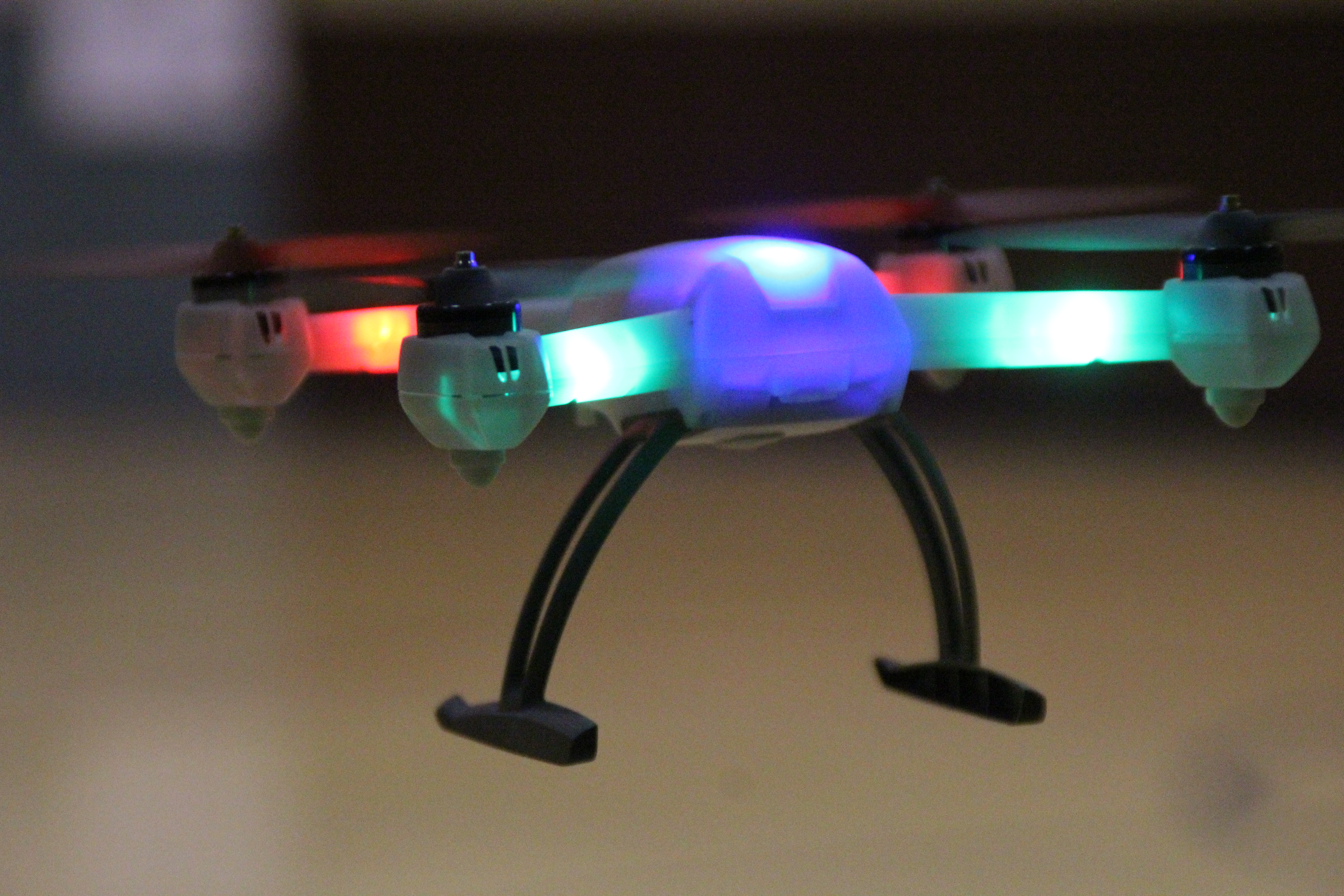
WASILLA — Fred Keller has more remote-controlled quad-copter drones than he has fingers and toes. So many, in fact, that he’s acquired a nickname among local remote-control enthusiasts: “Drone Man.”
Some of Keller’s drones are small enough to fit inside an empty cigarette pack. Others roughly the size of a large pizza box. Keller’s drone fixation started an extension of enthusiasm for radio-controlled flying and general do-it-yourself gumption.
He’s also good-natured about his nickname.
“I drone ‘em all out, don’t I?” he joked about the buzz generated by his large collection during a meeting of drone enthusiasts on Friday inside the Teeland Middle School gym.
Keller flew about a half-dozen drones around the inside of the gymnasium’s two rooms Friday. He was joined by others flying foam acrobatic planes, scale model Stearman biplanes, toy helicopters, and members of the local radio-control hobby community. The group meets at 6 p.m. each Friday.
Unlike some of the other craft whizzing around the building, some — though not most — of Keller’s drones will have to register with the Federal Aviation Administration under rules announced publicly in mid-December, which require any drone bigger than .55 pounds to obtain a registration number.
Keller said the rules didn’t come as a surprise.
“It was inevitable, definitely inevitable,” he said. “It’s like any kind of technology that comes along that’s going to impact some. And yet, we have to look at what they’re attempting to do, and that is to make things more safe for airline travel and everyone, basically.”
He and other members of the community point out the fact that new technologies have lowered the level of tech know-how required for people to fly drones. That, in turn, has led to close brushes with planes, and other unfortunate incidents, which is what the new regulations are designed to combat.
“The downside to it is that there are so many people that are interested in it that have no knowledge of the real world as far as aviation is concerned, even airlines and things like that,” he said. “We’ve got a lot of people out there, that they’re you know hot-doggers or individuals that want to push their envelope or whatever their thing is. It’s technology. We’ve got to have some regulation somewhere. If nobody was bothering anything, if nobody went and flew up in front of the airlines, if nobody did this, that and the other, we wouldn’t have to have it.”
Regulations applying to drones can be murky and confusing, said borough assembly member Steve Colligan. For example, he said borough officials briefly operated a drone without knowing which of several federal permits to apply for. Federal officials rejected an application for one type of permit, and instead told borough officials to apply for another. Colligan is also a member of the House Majority’s Unmanned Aircraft Systems Legislative Task Force, which provides guidance on the issue to state legislators.
Colligan — whose presence on the borough assembly is due in part to popular discontent over the way noise ordinances targeted radio-controlled planes in the past — used a Permanent Fund Dividend check to launch a company called Precision Flight Devices. The company serves as a clearinghouse for commercial drone applications.
A surveyor by trade, Colligan is among those who see a soaring future for commercial applications for drones in Alaska, where limited road access can make surveying remote properties difficult. The biggest challenge to responsible drone ownership is education, he said.
“If we’re going to follow the rules, everybody needs to follow the rules,” he said.
The task force is working to publish a rulebook for drones for public distribution, said chair Rep. Shelley Hughes (R-Palmer). Hughes got involved in the issue after constituents called her asking for a ban on drones amid a flurry of drone paranoia inspired by the devices’ military use in the early 2010s.
“To be perfectly honest, at that time, when you were hearing about them, you were hearing about them killing innocent women and children,” she said.
Over time, those concerns have changed to the unsavory uses private citizens might find for the machines, like spying on neighbors or kids. However, those uses shouldn’t mean all drones are banned, Hughes said.
“When I started researching it, I realized it’s a tool, and in the right hands, for the right things, it can actually be used for good,” she said. “And they can actually save lives, save money. In a state like ours, that has so few roads, and aviation is so huge, it would make sense.”
She cited potential uses as search-and-rescue operations, surveying, resource development, wildlife monitoring, oil field equipment inspection, and even (possibly) hunting — though the FAA has told her conflicting things about the legality of putting a gun on a drone. State officials banned drone-assisted hunting in March 2014.
“We were told that it was illegal to weaponize a drone because it’s illegal to weaponize an aircraft in the United States unless it’s a military aircraft,” she said. “So we didn’t worry about it.”
Then an attorney for the FAA told her states could pass rules regarding weapons and drones, seemingly contradicting the earlier statement, Hughes said. She thinks drones with guns could provide a recreational hunting outlet for the disabled, possibly.
A pamphlet published by the task force repeatedly urges people concerned about drones to contact the FAA Aviation Safety Hotline or local law enforcement if concerned about a drone’s wandering lens. The first instinct might be to shoot down a peeping quad-copter, but it’s probably better to resist. Shooting down any aircraft is a federal crime.
Back at the middle school gym, some local radio-control pilots worried the new regulations could burden law-abiding drone pilots, while rule-breakers are likely to ignore them. Teri Miner took up flying the hobby with her husband Gary after their children left the house.
“I do feel a little bit that the FAA may be overreaching a little bit here,” Teri said. “I don’t mind registering. I don’t have a problem with that. But those who cause problems won’t register. It’s that simple. It’s like guns.”
Others, like Jerry Friess, whose drone lost a prop and went out of commission Friday evening, worry more about the interaction between drone pilots and law enforcement. People who participate in a community of users, like the radio-control pilots at the gym, are more likely to know the rules, follow them, and behave responsibly, Friess added.
“I don’t worry about the FAA coming by,” he said. “I worry about a supercop. Somebody who wants to make a point.”
More information about drone regulations and responsible use is available online at the following websites:
www.knowbeforeyoufly.org — A public campaign intended to raise awareness of rules and regulations surrounding drone use.
www.alaskadrones.org — A website of the Unmanned Aerial Systems Legislative Task Force, where you can download an illustrated, accessible, guide to ethical drone use.
www.registermyuas.faa.gov — The federal government’s online portal for registering the new drone you received for Christmas.
Contact reporter Brian O’Connor at 352-2270, brian.oconnor@frontiersman.com, or on Twitter @reporterbriano.
A previous version incorrectly paraphrased Colligan as saying the borough got into the drone business without knowing regulations. Colligan said officials have followed the rules, but the regulations pertaining to drones are frequently unclear. The story also said the borough failed to get a required waiver, but at the time the borough began operating the drone, federal waivers for commercial and government operations were not required.

By Jeremiah Bartz Frontiersman.com A football coach using a hockey reference as the centerpiece for his keynote address may

Frontiersman.com With its headquarters in Wasilla, the Frontiersman has been a primary source of news for the Matanuska-Susitna

By Katie Stavick Frontiersman.com The next generation of leaders took flight this week as the Houston High School Class

By Kyle Wilkinson For the Frontiersman Keynote speaker and Carry the Cure President Bill Pagaran’s words boomed through the