Retiring teacher, coach urges Colony grads to ‘find their 68’
By Jeremiah Bartz Frontiersman.com A football coach using a hockey reference as the centerpiece for his keynote address may


You savor and see the fresh produce from the Mat-Su Valley all summer long at Anchorage area farmers markets. The colors of the locally-grown produce are deep and rich; the flavor is hearty. Nothing is more down home than purchasing jams and jellies processed from berries grown on the vine right here in Alaska.
But did you ever wonder what the day-to-day operations at the farms these yummies hail from are like?
Ever wonder what the process of not only growing these delicious eats but of running the farm in a business format is like?
Now you can get those answers straight from the fields where all that beautiful produce is grown via a new farm tour service run by a Palmer woman who for the past 10 years has immersed herself in all that is valley agriculture.
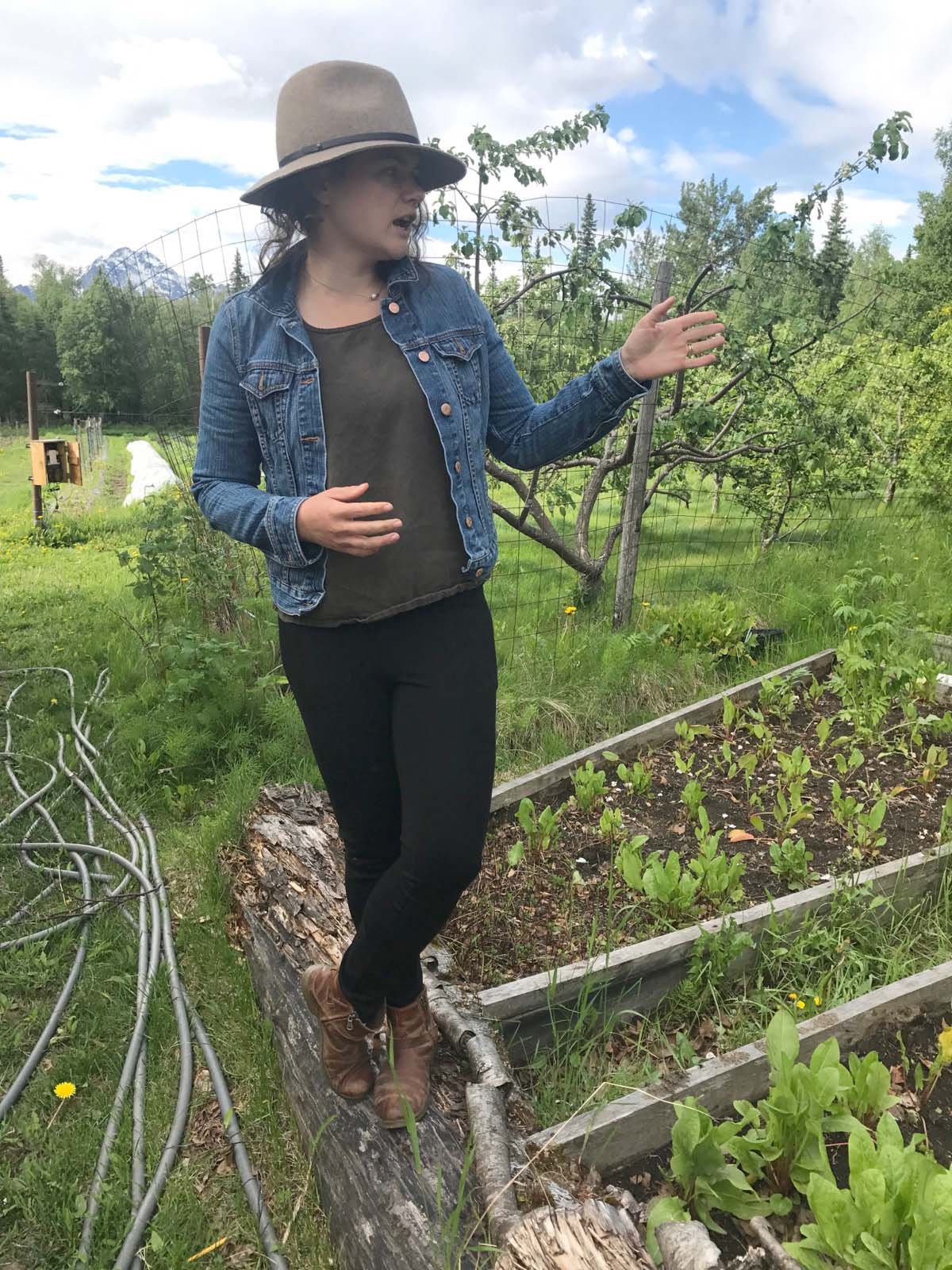
Meet Margaret Adsit, owner of Alaska Farm Tours.
Her passion for agriculture, farming and food production is immediately apparent as she begins a Palmer-based tour with a visit to the gardens at the Palmer Visitor’s Center.
“We can grow potatoes here in Alaska like nobody’s business,” Adsit told the members of a tour held in mid-June.
Sure, the growing season is short, she said, but it is also intense with extended hours of daylight each day – even when the skies are overcast – that promote plant growth.
She quizzes the tour participants on the types of potatoes grown in Alaska. Of course, the Yukon Gold is nearly a household name. But there are other potatoes developed just across the Matanuska River at the 405-acre Alaska Plant Materials Center in Butte by a career potato disease specialist whose name might not be on the tip of consumer’s tongues, but his product certainly is. Bill Campbell, better known in the Valley as “Potato Bill” spent 30 years improving the plight of the staple crop in Alaska’s challenging, yet opportunistic growing conditions. The Magic Myrna has a reddish/pink skin and yellow meat – the agricultural term for the inside flesh of the potato – with a taste compared to sweet potato. It and the Magic Molly, a purple fingerling potato named for Campbell’s daughter, have become popular with gardeners in the Lower 48 as well. Magic Molly seeds are available at Home Depot stores across the country.
The tour moves to a series of raised gardening beds.
She asks why the beds are raised – other to make it easier for gardeners to access, she says with a knowing smile.
“The frost we have here means it takes longer for our soils to heat up,” Adsit said. “By elevating the beds, the soils can warm up faster and extend the growing season.”
She leads the group over to a display of replica vegetables that are the record holders for the giant vegetable competitions at the Alaska State Fair.
“The sun we get here in Alaska is like steroids for plants,” she jokes. She shares a bit about her experience as a volunteer helping to officially weigh cabbages at the state fair one year. It was an eye-opener regarding the seriousness of the event. “The people who grow these huge vegetables; these huge cabbages, are rather protective of them.”
Rightly so. Yearly bragging rights are on the line, she notes.
As the tour group heads to her tour company van, she notes the large rhubard plants with more than enough growth for a harvest.
“We can get up to three cuttings in a summer season from rhubard,” Adsit said. “For a state not known for its fruit production, that is pretty good.”
The participants of the tour are in her van as Adsit drives Palmer’s back country roads on the way to Arctic Organics – a family-run vegetable farm on the picturesque Palmer hillside. The farm is owned and operated by Sarah and River Bean and became a commercial enterprise after Sarah, a home cook, realized other cooks with organic bent in Alaska were in search of the same type of pesticide-free produce that she wanted.
During the drive to the farm whose produce is a regular feature at the Anchorage Farmers Market held on Saturday’s at the Central Lutheran Church parking lot, Adsit presents a quick verbal tutorial on the history of western agriculture in the Mat-Su Valley.
As part of U.S. President Roosevelt’s New Deal, approximately 200 families were transported to the Valley from the Lower 48 to establish a farming colony.
“The families were selected based on economic need and not necessarily their farming skills,” Adsit said, adding the first few years were a tough go.
For the first summer, the families were housed in a tent city as each one drew lots to determine which 40-acre parcel of land would become theirs. Trouble was, maps were not particularly accurate and some families ended up in swampy areas. Some families’ left and other families were brought in to replace them. When the U.S. military began its build-up at Elmendorf Air Force Base and Fort Richardson in the 1940s and 50s, the need for produce such as cabbage, lettuce and potatoes as well as milk gave the colony project a much-needed market boost. The dairy industry in Alaska thrived until the 1970s when the shipping in the alfalfa hay that dairy cows prefer to eat became cost-prohibitive and Alaska’s dairy industry collapsed, she said.
“Alaska today is still trying to figure out how to revive the local dairy industry,” she said, noting that only one active farm remains. “Milk being shipped in from the Lower 48 has a decreased shelf life. So, it could be problem if somehow our shipping lanes were disrupted.”
While milk production remains challenging for local farmers, vegetable production is well under mastery as evidenced by the numerous fields in production at the Arctic Organics farm.
Adsit led the tour group along the edges of the farm discussing its unique features including the fact that when the land was initially purchased, it was completely covered in forest.
“They did all the clearing themselves using only natural methods to establish the fields so they would know the history of what has happened on this land while developing the farm,” Adsit said.
She explains various techniques in place including fencing around apple trees to get moose with munching habits away, the spreading of wolf urine as a natural propellant and the use of green plastics spread across the rows were plants are growing as a form of weed suppression.
Arctic Organics was one of the first farms to successfully grow kale in Alaska – an agricultural accomplishment once considerable a questionable idea. Kale requires warm and continually moist soils – not always a combination found abundantly in Alaska. Improved techniques now yield kale that grows at an appropriate rate to also produce the tart taste the plant is famous for.
The tour next visited a burgeoning fruit production facility under the guidance of Don Berberich. He just retired from 28 years of teaching at Palmer High School and was the advisor for the Future Farmers of America. Agriculture is in his blood and he has an optimistic outlook on the future of fruit in Alaska.
Except, “I am constantly fighting the grass,” he said. “I am not a person who likes herbicides and pesticides so I modified a brush cutter so I can get under the plants and cut away the grass without harming them. I guess I am a closet innovator.”
He has cherries, black currants, red currants, raspberries and strawberries in production and he is learning more about what each plant prefers. He has discovered that red currants really like organic material such as rotten log. He keeps two hives of bees nearby the strawberries to help out with pollination, but notices it is wasps that seem to most of that work with the currant plants.
He has developed several jellies and jams that he sells at various local farmers markets, craft shows and online at his company.
The last stop of the day was at a Valley icon: the Spring Creek Farm known more commonly by locals as Louise’s Farm.
Now run by Alaska Pacific University as a research and teaching facility, the farm began in 1948 when Louise Kellogg, an ambitious single woman who didn’t let thoughts that she couldn’t run her own farm derail her from her vision, Adsit said. At first no one would sell her land or dairy cattle, but within a few years she proved herself and purchased 240 acres and ten cows from the Loessing family. At the peak of her farming enterprise, Kellogg was known as the best dairy farmer in the Valley. At her death in 2000, her estate of 900 acres was given to the university.
Today, sustainability experiments are the hallmark of the facility, Adsit explained while showing off one of the facility’s greenhouses.
The tour ended with a picnic lunch at Spring Creek Farm that was prepared by Turkey Red restaurant in Palmer. It is named for a type of wheat from Kansas found to perform well in Alaska.
The restaurant uses as much fresh produce as possible from local farmers, Adsit said.
“You can tell by the flavor and texture that the vegetables are local,” she said. “They are much fresher.”
Adsit’s company offers three different tours including a Talkeetna-based tour featuring visit with birch syrup producers, a local farm producing a variety of products and the Denali Brewing Company.
Learn more about Alaska Farm Tours online at: www.alaskafarmtours.com.
Learn more about Arctic Organics online at: www.arcticorganics.com.
Learn more about Berberich’s fruit-based products online at: www.juicejellyandjam.com.
Reach AmyArmstrong via email at: writemomsocialbutterfly@gmail.com.

By Jeremiah Bartz Frontiersman.com A football coach using a hockey reference as the centerpiece for his keynote address may

Frontiersman.com With its headquarters in Wasilla, the Frontiersman has been a primary source of news for the Matanuska-Susitna

By Katie Stavick Frontiersman.com The next generation of leaders took flight this week as the Houston High School Class

By Kyle Wilkinson For the Frontiersman Keynote speaker and Carry the Cure President Bill Pagaran’s words boomed through the