Retiring teacher, coach urges Colony grads to ‘find their 68’
By Jeremiah Bartz Frontiersman.com A football coach using a hockey reference as the centerpiece for his keynote address may


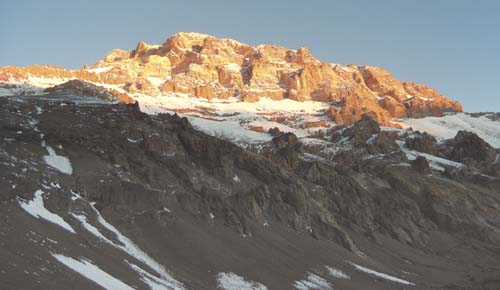
Few people outside of mountaineering circles have heard of the “Behemoth of the Andes” known as Cerro Aconcagua. But for climbers aspiring to test their high-altitude limits, it is a recurring dream.
At 22,820 feet, Aconcagua is the highest mountain in the Western and Southern hemispheres and the tallest outside of the Himalayas. It is nearly a half-mile higher than our own Denali.
This past December, youth across the country got to participate in a real-time virtual climb of Aconcagua thanks to a project carried out by the University of Alaska Fairbanks Cooperative Extension Service. Our expedition carried a GPS beacon that transmitted our coordinates every 10 minutes and posted them on high-resolution aerial photographs and topographic maps.
University of Alaska Fairbanks has a long history in mountaineering that blurs the line between personal and professional interest. UAF’s second president, Dr. Terris Moore, helped pioneer the West Buttress route on Denali with Bradford Washburn. Consequently, it is hoped this project would inspire youth to learn more about the world’s mountains and demonstrate a new technology.
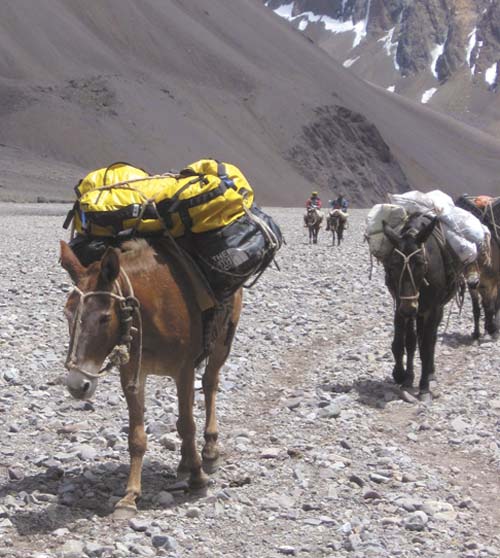
Our climb started Dec. 3 at Puente del Inca (8,900 feet) in the Andes Mountains near Mendoza, Argentina. It would be about a 25-mile hike to our 14,000-foot base camp at Plaza de Mulas, and that is a long way to lug food, fuel and equipment for a three-week expedition. We would need help. In the Himalayas, gear is transported to base camp by Sherpas and their yaks. The South American counterpart is the Muleteer and his hardy army of mules.
While transport by mules may seem a throwback to an earlier time, it is actually a high technology endeavor. Climber’s bags are tagged like to those on airlines and their departure and arrival is computer coordinated. Still, a gift bottle of fine Tennessee whiskey for the head Muleteer “insured” our equipment’s safe and timely arrival. Unfortunately, our gift would also keep camp awake until about 4 a.m.!
On the way up to base camp we spent three days acclimating at an area called Confluencia (11,000 feet). While there we decided to make a side hike to see the massive south face of Aconcagua. The south face is one of the world’s most dangerous climbs and spans nearly two vertical miles. Because this was an out and back hike of about 14 miles, many kids monitoring the GPS website thought we had given up early for some unknown reason.
Aconcagua has only about a 30 percent success rate among climbers (much more difficult Denali has about a 50 percent success rate). While Aconcagua is not a technically difficult mountain to scale if the weather is good, its high failure rate is due mostly to a lack of patience among climbers. Those who are patient and acclimatize will almost always fare better than those who don’t. While we were there, more than a dozen cases of high altitude cerebral or pulmonary edema were reported to emergency rescue teams. Both of these conditions can be fatal without a quick descent.
We chose to bide our time and spent three days in base camp. Aconcagua’s base camp is a fascinating place and is reminiscent of the bar scene in Star Wars. This is an international crossroads and people watching is a fascinating activity here. So is the mix of good, bad and bizarre advice on how to tackle the mountain.
The camp is also an interesting example of capitalism at work. One can purchase pizza, get your iPod charged, taste fine Argentinean wines or even experience a 5-star meal cooked by a properly schooled chef — and all of it in a tent. Unfortunately, most of it also has the after-taste of mule sweat.
Above base camp we would establish three advance camps on the way to the summit. Usually, two days were spent at a camp with the second day being used to cache supplies at the next camp above. Non-mountaineers often think climbing is nonstop adventure. Monotony is also an equal measure.
Finally, on Dec. 15, we reached Camp III at 19,000 feet. We went to bed before sunset after a crunchy meal of freeze-dried food. At this altitude, boiling water is no longer hot enough to cook food well. Our “lasagna” had the consistency of peanut brittle.
We were up at 1 a.m. on Dec. 16 and started climbing by headlamp at 3 a.m. Summit day was a mix of excitement and apprehension. Excitement stems from the potential of setting a personal high altitude record and bagging one of the world’s great peaks. Apprehension comes from fear of the unknown and also knowing thousands of eyes are watching your every step over the website, including my wife.
The climb from Camp III to the summit is about 3,000 feet, or roughly the same altitude gain as scaling Lazy Mountain in Palmer. Normally for me, the trip up Lazy Mountain is about two hours. After 10 hours of climbing we were finally nearing the summit. Just below the top it would take three or four breaths to move one step. At last, about 12:30 p.m., we topped out and sent out our success message via the GPS beacon. The 15 minutes on the summit was the culmination of months of training and a 25-year dream!
We were back down to Camp III by 4 p.m. After another crunchy meal of freeze-dried “stew,” we crawled into our sleeping bags and slept for nearly 15 hours. Though it would take us another two days to descend the mountain, there is no better sleep than one in the knowledge of a great goal achieved — and getting to share it with a potential new generation of mountaineers.
Stephen C. Brown is a Valley resident and avid marathoner and mountaineer.

By Kyle Wilkinson Kyle in the outside Our spring bear hunt was bittersweet this year. We’re heading home without

Frontiersman.com Valley athletes earned titles during the Region III Championships track and field meet last week at Colony High

Leila Petersen Palmer Moose Leila Petersen, a member of the Palmer track and field team, has been named a Frontiersman

By Jeremiah Bartz J’s World August would have been the start of my 25th year as an editor at