Retiring teacher, coach urges Colony grads to ‘find their 68’
By Jeremiah Bartz Frontiersman.com A football coach using a hockey reference as the centerpiece for his keynote address may


BUTTE — Like a scene from a John Wayne classic, a dusty band of travelers clad in mid-1800s garb pushes and pulls a convoy of handcarts through glacial silt, swarms of bugs and blazing sun.
Clean and smiling, the group of more than 200 boys and girls each load a bucket with no more than 17 pounds of gear into their family’s handcart for a 30-mile trek departing from the Alaska Gravel Products site off Sullivan Road June 10.
A team of 80 or more began planning the trek in October 2012, but added to the everyday challenges of wilderness camping for four days with 50 adults and more than 200 youth is the company’s mode of transportation.
With food, camping gear, water and other supplies loaded and goodbyes said, the teenage pioneers set off into the woods, led by trail boss Layne Channer from Wasilla.
Their reasons are spiritual for wrestling 25 human-powered handcarts loaded with thousands of pounds of gear along the dusty, uneven trails and across icy streams in the Knik River Public Use Area.
Between 1847 and 1869, an estimated 70,000 Mormons made the 1,400-mile journey by horse and wagon along the Mormon Pioneer Trail from Illinois to Utah.
The 2013 Pioneer Trek June 10 to 14 was organized by the Wasilla Alaska Stake of The Church of Jesus Christ of Latter-day Saints as a “re-enactment” of the journey made by about 3,000 people who used human-powered handcarts between 1856 and 1860 to make the pilgrimage.
Trail boss Channer said that Mormon Stakes around the world have organized similar treks for decades, but this is the first time for the Wasilla Stake. Anchorage and Soldotna stakes completed similar treks this year, he said.
Although 10 handcart companies made the trip, the focus is generally placed on the last two companies to begin the trek in 1856. About 1,000 people left Nebraska Territory that August as part of the Willie Handcart Company, led by Captain James Willie, and the Martin Handcart Company, led by Captain Edward Martin.
Slowed by broken handcarts, buffalo stampedes, food shortages and early winter storms, by Oct. 1, 1856, the Martin Company had reached Fort Laramie, Wyo. Although they knew they would exhaust their supplies hundreds of miles before they reached the Salt Lake Valley, both groups decided to continue. More than 200 died of cold and starvation before help reached them.
Chad Rice said the Wasilla Stake began preparing for the trek in February. The girls made their own pioneer clothing, handcarts were built, everyone read stories about the pioneers and prepared physically by exercising and eating healthy, he said.
On the trek, Rice and his wife were “ma and pa” to five boys and three girls; one set of 25 honorary parents on the trek who headed similar trek families.
Rice said his great-great-grandfather, Leonard Hurley Rice, was part of the rescue party that came to the aid of the Martin Company in November 1856.
“There are tons of us who have family ties like that,” he said.
For example, his trek son — Hunter Bigelow, 17, of Palmer — traces his ancestry to Harvey Cluff, one of 27 young men who left Salt Lake the morning of Oct. 7, 1856, in a dangerous attempt to bring relief to the 1,550 pioneers caught in early winter storms along the trail, starving and without shelter.
Bigelow said Cluff was one of three scouts who found the Martin Company at Red Buttes on the North Platte River Oct. 28, 1856 — about 100 miles east of where they found the Willie Company Oct. 19.
After a harrowing Sweetwater River crossing — which is an adventure story unto itself — the Willie Company reached the Salt Lake Valley Nov. 9, 1856, and the Martin Company on Nov. 30.
“Our main hope for the youth is that through experiencing what the pioneers went through, they will get to know the pioneers and how they came to know Jesus Christ through their trials; consequently, the youth can see how they can overcome trials in their own lives and become closer to Christ,” Channer said.
To help make the historic journey come alive, organizers placed small signs along the trail with interesting facts, and 25 scenes with various pioneer characters played out along the trail.
Behind the scenes, volunteers also worked preparing food, getting fresh water, firewood and other supplies, and transporting all of it over the miles of trail to reach the group.
Just for a group of this size to use the area required a permit from the Department of Natural Resources, Division of Mining, Land and Waters, according to trails committee chair Jimmy LaVoie.
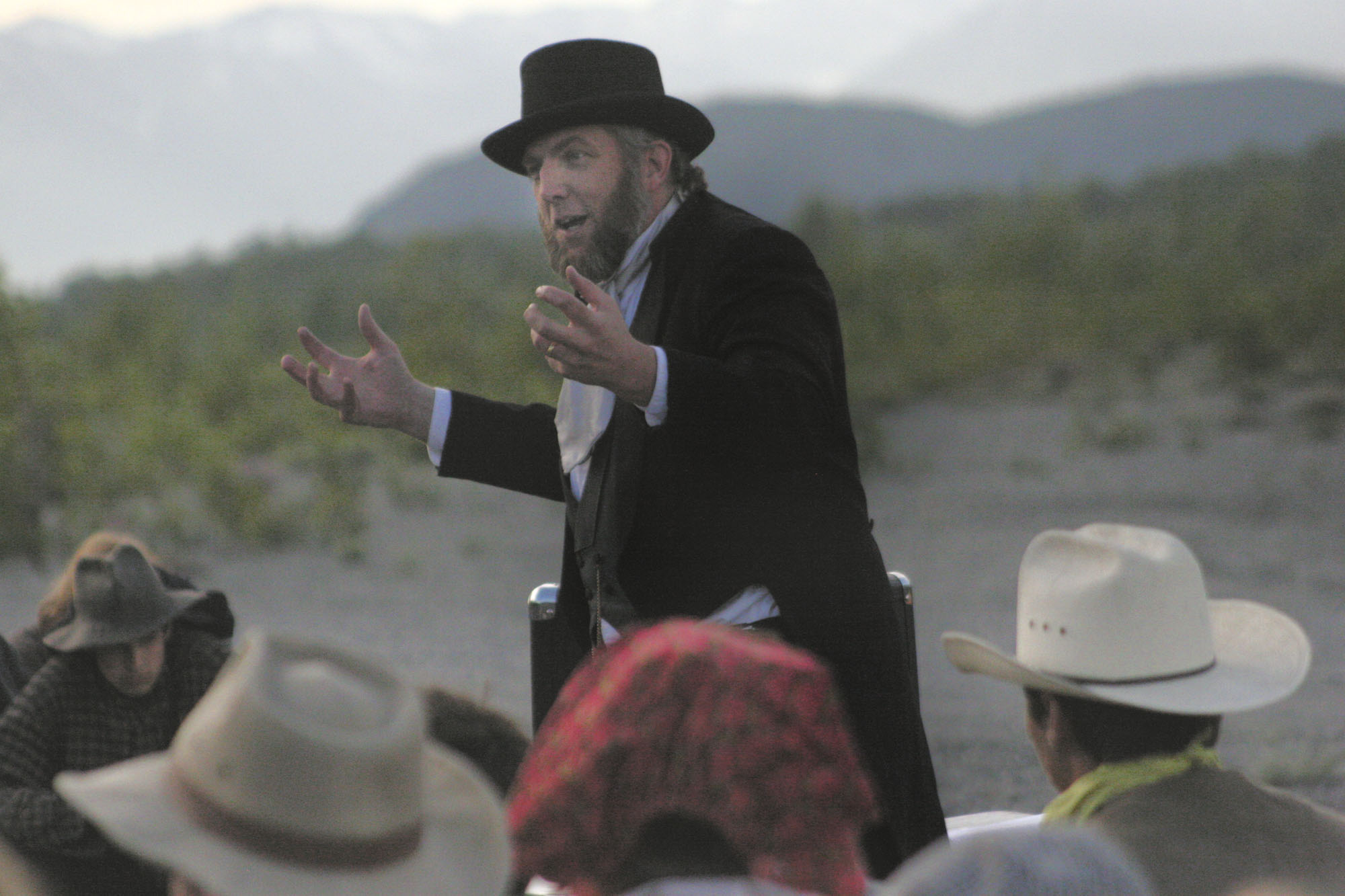
Other committees organized special activities during the four-day adventure, including a visit from Brigham Young, a hoedown, pioneer games and a mail delivery from the Pony Express.
“We tried to cover every project; just the letters for the kids from every parent was a project,” Channer said. “When the Pony Express came in, every kid got a letter from home and they were given quiet time to read their letters and reflect. Kids were touched.”
Wading through icy streams with flowing water up to their waists, wrestling handcarts loaded with 400 to 500 pounds of cargo through sand and up steep hills, adults volunteers said the experience for all involved was just a taste of what the pioneers experienced.
“We want them to know why their ancestors risked their lives,” Channer said. “We want them to understand the sacrifice someone else made for them to have what they have today.”
Emma Jenson, 14, of Wasilla said the trek was a good bonding experience that taught her more about working together.
“I gained a stronger understanding of the pioneers and what they went through,” she said. “I kept thinking, ‘What would I have been like?’ They were very strong.”
Channer said the trail provided a unique environment where kids could work as a group to experience what it is means to struggle to overcome real-life challenges.
“We put them through a hard test,” he said. “They learned that they can overcome.”
Harry Fife, 14, of Wasilla said he understands that challenges like crossing Jim Creek and Friday Creek are just a tiny slice of what the pioneers endured.
“It gave me a little insight of when one of the pioneer handcart companies had to cross a river in the winter with ice floes and it was chest deep, I can’t imagine it,” he said.
Trail boss Layne and wife, Kathy Channer, say the trek was an overwhelmingly positive experience that they hope the Wasilla Stake will offer often enough so all of its youth ages 12 to 18 have an opportunity to participate.
“The kids rose to the challenge and surpassed it on all challenges,” he said. “Let’s do it again.”
Barbara Adams contributed to this story.

By Barbara Hunt Palmer Buzz It was 6:43 on Friday morning and the Plant Owner was sound asleep when

By Kyle Wilkinson Frontiersman Memorial Day Weekend was filled with a variety of events in Willow. From live music to

By Kyle Wilkinson For the Frontiersman The Susitna Valley Emergency Preparedness Fair will be held at the Willow Community Center

By Barbara Hunt Palmer Buzz Green-Up happened at exactly 9:34 am on Saturday morning in Palmer. This was