Retiring teacher, coach urges Colony grads to ‘find their 68’
By Jeremiah Bartz Frontiersman.com A football coach using a hockey reference as the centerpiece for his keynote address may


Editor’s note: the following story includes graphic descriptions of a child’s death and emergency medical procedures unsuccessfully undertaken to save her life.
PALMER — A jury will decide the fate of a man accused of murder in the death of his daughter.
The trial of Clayton Phillip Allison, 31, of Wasilla, for charges of manslaughter, criminally negligent homicide, and second-degree murder caused by extreme indifference began this week.
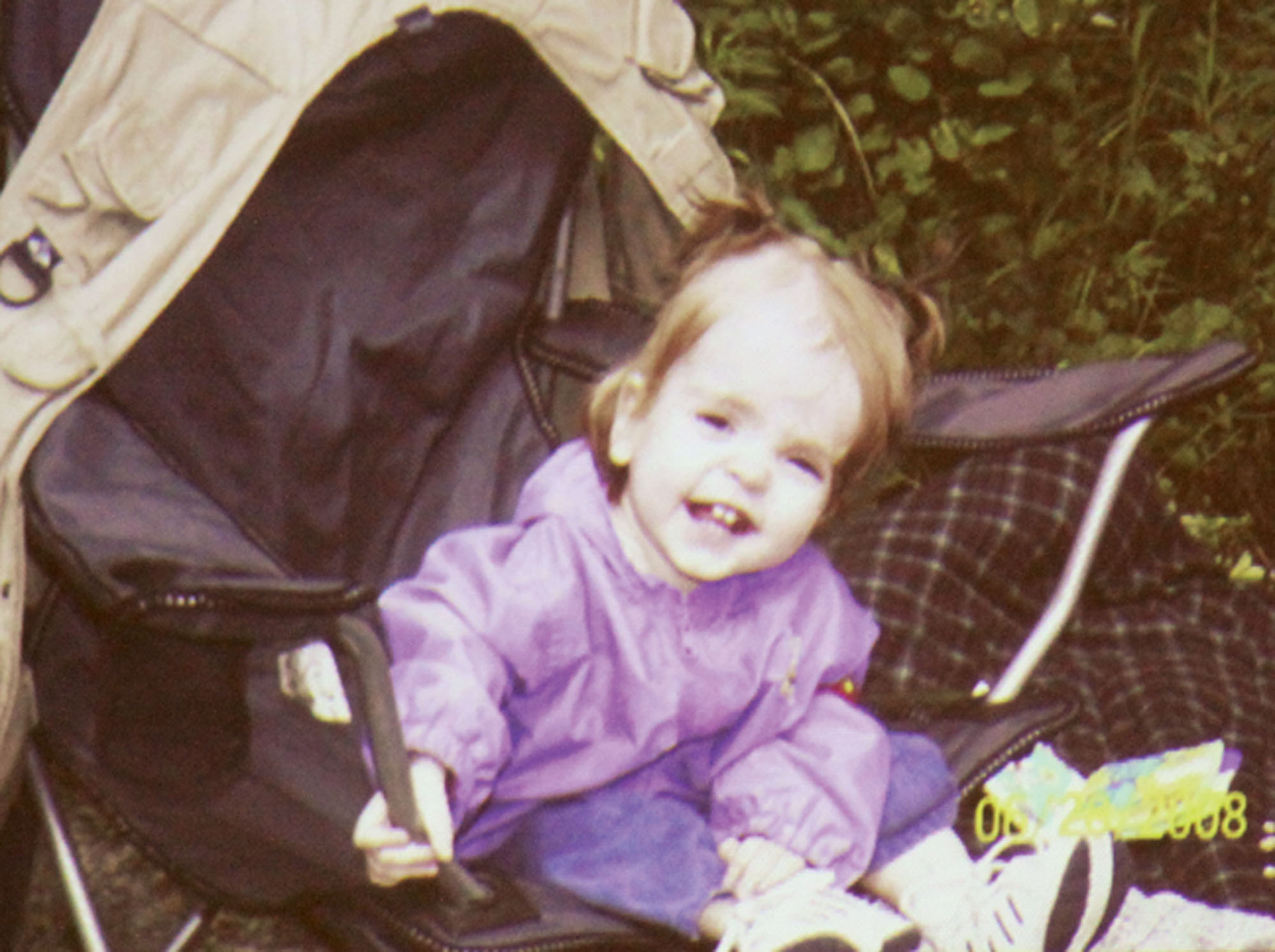
His daughter, identified in court Thursday as Jocelynn Allison, died on a Providence Hospital operating table about 8:30 p.m., Sept. 24, 2008, after what Clayton Allison initially told the police was a fall down eight carpeted steps while he was unclogging a toilet.
An obituary published in the Frontiersman at the time describes Jocelynn’s death as an accident.
However, Wasilla Police and Alaska State Troopers continued to investigate the incident after a medical examiner ruled the cause of Jocelynn’s death was blunt force trauma, and the injuries turned up in her autopsy and during treatment were reportedly inconsistent with the initial account, leading to criminal charges against Allison.
Prosecution attorney Krista Anderson repeated those claims during her opening statement, which detailed the last four hours of Jocelynn’s life in excruciating, at-times grisly, detail.
“This case is about time,” she said. “You will hear evidence that on Sept. 24, 2008, Jocelynn Allison ran out of time.
“You will hear evidence that Jocelynn went from crying to dying in a matter of seconds, and the man who is ultimately responsible for causing her untimely death is this man,” Anderson continued, gesturing to Clayton Allison.
Clayton Allison called two other people before calling 911, and did so only at his mother’s direction, Anderson said. When emergency personnel, who are expected to testify, responded to the scene at 3:54 p.m. the day of her death, they found Clayton Allison downstairs, in the basement of their home, and it wasn’t until they aggressively questioned him that he lead them to Jocelynn, who was found upstairs near a couch, Anderson said.
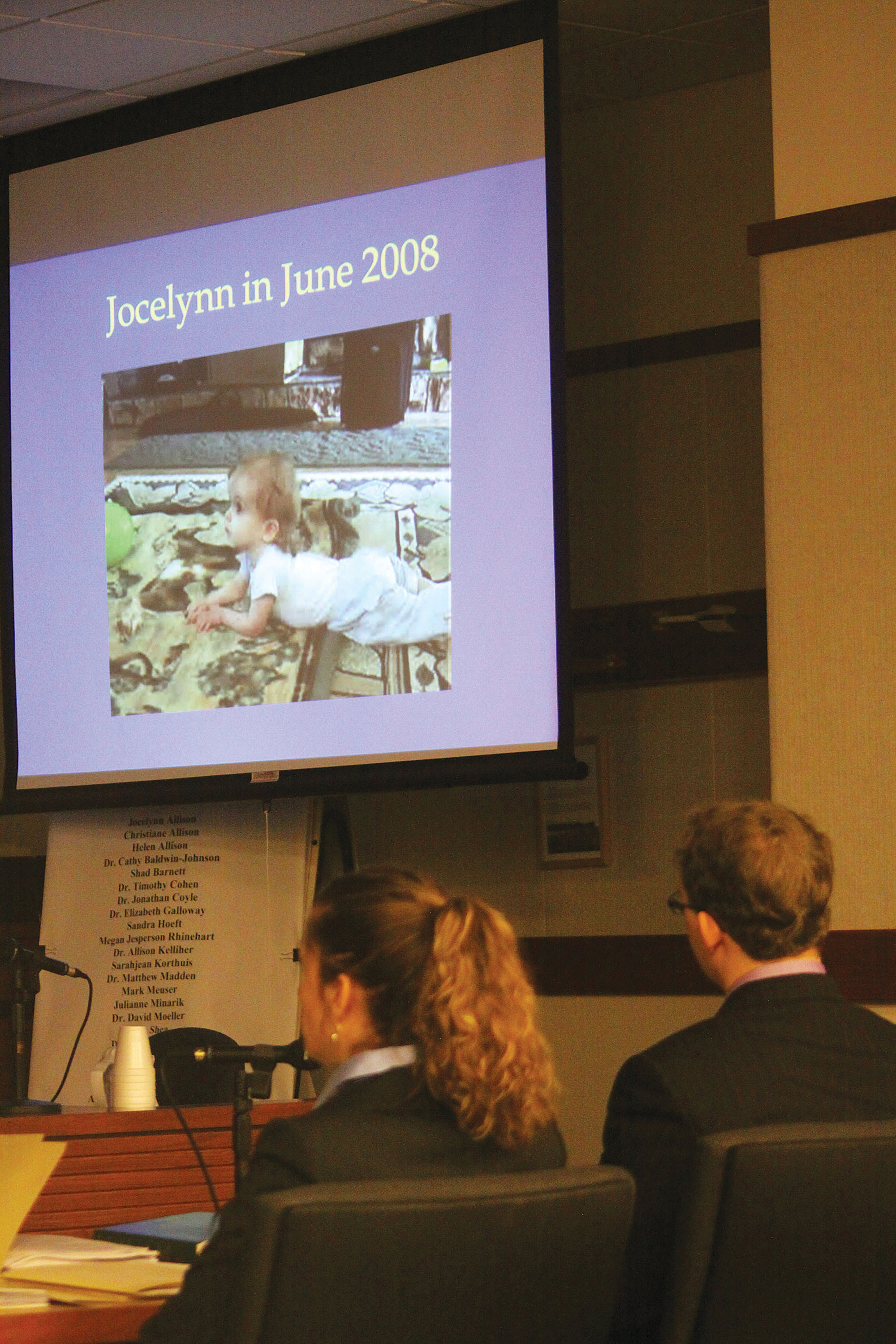
“Jocelynn was described as bright and interactive by her medical providers and by those that loved her,” she said. “They said there was a light in her eyes. When the EMTs arrived, the only Jocelynn they would know was described as catatonic, drooling, and having labored breathing. Her eyes were described as blown, or fixed.”
Surgeons and doctors, some of whom are expected to testify for the prosecution, eventually discovered that Jocelynn’s brain was bleeding, swollen, and bruised. Her neck was injured, and her eyes were unevenly dilated and the retinas were bleeding. A CT scan revealed earlier brain injuries, though the defense disputes the origin of those injuries. Pressure inside her skull was very high, Anderson said.
Jocelynn also exhibited agonal breathing, Anderson said.
“You will hear that agonal breathing is breathing that is gasping and labored, approximately one breath every 30 seconds,” she said.
Anderson paused at this point for about 15 seconds. The courtroom fell absolutely silent.
“Ladies and gentlemen, 30 seconds is a long time to wait between breaths,” she said.
The prosecution expects medical experts to testify that injuries like those found during Jocelynn’s autopsy are almost exclusively caused by a child being shaken or struck by an adult, Anderson said.
“Here’s what we know: we know that at her time of death, Jocelynn was not walking, that she was in the sole care of her father, that she had seriously inflicted injuries and died as a result,” she said. “At the end of this trial, you will be convinced beyond a reasonable doubt that Jocelynn Allison ran out of time … and that her father, not some carpeted stairs, is responsible for her death.”
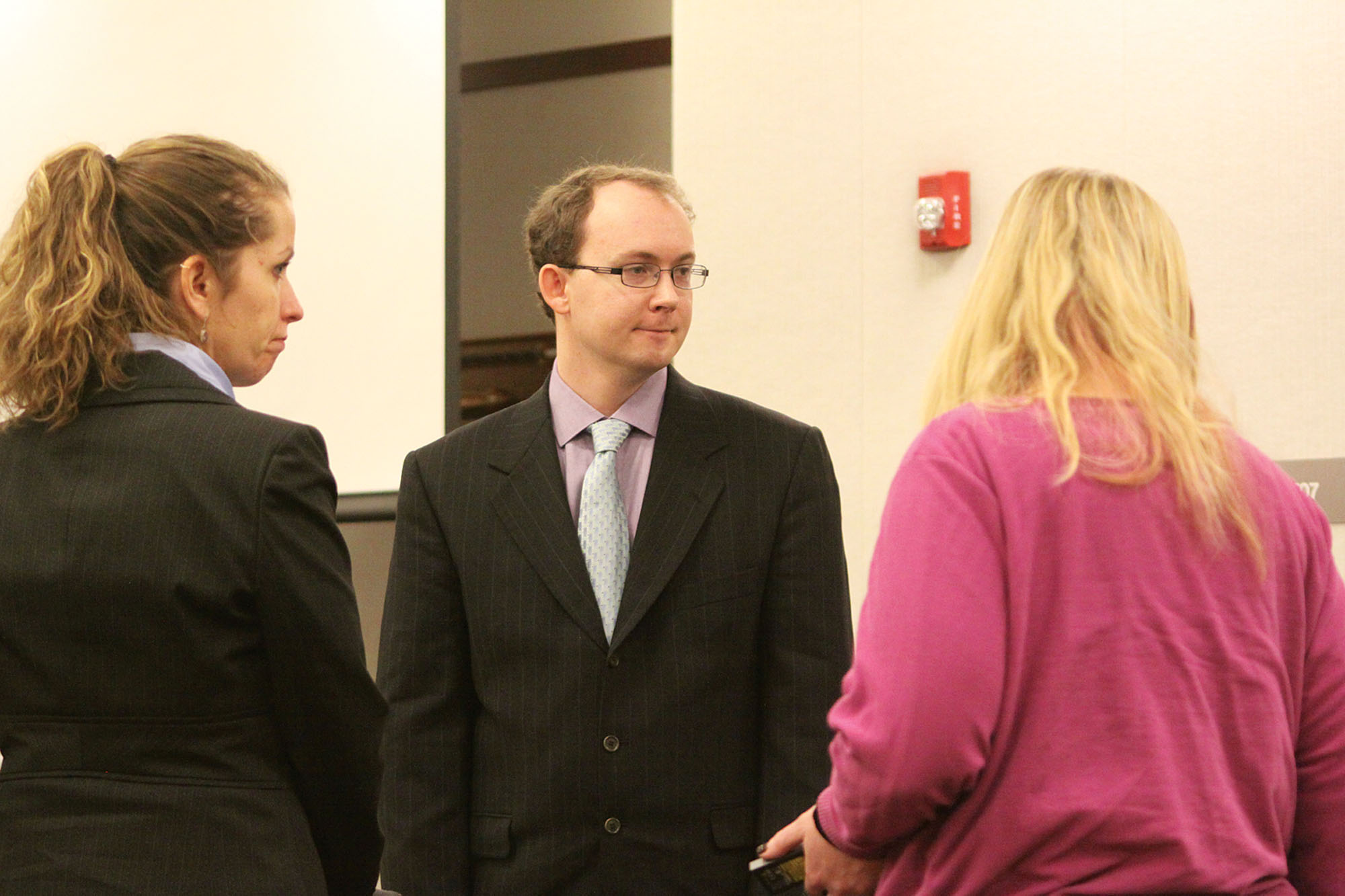
Defense attorney Ariel Toft painted a very different picture of Clayton Allison and the events that led to Jocelynn’s death.
While the circumstances surrounding Jocelynn’s death are tragic, Tofts said Clayton Allison played only one role in them: that of a grieving father.
“We have words to describe most of our pain,” she said. “A child who loses its parents is an orphan. A wife who loses her husband is a widow. But we have no word in our language for parents who lose a child. It is too outside the proper order of things. It is too wrong for us to contemplate, and it is too bleak for us to name.
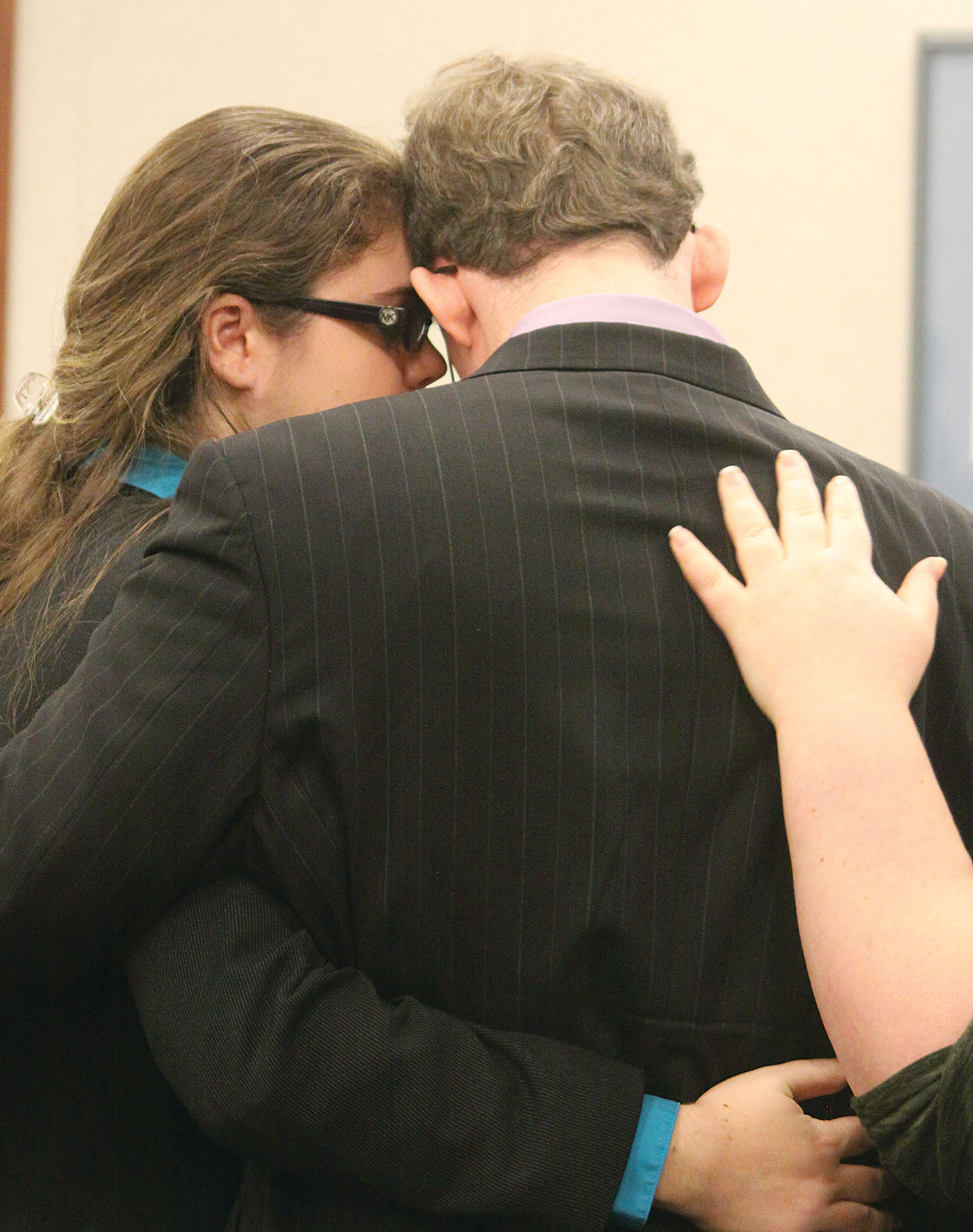
“That pain sits at our table,” she said. “It sits in the gallery with (Jocelynn’s mother) CJ Allison.”
The defense planned to call at least four medical experts, including California ophthalmologist Khaled Tawansy, expected to testify that Jocelynn’s injuries aren’t conclusive evidence of abuse, Toft said.
“Retinal hemorrhaging — bleeding inside the eyes — is something that many physicians incorrectly think means child abuse must be the cause of the injury,” she said. “Doctor Tawansy will testify that that is not correct.”
Retinal hemorrhaging can also be caused by a sudden rise in pressure inside a skull, consistent with a fall down the stairs, Loft said.
Jocelynn also saw what are known as “mandatory reporting” doctors — health care providers legally obligated to inform law enforcement if they see child abuse — at least 41 times in her short life, Toft said. None of them reported anything out of the ordinary, she said.
The phone calls Clayton Allison made the day of his daughter’s death before calling 911 were made before the severity of Jocelynn’s condition became apparent, Toft said.
“Mrs. Allison could hear Jocelynn crying in the background when she talked to her husband, and he informed Mrs. Allison that he had called his mother, who had EMT training,” she said.
“At some point during that conversation, Mrs. Allison will tell you that she heard her husband say ‘Oh my god! I think she’s not breathing,’” Loft added.
The defense also intends to present a recording of a 911 call for the jury, Toft said.
“We’ll hear that 911 call, and on that 911 call, you will hear Mr. Allison try to stay calm,” she said. “You will hear Mr. Allison give directions. You will hear Mr. Allison try to follow instructions from the dispatch.”
Clayton Allison had previously worked as a dispatcher for a security company, and knew the importance of staying calm, Loft said.
When emergency personnel decided to transport Jocelynn via helicopter, Clayton Allison asked to ride in the helicopter, but was told he couldn’t. He drove with his mother to meet CJ Allison at the hospital, Loft said.
“Jocelynn did not survive surgery,” he said. “The evidence will show that her mother learned this news from the treating physician in the halls of Providence Hospital, who caught her alone. The evidence will show that Mr. Allison learned this news from the sound of his wife’s screams down the halls of Providence Hospital.”
In the end, the trial isn’t really a murder trial at all, Loft said.
“This is a trial about a little girl,” she said. “It is a trial about medical history, medical research, medical advances, and medical practices, and about the answers science can and cannot provide us. It is the trial of her father, Clayton Allison, for a tragedy he could not predict and did not cause. It is not a trial about a murder. It is not a trial about a crime.”
Allison confessed to striking his daughter under questioning by the authorities shortly after charges in the case were first filed in 2009, according to court documents cited in a Feb. 11, 2013, Frontiersman story. The jury will not hear the confession during the trial. Presiding Superior Court Judge Vanessa White ruled the confession involuntary since police should have ceased their questioning after Allison mentioned getting a lawyer. It was therefore inadmissible, she ruled in July 2012.
White’s ruling lead to the dismissal of the original charges. However, prosecutors re-filed charges Feb. 1, 2013.
Contact Brian O’Connor at 352-2269 or brian.oconnor@frontiersman.com.

By Jeremiah Bartz Frontiersman.com A football coach using a hockey reference as the centerpiece for his keynote address may

Frontiersman.com With its headquarters in Wasilla, the Frontiersman has been a primary source of news for the Matanuska-Susitna

By Katie Stavick Frontiersman.com The next generation of leaders took flight this week as the Houston High School Class

By Kyle Wilkinson For the Frontiersman Keynote speaker and Carry the Cure President Bill Pagaran’s words boomed through the