Retiring teacher, coach urges Colony grads to ‘find their 68’
By Jeremiah Bartz Frontiersman.com A football coach using a hockey reference as the centerpiece for his keynote address may


WASILLA — It’s been a real sausage fest at Mat Valley Meats.
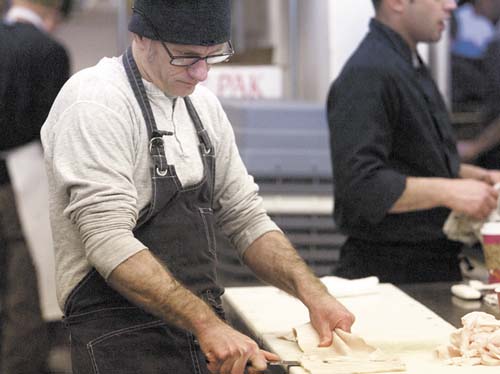
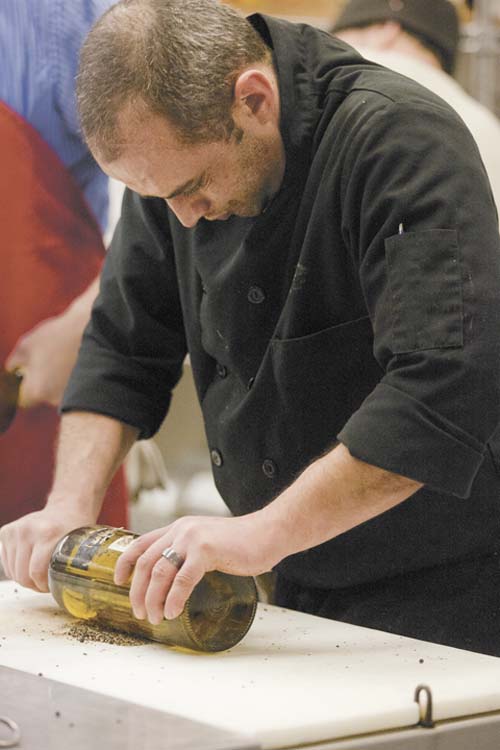
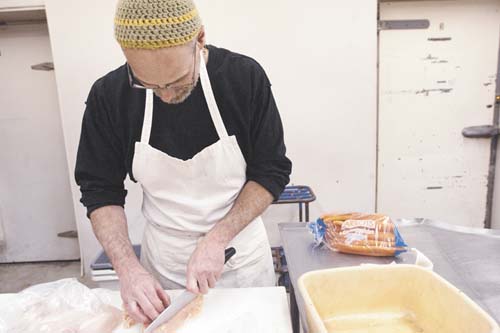
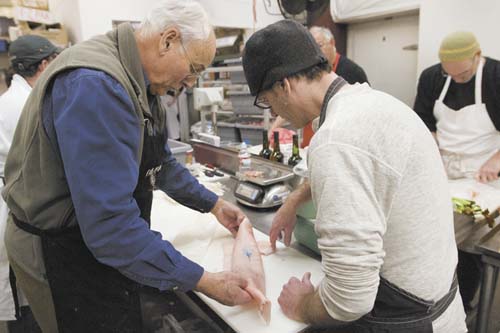
A handful of fine-dining chefs ranging from San Francisco to Minneapolis to New York — most with decades of experience — returned to the classroom this week. The chefs traveled thousands of miles to the Mat-Su Valley to learn from one of the world’s master salumieres, Palmer resident François Vecchio. The Swiss-born master charcuterie has been perfecting the old-world craft of making sausage and cured meats for 60 years.
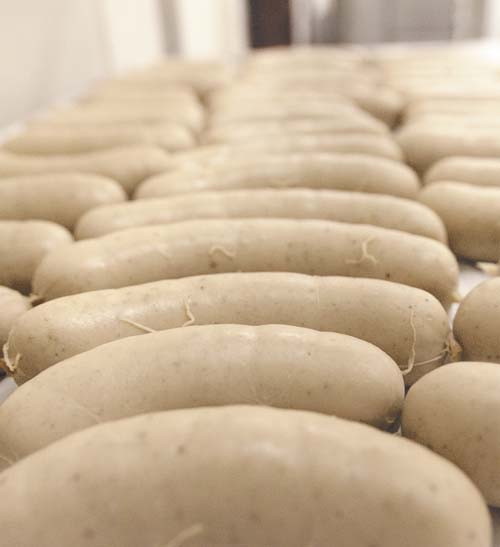
From pancetta, chorizo soria, Genoa salami, sopressata (a dry-cured sausage with fennel and red pepper) and zamponi to paté, boudin noir (also known as blood sausage), porchetta and the sophisticated boudin blanc (a white sausage made with pork, chicken and veal), Vecchio teaches chefs the fine details of his craft.
And it’s nothing like what most Americans are used to eating, he said.
“The core of the difference is that the industry works on numbers,” he said. “They’re driven by bottom lines, they’re controlled by scientists who count microbes and pH and stuff like that. Here, you have chefs who are educated with the taste, the sensitivity to flavor, aroma, looks. You go from a brain-driven relation to a heart, soul-sensitive connection to the ‘real’ stuff, and it makes a world of difference.”
Taste the difference from 6 to 9 p.m., Saturday at the Palmer Depot, when Vecchio’s students’ work will be featured at the Made in Alaska Taste Fest. Hosted by Turkey Red restaurant, more than 25 varieties of sausages and cured meats will be available for tasting. The cured meats are actually from a related teaching session in November 2011, said Turkey Red owner Alex Papasavas.
“It’s exciting to have (the chefs) up here and I’m excited for François to share what he knows with people who are really interested,” she said. “There’s so much talent here in our Valley. The quality, you can’t compare, especially when you do it out of care. It’s very labor-intensive.”
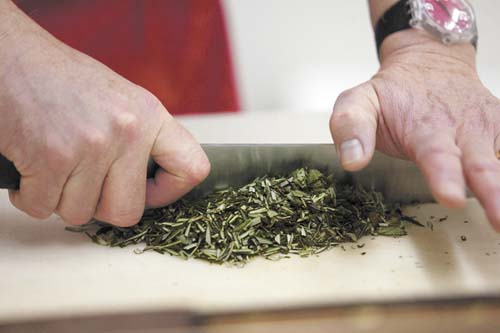
It’s that labor that makes the difference, Vecchio said. He and the chefs spent Tuesday butchering and breaking down five farm-raised pigs, provided by Terry Van Whye of Kenny Lake. They spent the rest of the week preparing dozens of classic and sophisticated recipes. It all starts with the animal, Vecchio said.
“The first thing they learned to do is to break, by hand, and to trim the meat,” he said. “It demands a lot of attention, and if you do it right, you get a better yield. You select and improve the quality of the material you’re going to use for sausage. When you have better quality ingredients, you position yourself to make a better product.”
It’s that level of detail and refinement that drew Christopher Lee, a chef from the San Francisco Bay area. Lee owned the restaurant Eccolo until he sold it two years ago, and before that was the chef at Chez Panisse in Berkley, Calif., for about 20 years. Although he’s been a chef for nearly 30 years and first started learning from Vecchio in the early 1990s, Lee said it’s never too late to learn and refine your craft.
“I came to learn more about curing meat,” he said. “This is a very specialized part of the kitchen. I got into this about 23 years ago on my own and I was sort of shooting in the dark. I went to Italy and learned there, then I met François and he became my mentor in this.”
Lee was working alongside Curt Clingman, who’s been a chef since 1982, also in Berkley.
Learning from a master like Vecchio “is a privilege,” Clingman said. “It’s truly an honor to work with him.”
That humility also was expressed by Ian Gatt, chef de cuisine for Melon’s Catering in San Francisco. When asked what it was like to learn from Vecchio, Gatt showed an arm covered with goose bumps.
“When I’m his age, I’ll call myself a ‘chef,’” he said. “Right now, I’m a sponge, man. I think this is awesome. I never thought I’d get to Alaska and work with all these great people and do all this stuff. I’ve still got chills. You can’t learn this anywhere else.”
For Vecchio, the path to Palmer was pretty straightforward. He moved to California to bring the old-world craft of working with meats to America about 32 years ago. Before that, however, he visited Alaska in 1968. After several vacations and visits over the years, he retired to Palmer in 2005.
“Why does a guy who is retired still go through the trouble of teaching people?” Vecchio asks rhetorically. “It’s a passion. Since I moved to Alaska, looking at the country (here) I see my Alps Valley.”
As he talks, Vecchio pulls out several pieces of meat that have been curing since his first class last November. There’s a long-cured pork loin, pancetta, chorizo soria and several types and flavors of salami. He slices them thin for tasting, and his passion is evident in the level of detail he instills in the chefs working at Mat Valley Meats.
“Ever since humanity has been hunting, preserving meat has been drying the meat,” he said. “Still here in Alaska, the Eskimo dry their salmon, the Indian do the pemmican and dry the meat. The modern industry today does exactly the reverse; they pump brine and water, add phosphate and sell you this ball of meat that you can shave, but are full of water, lack flavor. What we do here is strictly the old-fashioned work. We don’t inject anything, we use a lot of time to cure.”
Nothing is wasted, either, Vecchio said. The skin from the pigs is used to make cracklings, the ears and snout go into head cheese and the blood is used to make sausage.
For Mat Valley Meats owner Nate Burris, having Vecchio and the chefs working from his store is a pleasure, he said. He relates their work to making fine wine.
“They’re very precise,” he said. “It’s very different (from supermarket product), it’s like fine wine. The stuff you buy in the store is Mad Dog 20, this here is premium.”
It’s that reaction to industrialized, processed meats that keeps Vecchio going. As an example, he shows what he calls a “real” ham — a properly butchered piece of meat that’s been carefully cooked, without any water or artificial flavoring added.
“Here’s a ham, a real ham, that has not seen a drop of water,” he said. “That’s ham, all the rest is water sold as ham.”
Contact reporter Greg Johnson at greg.johnson@frontiersman.com or 352-2269.

By Barbara Hunt Palmer Buzz It was 6:43 on Friday morning and the Plant Owner was sound asleep when
By Frank Murkowski Opinion Is the threat to Alaska real? I believe it is. The continuing conflict involving Iran is

By Kyle Wilkinson Frontiersman Memorial Day Weekend was filled with a variety of events in Willow. From live music to

Farmers markets set to open June marks the beginning of freshly grown Alaska produce showing up around the Mat-Su