Retiring teacher, coach urges Colony grads to ‘find their 68’
By Jeremiah Bartz Frontiersman.com A football coach using a hockey reference as the centerpiece for his keynote address may


PALMER — Too often in the woods, most folks are looking up: at the trees, the birds, or where the trail is headed. Dr. Gary Laursen would prefer you look down once in a while, because that’s where the action is, for a mycologist like himself or for anyone interested in the careful harvest of mushrooms.
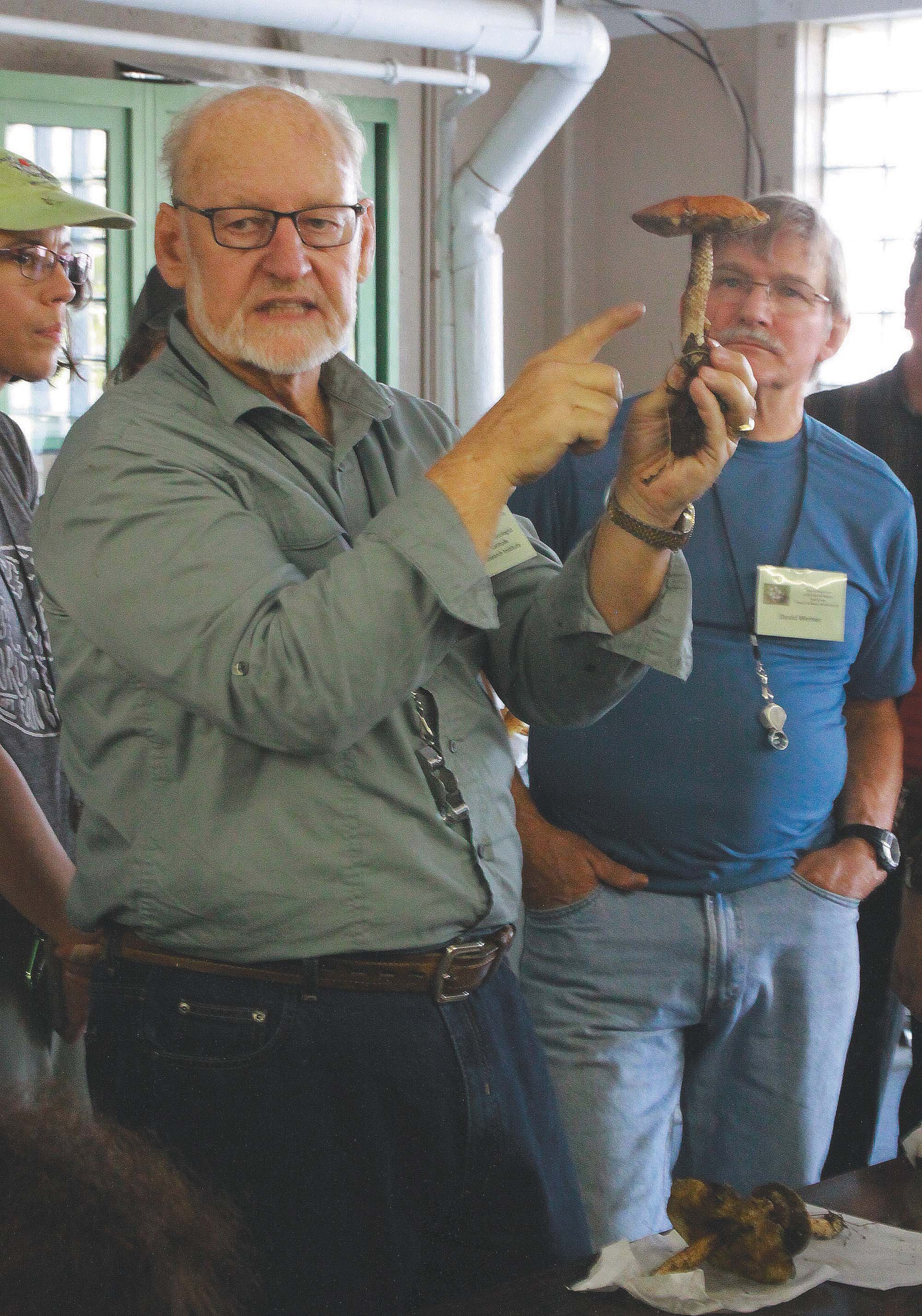
The University of Alaska professor returned to the Valley this week to host his third mushroom workshop in as many years, a three-day event organized through the Mat-Su Cooperative Extension Service that mixes classroom time with a few hours spent roaming the woods for fungi. The class — $100 for the full three-days — is capped at 25, and fills up in a hurry.
Laursen, an adjunct research professor and the director and president of the High Latitude Mycological Research Institute at UAF, said the noncredit class gives him the opportunity to share his years of experience and research with those interested in mushroom identification on any number of levels — from academic to the weekend harvester.
“I love sharing this with people,” Laursen said of mycology, the scientific study of fungi. “It is my passion and near and dear to my heart. I think more people are showing an interest in harvesting for food, and it can be done — in a careful way.”
Laursen just published his second field guide, “Alaska’s Mushrooms: A Wide Ranging Guide,” which he wrote with Neil McArthur.
Mushroom hunting can be a tricky. Eating an amanita can be deadly, while different types of bolete mushrooms — many are celebrated for their taste — can cause digestive distress in some people.
A three-hour classroom session Friday night led to a day of field exploration Saturday and Sunday. Saturday’s class got underway midmorning when Laursen led the group on a sweep of the trails near the experiment farm. Not 50 yards down the path a couple of puffballs were discovered. After many walked by a seemingly innocuous-looking log, Laursen brought them back and flipped it over, exposing several attached daedaleopsis confragosa, a polypore fungus. A few minutes later he held up a flammulina velutipe, the wild version of the enoki mushroom found in supermarkets.
“Is it edible?” Laursen asked in response to a question. “You bet.”
After an hour and a half, the dispersed group returned to the experiment farm shop, where they spread out their finds to fill up some 12 tables. Laursen said the collection represented 11 common groups that included lichen, polyspore, slime molds and cup fungi.
Class participants, longtime Valley physician Dr. David Werner and Anchorage resident Barbara Bachmeier, stopped to look over a table that held a wide range of amanitas, lichen, some slime mold and a couple of boletes.
“It is cool,” Werner said. “I have always been a mushroom hunter, but this gives me a broader understanding of what’s down there.”
The workshop was Bachmeier’s first, and wouldn’t be her last, she said.
“I missed last year’s workshop,” she said. “At there is just such a wealth of information that has come from this that I plan to come back next year just to be better prepared to sort through it again.”
Contact reporter Steven Merritt at 352-2269 or steven.merritt@frontiersman.com

By Jeremiah Bartz Frontiersman.com A football coach using a hockey reference as the centerpiece for his keynote address may

Frontiersman.com With its headquarters in Wasilla, the Frontiersman has been a primary source of news for the Matanuska-Susitna

By Katie Stavick Frontiersman.com The next generation of leaders took flight this week as the Houston High School Class

By Kyle Wilkinson For the Frontiersman Keynote speaker and Carry the Cure President Bill Pagaran’s words boomed through the