Retiring teacher, coach urges Colony grads to ‘find their 68’
By Jeremiah Bartz Frontiersman.com A football coach using a hockey reference as the centerpiece for his keynote address may


PALMER — Members of the fastest growing prison population in the state peered through two-way glass at a small group of corrections officials about 10 a.m. Friday.
Some merely glanced sideways through the glass and kept walking. Others lingered or stared at the interruption to their routine.
It was an average day at the self-contained Mat-Su Pretrial Detention facility. Inmates were getting ready for lunch service from the unit’s small kitchen, which has two meal stewards and small crews of between four and six inmate workers. Department of Corrections officers made the rounds through the facility, keys jangling, whie a few inmates hurried down a chilly hallway from the central dorm areas to the medical and intake side of the building.
“It’s amazing how fast people walk once it starts getting cold outside,” said corrections lieutenant Robert Larson.
You might not know it from looking — the Frontiersman’s chaperoned tour did not include the housing modules or the facility’s segregation unit, which are off-limits to visitors for security reasons — but it was another relatively crowded day at the facility, which was originally built to house 102 inmates, but instead housed 110 on Friday.
The obvious solution would be to build more beds, though officials like Larson acknowledge the sometimes-repetitive nature of that request.
“We would love more space,” he said. “Corrections is an industry that will always ask for more space.”
Over the last year, Pretrial has averaged a weekly population higher than the building’s design capacity, Larson said. The facility isn’t alone in the numbers crush. Figures presented to the Alaska Legislature in July showed a state prison population that has increased by 27 percent since 2005. Projections show an anticipated 27 percent increase over the next decade with the expectation that the correction system’s in-state capacity will be exceeded by 2017.
Mat-Su Pretrial serves primarily as short-term housing for the adjacent Palmer courts, as well as a jail for the Valley’s three law enforcement agencies. Officials regularly organize transfers to Goose Creek Correctional Center in the Point MacKenzie area and Hiland Mountain Correctional Center in Eagle River to clear space. Of the various segments of inmate populations, pre-trial inmates (those who have been accused but not convicted) are growing fastest, up roughly 80 percent in the last decade.
The $240-million Goose Creek facility opened in 2012 with 1,536 beds for medium-security inmates. At the time, it was intended to bring criminals back to Alaska from other states.
With swelling populations come increasing costs associated with housing inmates (roughly $327 million in 2014, up from $126 million in 1995, according to figures compiled by the Pew Charitable Trusts). That fact prompted legislators to send a letter asking for reduction ideas from the newly minted Alaska Criminal Justice Commission. Legislators requested policy options for population reductions of zero, 15, and 25 percent, all of which hinge on “averting all future prison growth.”
“Prison beds are expensive and should be reserved for those who have committed the most serious crimes and who pose the greatest risk to our communities,” the letter read in part. “In this budget climate, the ability to invest in treatment and services only becomes possible with a reform package that results in substantial, real net savings to the State.”
That contrasts with the current situation, where misdemeanor offenders make up 76 percent of sentenced inmates. Violent felons account for 10 percent, according to the Pew figures.
Some temporary measures have already been adapted to adjust to overcrowding. Officials have frequently made use of “boats” when regular beds are full. A boat looks like a heavy-duty colorless child’s plastic sled scaled up to adult-size and lined with gym mats at night (during the day, the mats and boats are stacked in one corner to save space). Inmates use them in different styles, inverting them to elevate themselves a few inches off the floor, or putting them flat-side down and sleeping in them like a boat, Larson said.
The typical inmate visit to Mat-Su Pretrial starts in a small room with a large cage and three cells at the end of the cold hallway. Inmates who behave are put in the cage with other inmates, while more unruly, violent, or dangerous inmates end up alone in a cell. Inmates are fingerprinted and searched, and Corrections officers store personal property in cartons for safekeeping.
From there, inmates enter the day-to-day routine of the jail. Fights over television — five channels — are more infrequent than in the past, Larson said. He said the most popular programs are basketball and football games, and, ironically, the law enforcement documentary “Cops,” though Larson isn’t sure why. Non-denominational religious ceremonies are held in small rooms adjacent to where video arraignments are held, and the visitor booths with the telephones on either side of a window. Inmates who step out of line, who are in danger, or who commit rules infractions or crimes inside end up in the segregation unit. Inmates who follow the rules get time outside in the exercise yard, when the weather allows it.
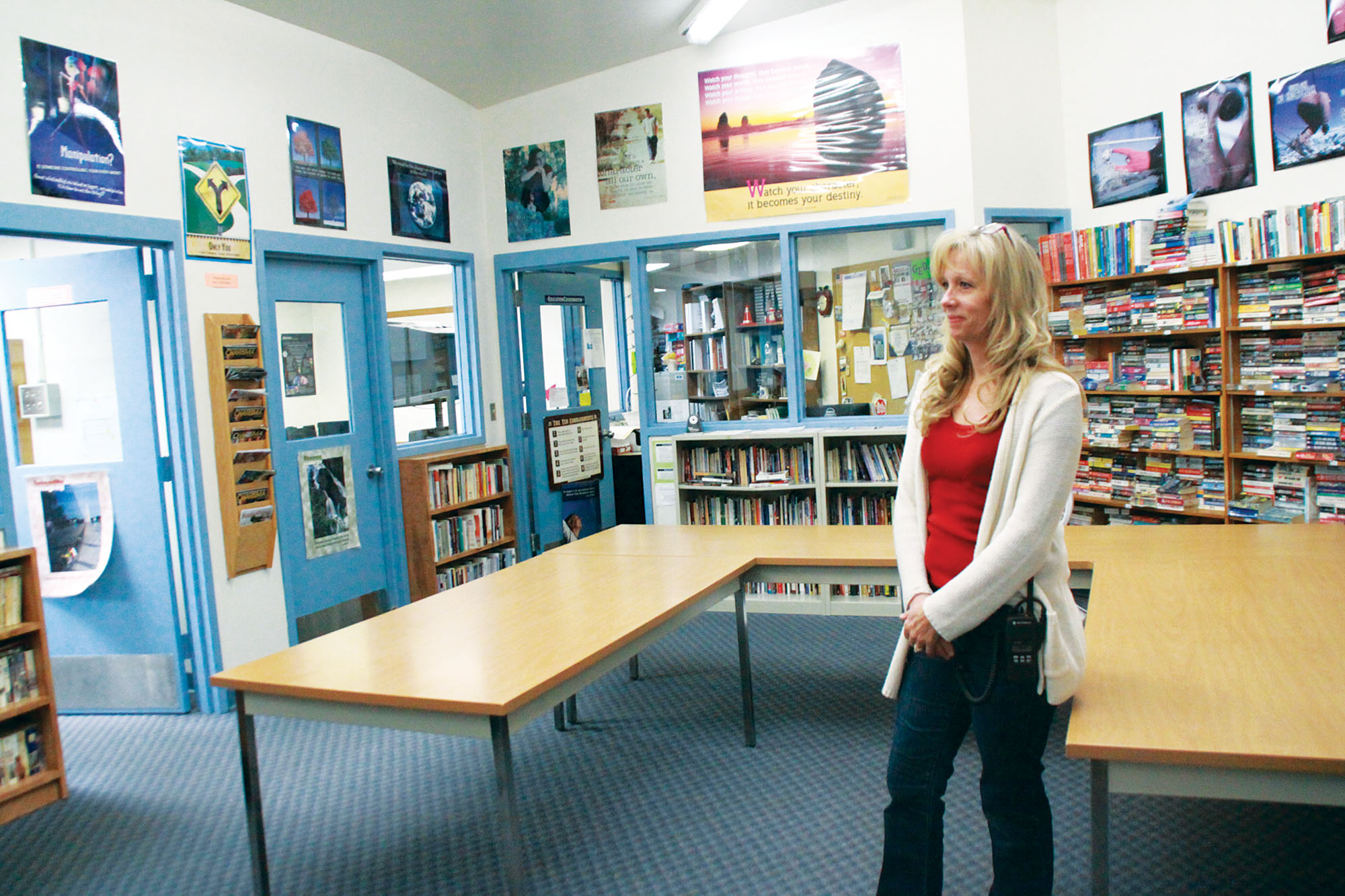
Mat-Su Pretrial also has a library lined with laminated inspirational posters, with access to the law library and shelves of paperback-bound novels. Educational coordinator Kaye Saxon emphasizes parenting classes taught from curriculums developed by the National Fatherhood Initiative and Parenting With Dignity. She’s also helped people pass the General Educational Development test.
“It’s really rewarding to have that educational opportunity for them,” she said.
More women are also walking through the doors of the jail. On Friday, 16 female inmates were at the facility, where the typical numbers were in the single digits, Larson said.
“The numbers have gone up twofold,” he said.
The shifting demographics and calls for reform come amid a shift in leadership at the facility. New superintendent Tomi Anderson took over the reins this summer following a stint at the helm of the Palmer Correctional Center and the retirement of the prior superintendent. The move represents something of a homecoming. Anderson’s career in corrections started at Mat-Su Pretrial.
She’s proud of her department and the facility, and said her biggest job is getting people out of jail and successfully back into society.
“The first day of incarceration is really the first day of their re-entry,” she said.
Contact Brian O’Connor at 352-2269, brian.oconnor@frontiersman.com, or on Twitter @reporterbriano.

By Jeremiah Bartz Frontiersman.com A football coach using a hockey reference as the centerpiece for his keynote address may

Frontiersman.com With its headquarters in Wasilla, the Frontiersman has been a primary source of news for the Matanuska-Susitna

By Katie Stavick Frontiersman.com The next generation of leaders took flight this week as the Houston High School Class

By Kyle Wilkinson For the Frontiersman Keynote speaker and Carry the Cure President Bill Pagaran’s words boomed through the