Retiring teacher, coach urges Colony grads to ‘find their 68’
By Jeremiah Bartz Frontiersman.com A football coach using a hockey reference as the centerpiece for his keynote address may


PALMER — The City of Palmer celebrated Alaska Recycles Day on Tuesday, hosting an event highlighting the newly formed Mat-Su Bag-It committee, along with discussions on the Mat-Su Borough’s Central Landfill and recycling efforts, and information booths set general refuse waste disposal. Palmer Deputy Mayor Linda Combs kicked off the evening with an official declaration noting the city joins in Alaska’s efforts to increase recycling.
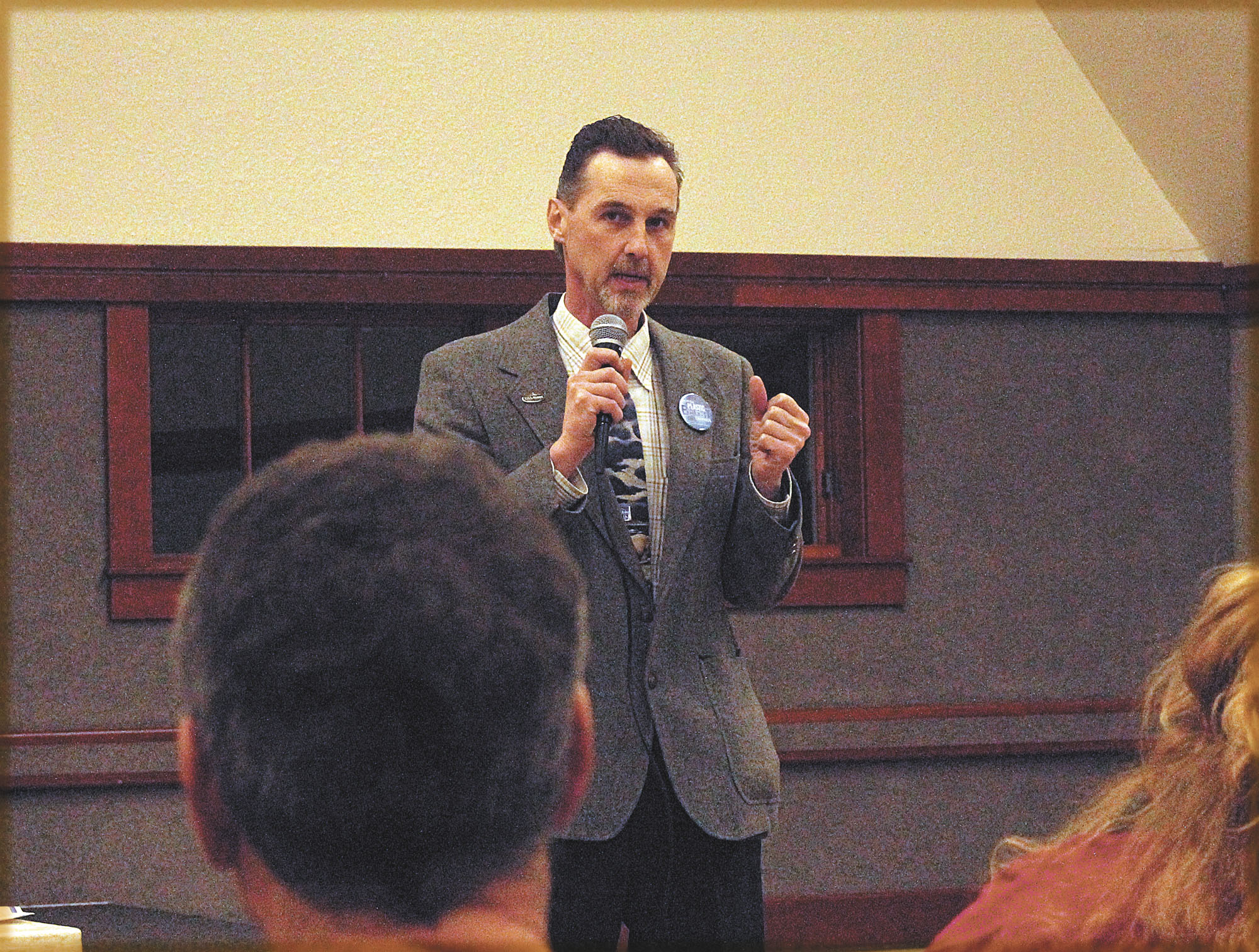
The Bag-It committee is the newest effort of the Mat-Su Recycling Coalition with a goal of reducing waste being pumped into the borough’s Central Landfill. Bag-It committee member David Johnson addressed the gathering on an effort to gauge the community’s feelings on the topic of the free plastic stores provide their customers.
“The coalition has made a positive impact,” Johnson said. “We now have (refuse) transfer stations, and the composting program...but we can always grow.”
Johnson said the lightweight, plastic bags most everyone carries out of a store can be seen almost everywhere. He encouraged everyone to take a look the next time they go outside.
“Look around. They are in the bushes and the trees,” Johnson said. “The committee is just trying to find out the interest...what are the options?”
Johnson said statistically, the average American collects 385 plastic shopping bags annually. He said even getting that number down to 200 bags a year would have a major ecological impact.
To do that, the committee has started sampling borough residents with a two-question survey. The goal is to determine whether they would be willing to either pay a fee for each bag used, and if so, how much; or would they favor eliminating the option. Johnson said Americans have become very accustomed to the plastic bags using them for a lot of things including emptying the cat’s litter box to packing a lunch.
“We were emptying litter boxes before they came along,” Johnson pointed out. “People have become pretty comfortable with the bags...they weren’t around 20 years ago. We’ve gotten pretty used to the convenience of a free shopping bag...what in the world do you know that is free?”
He said what appears to be free is inevitably paid for on the back end. Johnson said those bags either end up occupying valuable space in a landfill or worse yet, littering the landscape.
Johnson said about 14 to 16 individuals comprise the committee, which has been meeting for about six weeks. He said campaign members wanted to keep the survey simple and committee members will continue the campaign about a year.
“We wanted to create a little bit of a buzz and then lighten up before Christmas. Then we’ll probably pick things back up after the first of the year,” Johnson said. He said several major borough stores have been contacted about allowing committee members to survey customers. “Wal-Mart is on board and were talking with others.”
In the short time that word has been out about both the campaign and survey, Johnson said he’s received well over 100 responses. Both Central Landfill and VCRS have survey links on their Facebook pages. Those wishing to take the survey can visit the pages or go to its direct link--https://www.surveymonkey.com/r/XH9KQ5B.
Among the questions Johnson answered was how can the public get involved with the effort. He said the committee welcomes additional help in collecting the surveys. In fact, Johnson noted help collecting data is needed this weekend in the Palmer-Wasilla area. Anyone wanting to donate a couple hours of their time to help can call Pam at Valley Community for Recycling Solutions (VCRS) at 907-745-5544.
Johnson’s presentation was the last item on the agenda. Borough solid waste manager Butch Shapiro started things off with a Central Landfill overview. He addressed where the landfill stands, what the future holds and focused on the high costs associated with meeting state and federal requirements. Shapiro said Central Landfill is currently the third largest in the state and is poised to move ahead of Fairbanks for second-place.
Shapiro also talked about the importance of recycling and its ability to keep as much as possible out of the landfill’s waste stream. He said technology is also lending a helping hand. One area under investigation is the use of a bio-reactor, which uses much of what ends up at the facility to produce methane. Another option is pyrolysis which utilizes heat to reduce plastics and tires back into fuel. Both are petroleum-based products. In turn, the energy generated in the processes could be used in borough facilities or sold back to the power grid.
Shapiro wrapped up his segment focusing on a new phone application called “Trash App”. It will allow individuals to directly report locations of abandoned waste, white goods and automobiles. He said it will work on both Android and iPhone platforms, and is expected to be online within the next year. He said a link will be placed on the borough landfill webpage once the application is up and running.
“It’s just the first app designed to increase communication between residents and your borough team of dedicated locals that want to provide you with a way to help us make a difference,” Shapiro said.
His presentation was followed by VCRS Director Molly Boyer. Boyer gave an overview of recycling operations. With the center’s new baler, it has a much greater capacity to handle additional recyclable materials. She encouraged those attending to get the word out and help do their part for the cause.
VCRS volunteers Pam Huyck and Susie Hayes, with help from Palmer City employees David Sutton and Ailis Vann, provided an interesting take on recycling.
Sutton, a Palmer Department of Public Works employee, hauled in a refuse bin containing family refuse Vann collected over a week’s time. As the items were dumped on the floor —with all food scraps contained in their own separate bag, Huyck, who is also VCRS outreach coordinator, began explaining what items were and weren’t recyclable.
As the pile was whittled down, it became quite obvious that about three-quarters of the waste could be set aside for recycling and thus kept out of the landfill. Discussing plastic products, Huyck said the “recycling triangle” placed on items by the industry, doesn’t necessarily mean the item can be recycled. The number inside the triangle plays an important part in that determination. More information on what plastics can be sent to VCRS is available on its website--valleyrecycling.org, or on handouts available at many businesses throughout the borough.
Boyer wrapped things up for the segment inviting the public to visit the center, participate in the classroom and “work together and turn it around”.
In addition to the presentations, a number of representatives from the industry were on-hand. Included were Alaskans for Litter Prevention and Recycling (ALPAR), local recyclers and pick up service providers, and refuse haulers.

By Jeremiah Bartz Frontiersman.com A football coach using a hockey reference as the centerpiece for his keynote address may

Frontiersman.com With its headquarters in Wasilla, the Frontiersman has been a primary source of news for the Matanuska-Susitna

By Katie Stavick Frontiersman.com The next generation of leaders took flight this week as the Houston High School Class

By Kyle Wilkinson For the Frontiersman Keynote speaker and Carry the Cure President Bill Pagaran’s words boomed through the