Retiring teacher, coach urges Colony grads to ‘find their 68’
By Jeremiah Bartz Frontiersman.com A football coach using a hockey reference as the centerpiece for his keynote address may


PALMER — At the corner of Airport Road and the Old Glenn Highway in Palmer sits the imposing Mat-Su Area office of the state of Alaska Division of Forestry. Located strategically adjacent to the Palmer Airport, the office includes a sprawling administration building and training center and a huge supply warehouse. But more impressive than the buildings, their world-class backdrop of both Matanuska and Pioneer peaks and the multiple neon green engines lining the large parking lot is a fine-tuned staff of men and women who coordinate and fight wildland fire in the Mat-Su.
From the top ranks of fire prevention officers to on-call emergency firefighters, the Palmer office boasts a group highly trained, experienced, dedicated crewmembers that are passionate about their work.
State Forestry Wildland Fire Management is part of a huge collaborative firefighting effort in Alaska that includes the Bureau of Land Management, U.S. Forest Service, National Park Service, Bureau of Indian Affairs and local fire departments. This collaborative approach to fighting fires is unique in the U.S. and was borne out of the 1996 Miller’s Reach Fire in the Mat-Su Borough.
Commanded by the Alaska Interagency Coordinating Center in Fairbanks, Alaska deploys a tactical process of prioritizing wildland fire suppression and allocating resources of tankers, helitack crews, elite firefighting crews (including 73 Village Hotshot crews), engine crews and smokejumpers.
“The Miller’s Reach Fire provided a catalyst for interagency collaboration,” said Phil Blydenburgh, assistant fire management officer. “Lessons learned then prompted agencies to train and work together.”
Alaska experiences 600 to 800 fires per year, according to a report by the state of Alaska, Department of Natural Resources, Division of Forestry, Wildland Firefighting and Aviation Basics. Last year, there were about 100 in the Mat-Su, caused mostly by burn barrel, campfire and open-burn incidents. Of the fires in Alaska last year, 85 percent were human-caused.
Norm McDonald, fire prevention officer, began as an emergency firefighter stationed in Big Lake right out of high school in 1989. Like most of the staff at the Palmer office, McDonald worked his way up through additional training and years of experience on the job.
He said the facility’s location next to the Palmer Airport provides quick access to both the helitack and tanker bases. The facility also includes a dispatch center, a large warehouse that hosts multiple engines, supplies and plenty of space and grounds for training. This all translates as an opportunity for swift dispatch of crews and supplies during an emergency.
“It’s a tough job, very arduous and anything but glamorous,” McDonald said.
He said the goal is always to catch fires quickly, keep them manageable and protect the people and property at risk.
Wildland Firefighting Training (sometimes called Red Card Training) wrapped up its weeklong Palmer session Friday. This entry-level firefighting training is available each spring at various agencies throughout the state and is offered at the Palmer area office in April. The training is required for persons who want to get a foot in the door for any position within the organization.
The Palmer area office houses six F-550 engines that carry 300 gallons of water manned with two- to four-person crews. They also have four engines that carry 800-1,000 gallons also with two four-person crews. A helitack crew with helicopter contracted through Evergreen rounds out the group. The helitack and engine crews rotate weekly so that firefighters are cross-trained and allow for a more even workload.
Two full-time, 20-person hand crews operate out of the Trunk Road facility. The Pioneer Peak Interagency Hotshot Crew is highly trained and highly experienced. The Gannett Glacier Crew also has 20 members and is classified as a Type II Initial Attack Crew.
Besides the two hand crews, the office maintains an auxiliary crew of emergency firefighters who remain on-call throughout the season.
The class this week taught the basic command system, language and work force structure, tool use and safety, fire behavior information and shelter deployment training.
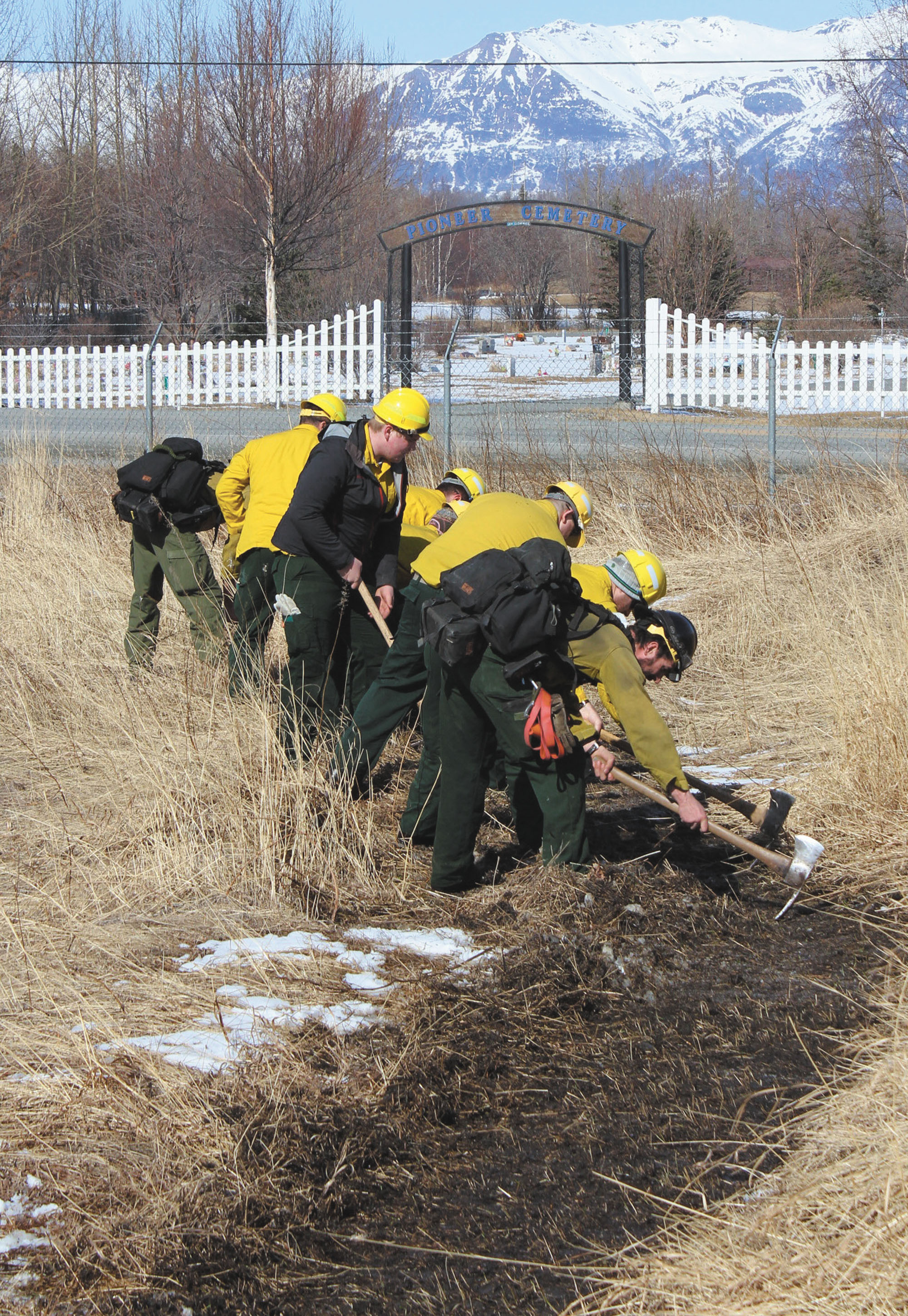
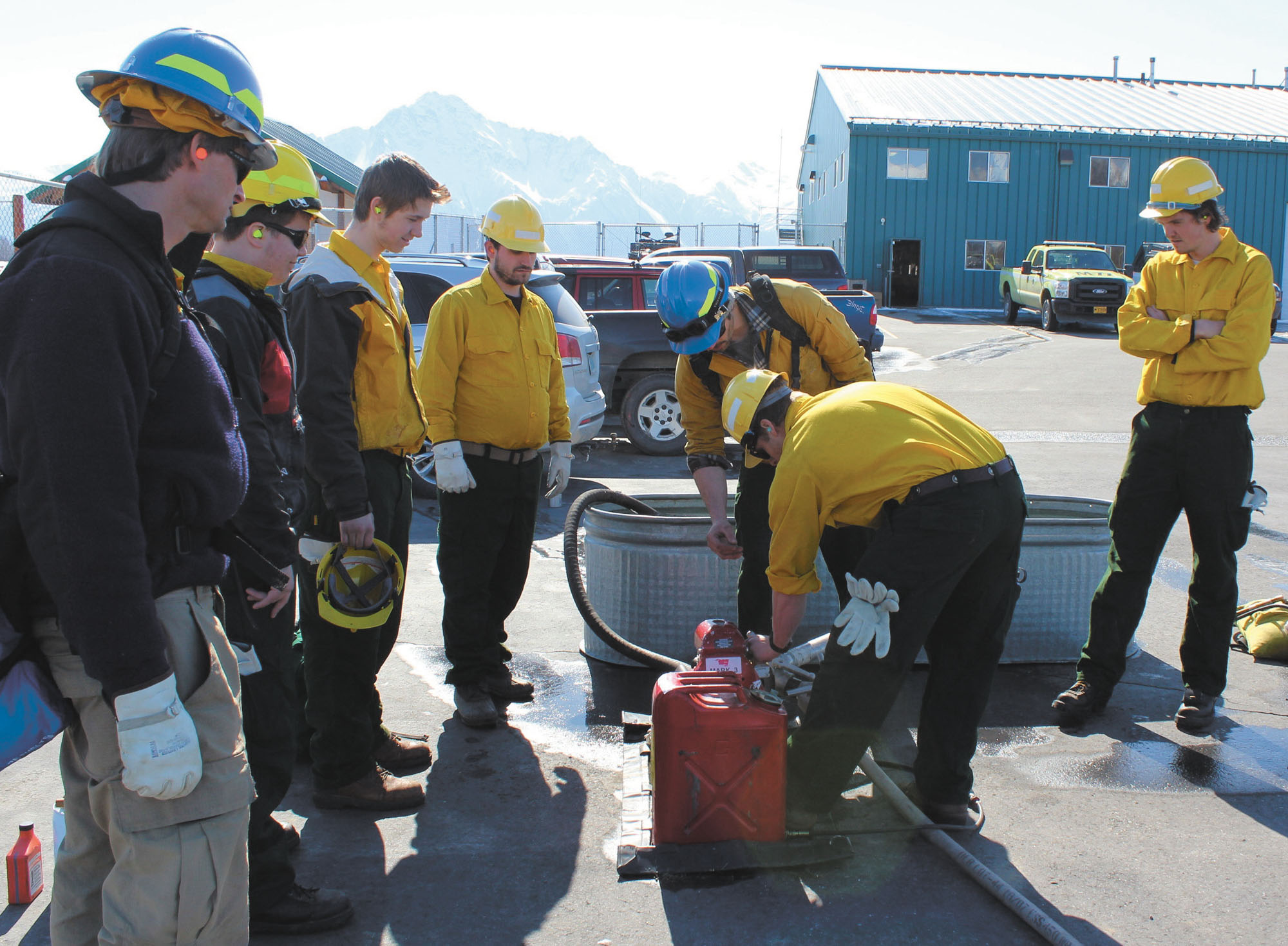
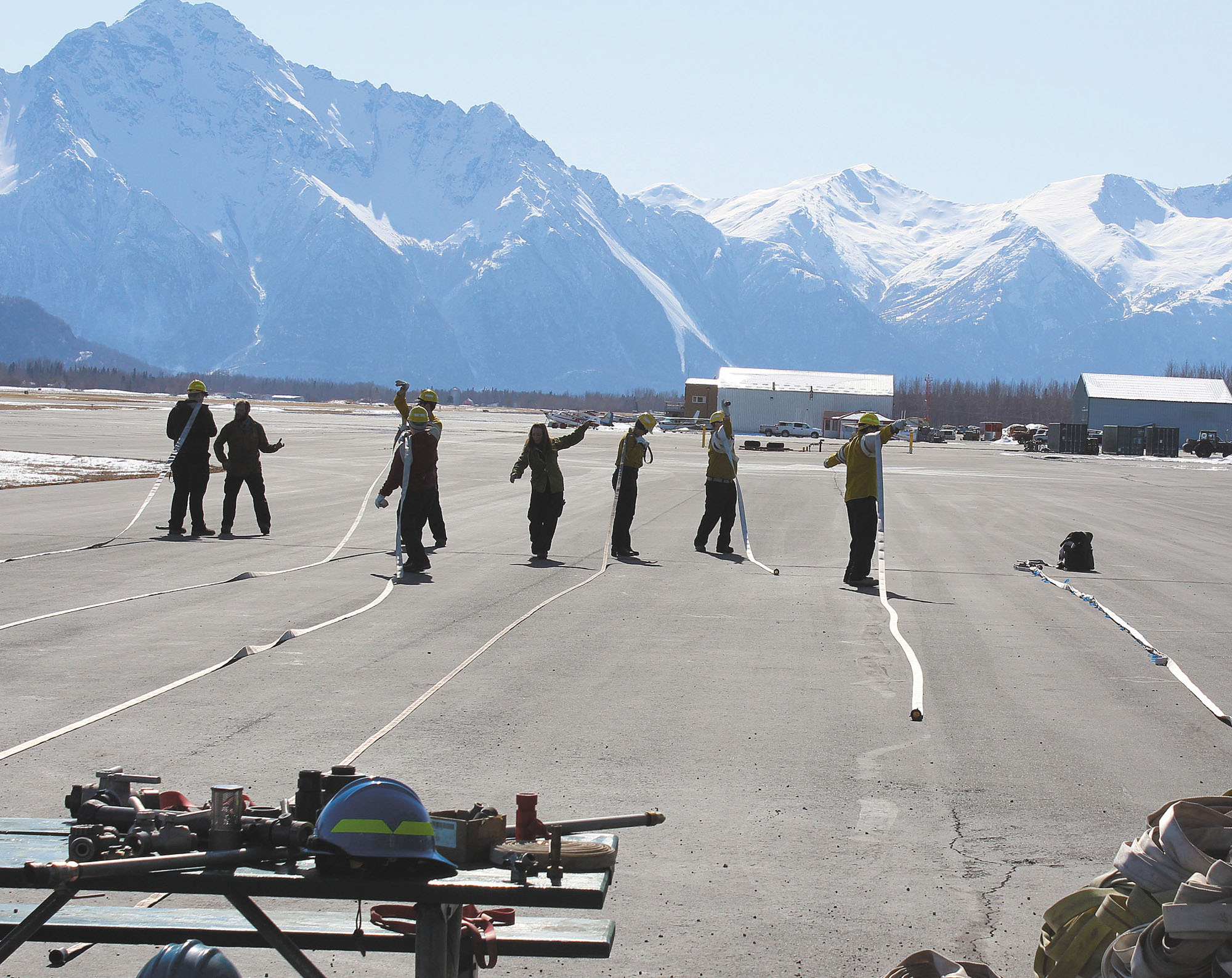
Friday, students put their classroom training to use in hands-on activities, including fire line building with pulaskis, maps and compass use, hose packing, pump operation and how to sharpen and maintain equipment. Unit exams follow each class.
To receive a red card, potential firefighters must also complete a pack test, which requires carrying a 45-pound pack three miles in 45 minutes. Persons who pass both the exams and pack test receive several certificates in Basic Fire Behavior, Basic Firefighting and Instant Command Systems. Some graduates may immediately find work on the Pioneer Peak or Gannet Creek crews. Others join the auxiliary crew as emergency firefighters for the summer.
•••••
Lori Wiertsema, also a fire prevention officer, focuses her work on burning permits, public education and enforcement. Wiertsema said she began basic training as a mother of three in Arizona, where she fought fire as a volunteer. She made her way north to Anchorage in 1998 and then shortly thereafter moved to Willow.
Wiertsema said a big issue for prevention is improper burn barrels. She said that over time, burn barrels become full of ash and the bottom rusts out. Burn barrels are often left unattended, lack a proper perimeter, require a screen, or are used when windy or to burn non-combustibles. She said most people obtain a burn permit as required, but she encourages people to read the permit and follow its directions, including actually calling in when they are planning to burn and actually listen to the recording.
She asked that Valley residents to pay close attention to fire suspensions and closures. Wiertsema said the office only issues a burn suspension or closure when absolutely necessary for safety.
She also recommended that homeowners learn about defensible space and referred people to Firewise Alaska. Get on the list for a free wildfire risk rating by calling 373-8823. Find more information online at bit.ly/QhG8aT.
•••••
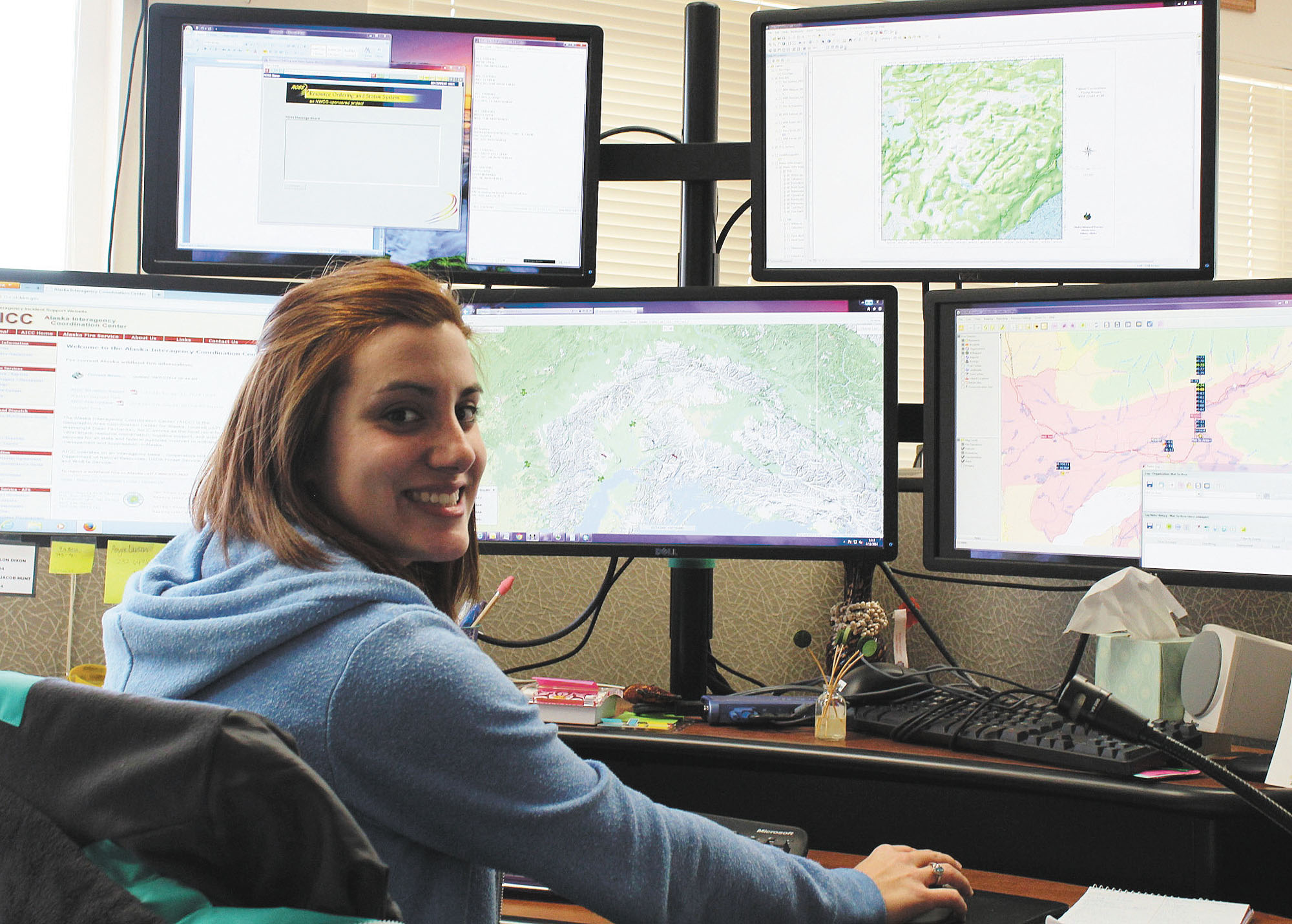
Becky Metcalf and Tessla Mallo work dispatch. Their office space is dominated by a mass of computer screens. Maps, data, reports and radio transmissions spread over the monitors. These two energetic ladies work staggered shifts. When the fire season heats up, they close dispatch only when their crews end suppression activities each night.
“I like this job because it is so diverse,” Metcalf said. “You never know what’s going to happen on any given day, but it’s never boring. We get a fire and we take care of it.”
Metcalf rattled off a list of acronyms and quickly defined them. She explained how they practice Integrated Fire Management using the Computer Automated Dispatch system.
The Alaska Management Plan defines four protection levels for all areas of the state. “Critical” designation tops the list with focus on protecting human life and inhabited property. “Full” includes cultural and historic sites, uninhabited property and high resource areas. The “modified” option includes the same coverage as full, but depending on the demand for fire suppression resources may be downgraded to “limited,” which encompasses remote areas difficult to protect and hold minimal resource value.
Not all fires in the Valley warrant the allocation of crews or resources. Weather plays an important factor and often dictates aggressiveness of an attack. Resources already expended may influence the protection level given a fire.
Mallo is one of the newer members to the fire team, even with four years on the job. She initially worked as an emergency firefighter during a rainy summer and didn’t see much firefighting.
“But it was great to learn that aspect of the job,” she said. “I had great teachers and now I have a great job. That training gave me a better appreciation for what firefighters do.”

By Barbara Hunt Palmer Buzz It was 6:43 on Friday morning and the Plant Owner was sound asleep when

By Kyle Wilkinson Frontiersman Memorial Day Weekend was filled with a variety of events in Willow. From live music to

By Kyle Wilkinson For the Frontiersman The Susitna Valley Emergency Preparedness Fair will be held at the Willow Community Center

By Barbara Hunt Palmer Buzz Green-Up happened at exactly 9:34 am on Saturday morning in Palmer. This was