Retiring teacher, coach urges Colony grads to ‘find their 68’
By Jeremiah Bartz Frontiersman.com A football coach using a hockey reference as the centerpiece for his keynote address may


GATEWAY — In a state where the oldest continuously published newspaper is 113, a centenary celebration is a big deal.
Which is why, when staff members at the University of Alaska Fairbanks Matanuska Experimental Farm gathered to celebrate on June 30, the mood was mostly jovial and nostalgic, even as staff members grappled with recent changes planned for the farm.
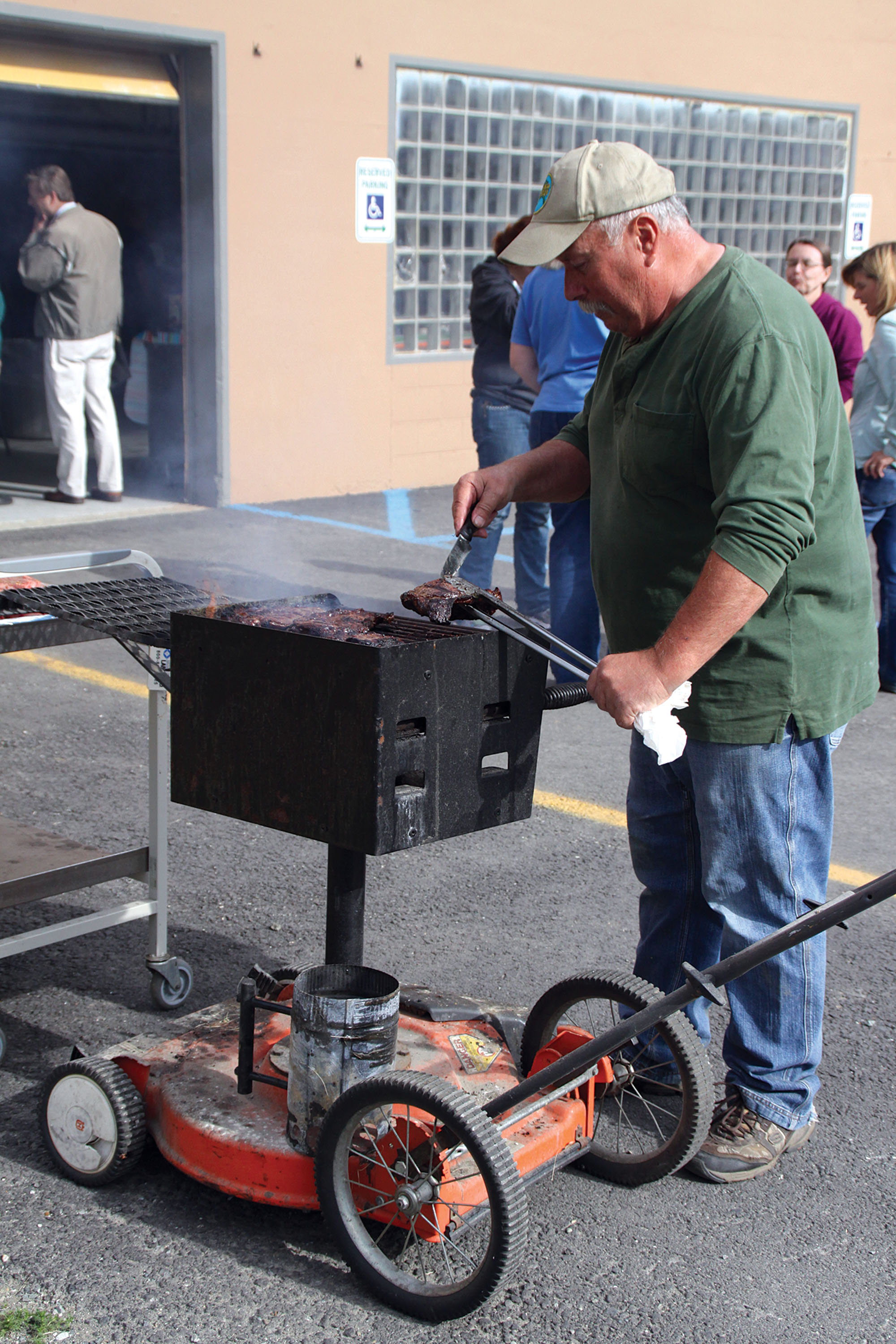
People stood up to tell stories of the history of the surrounding area, and to trumpet the accomplishments of the research conducted there. Kiwanis president-elect Marian Lear gave a brief speech on the history of the Kiwanis program while steaks sizzled on oddly shaped grills, and people chatted and ate freely.
The man behind the twin celebration, former state agriculture director and current Kiwanis program chairman for June Sig Restad, came up with the idea after he ran into a dilemma.
“Normally we meet on Tuesday evening, on the last Tuesday we meet,” he said. “The place in town, they had bigger fish to fry than us, so we were looking for a place for a meeting. Well, I’ve been talking with people at the station and if the university was planning anything. Well, the university isn’t, and the reason is because they weren’t alive yet.”
The past
Officials with the U.S. Department of Agriculture established the first experimental agriculture station in Sitka in 1898 under the tenure of Professor Charles Christian Georgeson, whose name adorns nearby Georgeson Road. At the time, 31 years after Seward’s Folly officially turned Alaska from Russian to U.S. Territory, Sitka was still the territorial capital. Then, as now, the coastal region hosted the territory’s population center of gravity, according to the spring 1998 edition of the Agroborealis academic journal, which was dedicated to the experimental program’s centenary.
“The coast region contained practically the whole population and it seemed likely to remain the most important region for a long time to come,” Georgeson wrote.
USDA stations soon opened in Kenai, Rampart, Copper Center, Fairbanks, and finally, in Mat-Su. When the volcano Novarupta erupted in 1912 it covered Kodiak Island in 18 inches of ash and dealt a severe blow to the Kodiak station’s cattle-focused mission.
The blast from the eruption was heard in Juneau an hour later, and ash darkened the sun as far north as Fairbanks and as far south as Seattle.
When the Kodiak station officially closed, one of the buildings was transplanted, board-by-board, to the Matanuska station, and reconstructed in 1931.
“They call that building over there the ‘Kodiak Cabin,’” Restad said.
The same system that spawned the Matanuska Experimental Farm also birthed the Rampart Station in 1900, the northernmost agricultural experiment station in the United States at the time, a mere 75 miles below the Arctic Circle. It might have been the northernmost agricultural experiment in the world.
“The original plan for work at this station has been adhered to strictly, namely, the testing and breeding of varieties of grain, at the same time gradually extending the clearing and adding to the equipment until the station is fully prepared for this line of work,” the stations annual report read in 1910, according to the article.
During the height of the gold mining rush years in the 1910s, the village counted 10,000 people. By 2010, the last census, Rampart reported 24 permanent residents. The station there closed in 1925, and lumber from the building was used to construct a new school.
When the Sitka and Kodiak stations closed in 1931, the only remaining stations were in Fairbanks, where a station was founded at the request of residents in 1906, and the Matanuska Experimental Farm. Other stations would come and go over the years, including relatively short-lived experiments with fur farming in Petersburg in Southeast, another Kodiak station, and a second station in Palmer, which led to the construction of the “Kremlin” office building in downtown.
The opening of the Palmer Station coincided roughly with the beginning of the boom years of Alaskan agriculture research. According to a timeline that accompanies the Agriborealis article, from 1898 to 1920, federal research in Alaska resulted in only two new crop strains: the Sitka hybrid strawberry and Trapmar barley.
Between 1952 and the late 1980s, research stations and the University of Alaska accounted for more than 40 strains, ranging from Alaskaland Red clover to a dozen breeds of potato (the last came in the early 1980s in the form of the Alasclear potato), to a single new breed of corn, Yukon chief, to Kenai polargrass, the last strain to come out of direct federal research efforts in the mid-1980s.
In the mid-1990s, the USDA closed the remaining USDA Agricultural Research Stations in Alaska, and transferred the buildings to the University of Alaska, which was founded two years after the Matanuska Experimental Farm in 1917.
“It’s unfortunate that Fairbanks would hold on to this site and wouldn’t do more to celebrate it,” Mat-Su College President Talis Colberg told the assembled guests on Tuesday. “It’s probably the oldest set of buildings still in good shape anywhere in this Valley.”
The list of accomplishments can be bewildering for non-farmers to understand. Norm Harris, an associate professor and part-time administrator at the station, puts it more bluntly.
“The Matanuska Colonists came up because of work done here,” he said. “They proved that you could grow agricultural crops in Alaska. Palmer’s the only community that was founded on agriculture and nothing else. Everything else had some other reason for being there, but not Palmer.”
The present
With the retreat of federal funding, research at the station has dwindled. A farm that once boasted as many as 100 researchers now has only two full-time faculty, Harris said. One of them, a specialist in permafrost soils, is retiring in December.
The station also boasts wildland resource management research involving fistulated moose and caribou — animals with holes in their sides into their digestive tracts, so researchers can observe what they eat at different times of the year.
While the farm provides offices for the UAF cooperative extension have relocated to the experimental building — Stephen Brown is involved with at least some of the recent research — their primary focus is informational and not experimental, Harris points out.
“It’s kind of hard to operate a research program if you don’t have people to do the work,” he said.
The recent declines in research come as Alaska struggles with food self-sufficiency and new doors are opening behind the legalization of marijuana, Harris said during an interview conducted across a grill full of sizzling steaks.
“You can grow enough food in this state to provide people with everything they need,” he said. “We can (become food sufficient) if there’s enough people growing. We just haven’t really provided the information they need at this point.”
Beside simply increasing the acreage set aside for growing, the state needs more USDA-certified processing plants for meat. For example, while numerous people raise and slaughter their own chickens in the Valley and elsewhere, the state lacks a processing plant to turn chickens into commerce.
“We need to have more processing plants for beef and that sort of stuff if we’re going to get more going on, because most people are busy processing game and that sort of stuff,” he said.
Beyond growing things to eat, the station is also examining the possibility of farming cash crops, like Rhodiola rosea, a small flowering plant that has potential pharmaceutical applications, based on early research, Harris said.
Then there are the peonies.
“We can produce peonies during a one-month window when no one else can produce peonies,” he said.
That window coincides with the height of wedding season, making it economically feasible to ship peonies from Alaska to more populous states.
After dinner, people listened while Restad and others told stories about early adventures in Alaska agriculture. At one point, local resident Allan Lynn hazarded a guess about the future of farming in the state.
“It’s my personal feeling that at some time after I’m gone, probably quite a long time after I’m gone, not because of global warming, but because of the innate ability of the land to produce, there will be agriculture in Alaska on approximately 200 million acres,” he said. “It’s not going to be California agriculture, it’s not going to be Iowa agriculture. It’s going to be Alaskan agriculture. It’ll probably use bison for the livestock.”
“We can do wonderful things with agriculture,” Lynn said, his voice ringing with pride.
The future
For now, Harris, Lynn, Restad, and other agriculture proponents appear ready to circle the wagons in support of a venerable Valley institution.
The Experimental Farm has long been an autonomous unit within the larger UAF framework, capable of providing at least one full degree program without the student setting foot on the Fairbanks campus. This year, administration duties, will be relocated to Fairbanks and managed from a central location, Harris told the crowd. That means decisions about the future of the program will be made hundreds of miles from the rolling farmlands where cows graze in grassy fields, posing for artists painting on easels along South Woodward Loop.
UAF spokeswoman Marmian Grimes said concerns about what that means could be overblown.
“Because of a lull in research activities at the farm, there really isn’t the need for an on-site administrator anymore,” she said.
She pointed to the end of the Agricultural Research Service activities in Alaska and flat levels of state funding as causative factors. The shifting of the duties doesn’t herald the elimination of the program, Grimes said.
“We are still committed to the farm and plan to maintain a presence there in the Mat-Su Valley,” she said.
Harris is also blunt about the farm’s long-term survival prospects under centralized administration.
“They’re trying to do everything from Fairbanks, we’ll see how that goes,” he said. “I think any move Fairbanks does puts this program at risk. They don’t really see the value, I don’t think. They talk like they do, but we really haven’t seen them step up. There’s still agricultural research that needs to be done here.”
Contact Brian O’Connor at 352-2269, brian.oconnor@frontiersman.com, or on Twitter @reporterbriano.

By Jeremiah Bartz Frontiersman.com A football coach using a hockey reference as the centerpiece for his keynote address may

Frontiersman.com With its headquarters in Wasilla, the Frontiersman has been a primary source of news for the Matanuska-Susitna

By Katie Stavick Frontiersman.com The next generation of leaders took flight this week as the Houston High School Class

By Kyle Wilkinson For the Frontiersman Keynote speaker and Carry the Cure President Bill Pagaran’s words boomed through the