Retiring teacher, coach urges Colony grads to ‘find their 68’
By Jeremiah Bartz Frontiersman.com A football coach using a hockey reference as the centerpiece for his keynote address may


WASILLA — Months of planning and public meetings have brought Matanuska Electric Association full-circle with the city of Wasilla over the power cooperative’s plans for upgrading transmission lines to the western part of the Mat-Su Borough.
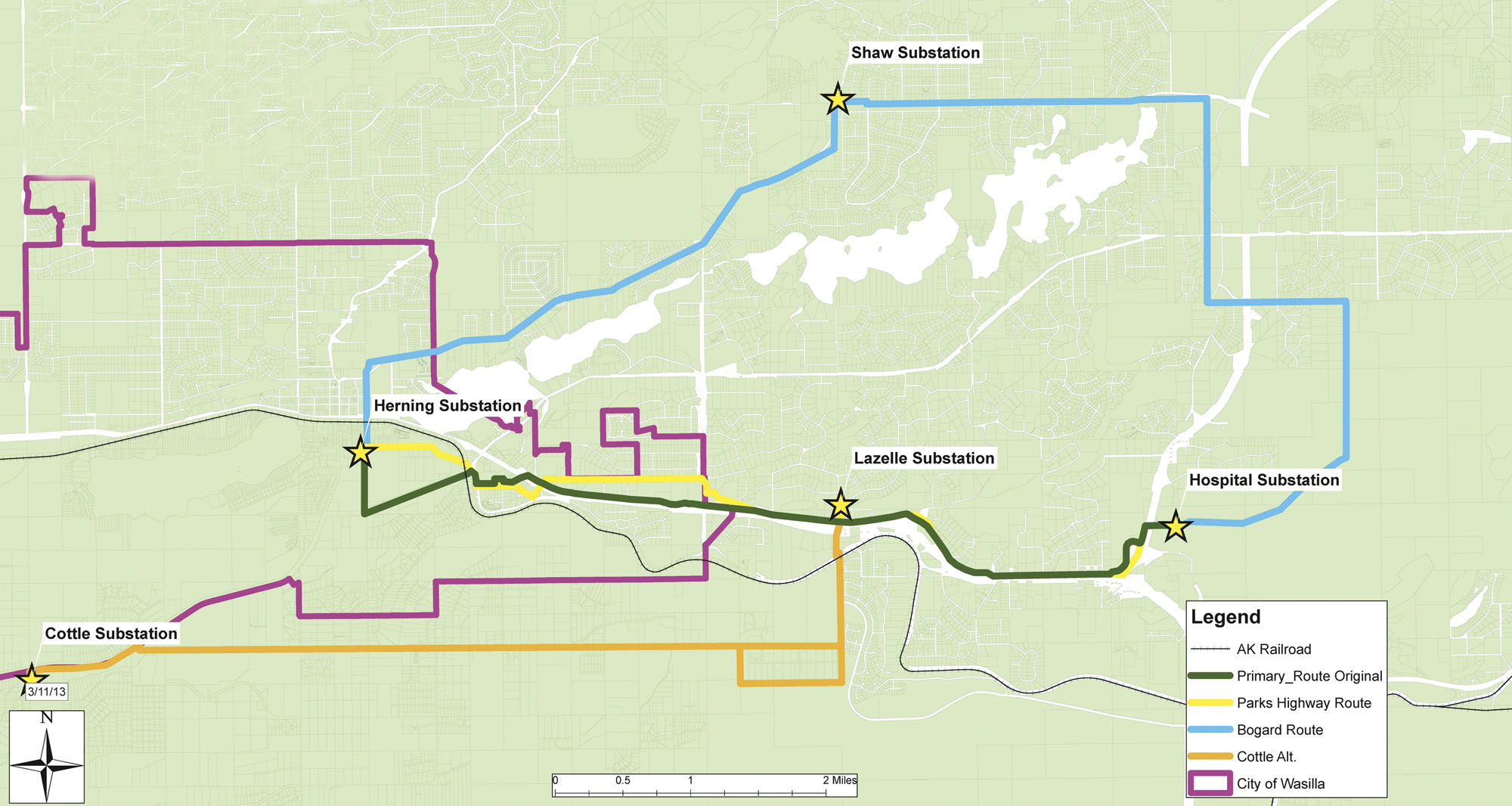
After a proposal that included replacing existing 45-foot power poles with 80-foot towers along more than six miles of the Parks Highway was opposed by city staff and administration, MEA has held a series of public meetings to gather input on alternative routes for the upgraded lines in preparation for the expected 2015 opening of its $265 million Eklutna power generation plant.
Costs of running the lines along various alternatives, and even underground, range from $9.75 million to nearly $41 million.
In the end, MEA has submitted an application to the Wasilla Planning Commission for its original proposal, which includes three miles of lines within city limits along the Parks Highway. The cooperative withdrew its first applications months ago after receiving blowback from city administration that the larger poles would destroy the viewshed along that section of the Parks Highway.
That MEA would submit an application for essentially the same plan is confusing, said Tina Crawford, the city’s planner.
“We still have those same issues we had before,” she said. “They submitted a land use permit and were elevated by staff to the planning commission for a public hearing.”
That public hearing hasn’t been scheduled yet, but the first opportunity on the planning commission’s schedule is May 14, she said.
While he said he understands MEA’s prefers the cheapest alternative at $9.75 million, Public Works Director Archie Giddings said on a $265 million project the $5 million difference between the cheapest and most expensive alternatives is negligible.
That inference is one of the reasons MEA is still pursuing the Parks Highway route, said Kevin Brown, MEA spokesman. In fact, he said, the cost of upgrading the lines is not part of the Eklutna project and is funded through different sources. Also, any added costs have to eventually be paid by customers, he said.
“These are not the same project and their financing is not connected to each other,” Brown said.
Besides, Brown said, the Parks Highway route makes sense for more than just being the cheapest. It’s also along one of the city’s most developed commercial corridors and the lines would replace those that are already overburdened by the demand from that area.
“Wasilla is the primary load growth source and it’s far greater than the surrounding area,” Brown said. “Its growing needs are commercial, most of it along that corridor. We currently have the capacity to serve them. … (But in the future) it’s going to be effected and there will still need to be upgrades at a later date.”
That the larger poles will harm the viewshed is simply not true, Brown said, and is a sentiment supported in public testimony at meetings to discuss the transmission lines. At the latest meeting on Thursday, Brown said 15 people spoke in favor of the Parks Highway route while four people spoke against. Three of those four were Wasilla Mayor Verne Rupright, Giddings and Crawford, he said.
“The feedback we’ve gotten has been overwhelmingly supporting the Parks Highway route,” Brown said, adding he has no idea how MEA’s application will be received by the planning commission. “At this point, I don’t really have any expectation. We’re pursuing all the options and we’re hoping the city will see the value that being able to bring additional amounts of electricity will bring to their corridor.”
The new application, Brown said, is the first step in beginning a dialogue with the city. The way city code reads, an application has to be filed before an entity can have a public hearing with the commission.
“There’s nothing in the city of Wasilla’s code that lets us engage in a dialogue with the city planning commission without submitting an application for approval,” he said. “What we’re experiencing here is a lack of communication venues. But before we invest $100,000 or more in detailed engineered drawings for a potential route, we want to know if it’s a potential route.”
On the drawing board now, Brown said, is the preferred route ($9.75 million); an amended Parks Highway route ($13.4 million) that reroutes the lines away from the highway within city limits; running the lines up around Bogard Road ($19.965 million); and a route that runs the lines along Fairview Loop to MEA’s Cottle Substation ($11.875 million).
Brown said the idea of burying the lines for the three miles they run through the city is simply not an option, although the suggestion does come up occasionally.
At a cost of nearly $41 million, “that is literally spending $30 million more to avoid seeing poles,” Brown said. “And that’s a cost we, frankly, have a hard time passing on to the customer in Talkeetna who doesn’t see the benefit, or Palmer, to accommodate the wishes of the mayor of Wasilla.”
Contact reporter Greg Johnson at greg.johnson@frontiersman.com or 352-2269.
Project length 6.4 miles
Est. No. of parcels 49
Est. residences passed 24
Est. businesses passed 58
Right of way direct costs $2.72 million
Construction costs $7.03 million
Total cost $9.75 million
Project length 6.7 miles
Est. No. of parcels 62
Est. residences passed 29
Est. businesses passed 72
Right of way direct costs $5.9 million
Construction costs $7.5 million
Total cost $13.4 million
Project length 12.7 miles
Est. No. of parcels 150
Est. residences passed 46
Est. businesses passed 43
Right of way direct costs $1.19 million
Construction costs $12.505 million
Demolition costs $1.27 million
Total cost $14.965 million
Project length 12.1 miles
Est. No. of parcels 58
Est. residences passed 65
Est. businesses passed 32
Right of way direct costs $2.09 million
Construction costs $11.875 million
Total cost $13.925 million
Project length 6.4 miles
Est. No. of parcels 49
Est. residences passed 24
Est. businesses passed 58
Right of way direct costs $2.72 million
Underground costs $34.32 million
Overhead const. $73.882 million
Total cost $40.922 million

By Jeremiah Bartz Frontiersman.com A football coach using a hockey reference as the centerpiece for his keynote address may

Frontiersman.com With its headquarters in Wasilla, the Frontiersman has been a primary source of news for the Matanuska-Susitna

By Katie Stavick Frontiersman.com The next generation of leaders took flight this week as the Houston High School Class

By Kyle Wilkinson For the Frontiersman Keynote speaker and Carry the Cure President Bill Pagaran’s words boomed through the