Retiring teacher, coach urges Colony grads to ‘find their 68’
By Jeremiah Bartz Frontiersman.com A football coach using a hockey reference as the centerpiece for his keynote address may


PALMER — Matanuska Electric Association ratepayers as far away as Florida listened in to a “Meet the MEA Board Candidates” event in Palmer Thursday, thanks to online streaming of the event provided by Radio Free Palmer.
Toastmaster and the Mat-Su Valley Frontiersman organized the meet-and-greet event for candidates for the electric utility’s annual election at Mat-Su Senior Services in Palmer.
The only contested race is for the seat representing the Matanuska District. Larry DeVilbiss had held the seat, but opted not to run for re-election. Candidates Jamey Duhamel and Marvin Yoder are running against each other for that seat on the board.
Also up for election this year is Susitna District Director Bob Doyle, who did not draw a challenger in this year’s race, and Eagle River District Director David Glines. Glines accompanied his father to a World War II ceremony that night and was unable to attend the event.
The other three attended the MEA meet-and-greet and answered questions from the audience and moderator Beth Fread of Toastmasters. She asked candidates a series of questions, after which audience members could ask candidates their own questions.
Fread began the evening with introductions from all three candidates, starting with Doyle.
Doyle said he has been an MEA member for 32 years and remembers riding the train as an Anchorage high school student when his team played Palmer in basketball. He said he’s happy to support the Eklutna generation station and is looking ahead to the work the board must do to secure the long-term gas contracts needed to operate the plant.
“It’s really not an option to go on diesel,” Doyle said.
Duhamel followed Doyle at the mic. She said she is a lifelong Alaskan and a member of the first graduating class from Colony High School, married her high school sweetheart and now they are raising their four sons in the Valley.
“I have everything at stake when it comes to making decisions for myself and my community,” she said.
Duhamel said her background in the Valley includes work with sexual abuse victims and long-term placements for foster children, among other roles she’s filled with her background as a social worker. She said her point in mentioning her other roles in the community was to explain her motivation for seeking the seat.
“Understand my motivation is about people,” she said. “It’s about you. It’s about your families.”
Duhamel said she understands the roles and responsibilities of board members and the role teamwork plays. She said she is a working mom who has worked to educate herself on local energy issues.
“When we make decisions we need to understand how that trickles down,” she said.
Yoder was last to introduce himself to the 20 or so audience members at the new Palmer senior center.
He came to Alaska in 1969 and has worked in various regions of the state, including Southeast, the Interior and, in 1997, the family moved to the Southcentral region.
Yoder said his background as a city manager and working on other power projects make him uniquely suited to serve on the board during this transition period when the 72-year-old co-op will switch from a power distributor to a manufacture that buys gas, and manufactures electricity and sells power.
During his 25 years working in various municipal governments — including 10 years as manager of the Galena electric utility — he said he’s had the opportunity to work on several utility projects. He said from his time in the Bush he knows the importance of thrift and wringing value out of every penny of ratepayer monies.
“Most of those budgets are very small and very tight,” Yoder said.
He said he’d like to see the Valley grow, and low-cost power is a key to that.
Following candidate introductions, Fread asked Yoder and Duhamel a series of questions picked from a longer list of questions submitted by the candidates, Toastmasters and the Frontiersman.
Asked about the utility’s two top priorities for the next year, both Yoder and Duhamel said getting the Eklutna power plant online and contracting for gas to power it are the board’s top two tasks.
Yoder said he sees the uncertainty regarding natural gas to fire the plant as cause for concern. He said the state has several plans to bring natural gas to market, but no one seems to know where the gas will come from.
“How do we get that plant built and gas contracts to operate it?” Yoder asked. “Getting that plant ready by 2015 is the biggest challenge.”
Duhamel was more optimistic about signing gas contracts to power the plant. She said Alaska has a lot of natural gas, but the problem is getting it in the pipe and to the Mat-Su.
She said she had it on good authority — but she did not site the source — that MEA was in good shape with regard to contracting for the needed gas from Cook Inlet suppliers.
MEA’s related transmission line project is another important piece of the project, she said.
“I’d like to be at the table to help get the best route without ruffling too many feathers,” Duhamel said.
Duhamel concluded her response by saying she sees savings for the utility by increasing the energy efficiency of buildings in its service area, and thus using less electricity and the natural gas to generate it.
“MEA can be important leaders in energy efficiency,” she said.
That answer led into the next question from moderator Fread, which also was about using new energy efficient building regulations and MEA grants to encourage people to improve buildings’ efficiency.
Yoder said he’s not a fan of regulations. He said if there is a business case for energy efficiency, business will pursue it on their own. But he said he is leery of regulations that hinder development.
“There are ways you can provide incentives,” Yoder said. “But I wouldn’t support adding regulations.”
Candidates Yoder and Duhamel differed on what they see as the power source as the Valley grows over the next 50 years to a predicted population of more then 400,000.
Yoder said the technology is changing so fast, he wouldn’t take anything off the table in terms of where the power might come from.
Duhamel said the Eklutna natural gas plant is on the right track. She said one of the two proposed gas line projects could supply additional fuel, but Cook Inlet isn’t a long-term gas source.
She said energy projects take years to build. As such, Duhamel said she’d like to see MEA begin advocating for the projects that are already on the table, or design their own solutions.
Duhamel said she would take some power sources off the table — specifically, coal. She said she prefer natural gas, hydro, geothermal or wind.
“Let’s set a side things that don’t make sense for our community or our families,” she said.
Yoder and Duhamel also differed on support for the By-laws Committee’s recommended changes.
Duhamel said she supports and trusts the work of the By-laws Committee, and recommends voting yes on all of the nine proposed changes. Yoder, who is himself a member of that committee, said he supports the electronic voting amendment, establishing a fourth district and creating a code of ethics for the board of directors.
He said he does not support Proposition 8 on the ballot, which eliminates campaign disclosure and group registration.
“People need to know who is putting money in,” he said. “Who was putting money in and why.”
At the end of the moderator’s questions, Mat-Su Borough Mayor DeVilbiss asked candidates to look into the past five years and imagine how they would have voted if they had been board members when the decision was made to build the Eklunta plant without gas contracts to operate it.
“Would your decision-making be any different?” DeVilbiss asked Yoder and Duhamel.
Yoder said he would have voted to build a coal-powered plant.
“Had we built a coal plant, we would have stable, long-term power by now,” he said.
As is, he said MEA ratepayers will pay more for the natural gas plant and for the transmission lines needed to tie it into the existing power grid.
Duhamel thanked the board for its unanimous vote five years ago to build a natural gas-fired power plant.
“The community spoke loud and clear about coal,” she said. “They didn’t want it here and you were responsive to that. And I thank you.”
Doyle, back to answer audience questions, said China is building coal plants and burning U.S. coal in them. He said there is a lot for the utility to consider, such as the needed transmission lines and what to do if the Susitna-Watana Hydroelectric Project comes online.
“What will we do with the surplus electricity when Watana comes online?” Doyle said.
He said Alaska is a resource extraction state with 93 percent of state revenues coming from oil. Doyle said Alaska has abundant coal reserves and it should be on the table, too.
Duhamel, a champion collegiate debater, wasn’t buying Doyle’s coal pitch.
“Fairbanks has six coal-fired plants and they have the bad air quality and the high energy costs,” she said. “To me, that’s pretty clear evidence coal is not the answer.”
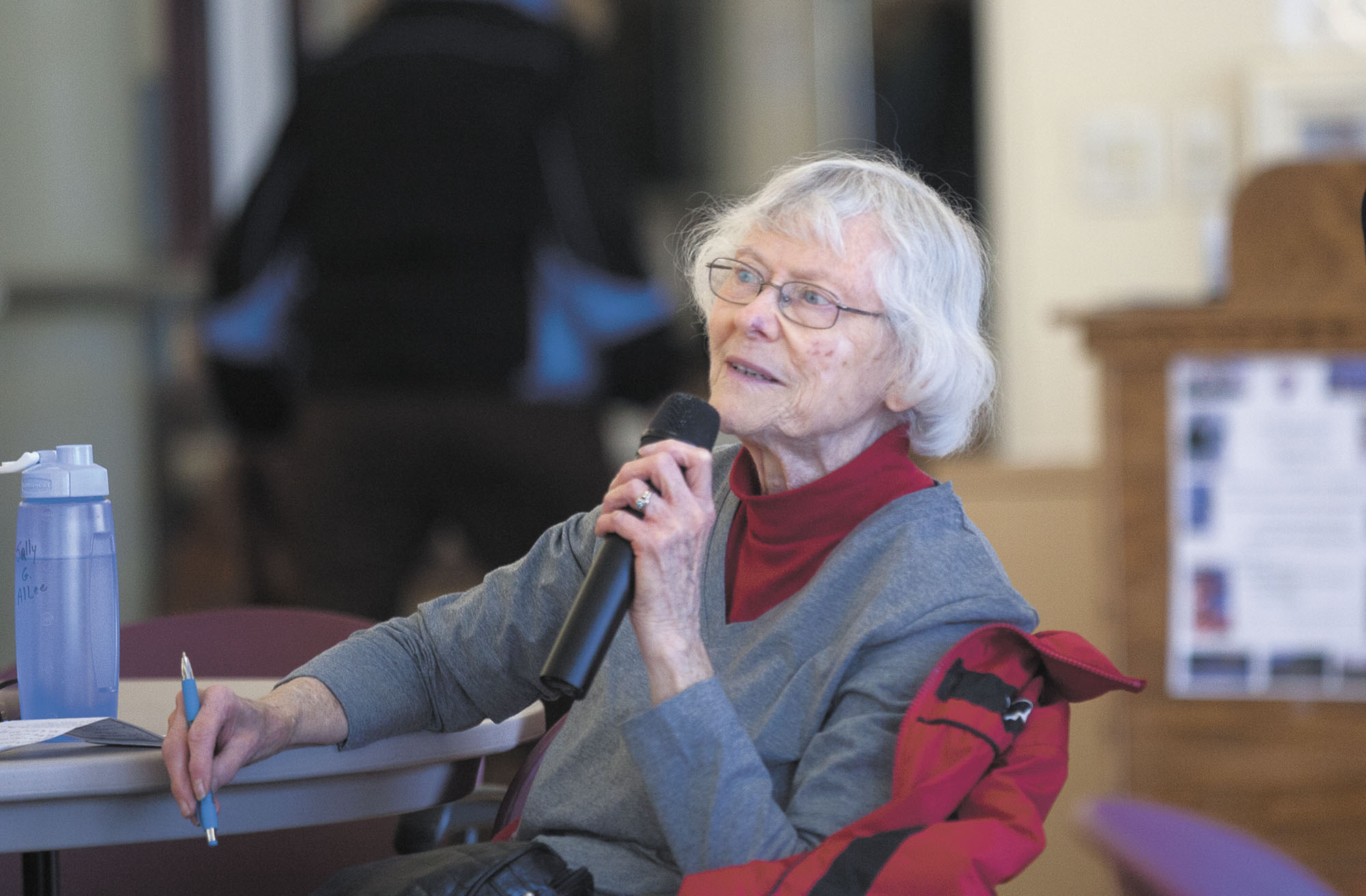
Audience member Sally AlLee asked Yoder if he was in Galena when that community explored using a nuclear power plant.
Yoder said he was and that nuclear power was the source recommended after a Department of Energy study. He said the Toshiba reactor Galena considered was air-cooled and didn’t have the risks associated with the failed liquid-cooled reactors in Japan.
This year members can vote online, by mail or in person at the annual membership meeting at 5 p.m., April 23 at Raven Hall on the Alaska State Fairground in Palmer.
Contact managing editor Heather A. Resz at 352-2268 or heather.resz@frontiersman.com.


By Jeremiah Bartz Frontiersman.com A football coach using a hockey reference as the centerpiece for his keynote address may

Frontiersman.com With its headquarters in Wasilla, the Frontiersman has been a primary source of news for the Matanuska-Susitna

By Katie Stavick Frontiersman.com The next generation of leaders took flight this week as the Houston High School Class

By Kyle Wilkinson For the Frontiersman Keynote speaker and Carry the Cure President Bill Pagaran’s words boomed through the