Retiring teacher, coach urges Colony grads to ‘find their 68’
By Jeremiah Bartz Frontiersman.com A football coach using a hockey reference as the centerpiece for his keynote address may


PALMER — The last time the Havemeister family missed a milking was on March 27, 1964, when a magnitude 9.2 earthquake struck Southcentral Alaska. When Gov. Mike Dunleavy dropped his budget that he said “matches revenues with expenditures” on Feb. 13, 80 years of farming history and a booming dairy business were suddenly in jeopardy.
“Back in 1935 my grandparents are colonists, they’re part of the New Deal. They come to Alaska. We’ve had cows on the farm ever since, haven’t missed a milking since the big earthquake in ‘64. My parents have seen everything virtually, they’ve been through every dairy anything that’s happened with dairy industry in the state,” Ty Havemeister said. “I decided that we would start our own creamery and that was 2011. We were on the shelf for two months and we’ve been sold out ever since.”
With the elimination of $180,000 for a dairy inspector, the Havemeister Dairy, the last dairy farm in the Mat-Su and only one of two in the state, would cease to exist. Without an inspector, the Havemeister cows would not have their milk distributed throughout Southcentral Alaska. Havemeister Dairy is currently in a predicament that many business owners envy, where the demand for milk from local cows is higher than what the cows can actually supply.
“It’s a good place to be,” Havemeister said.
Before any of the cows are milked, before the milk is pasteurized or distributed to stores in Talkeetna, Wasilla, Palmer and Anchorage, there is already a demand for each jug full of white gold. Havemeister is frustrated to see what 80 years of his family’s legacy cut from the budget. Along with the frustration felt by the Havemeisters and thousands of local milk drinkers, there is also confusion.
“There are people that voted no to cut the dairy sanitation program, some of those people made that vote I think under the false thought that passing a raw milk bill was going to help us out and it was going to solve everything. The problem with that is a multi-billion dollar corporations like Kroger, Safeway, 3 Bears, name a retailer, they are not going to put non-inspected raw milk on the shelf. The states that have raw milk legal, there’s even more stringent inspections than you have now,” Havemeister said.
Among the confusion of the ‘raw milk bill’ that Havemeister said he has only heard about from third parties, there has been some speculation over the $180,000 dairy inspector. The dairy inspector visits the Havemeister Dairy once a month to collect samples which usually takes less than a half hour. The dairy inspector also checks their pasteurization process quarterly. Among that $180,000, Havemeister believes that not all of that money is going to inspect dairy, but providing other valuable agricultural monitoring services as well. Havemeister runs his family’s dairy with six other employees, not including members of the Havemeister family. Ty’s brothers pop in sporadically or when they need an extra set of hands. One of the Havemeister brothers takes a vacation from the inclement Florida weather during haying season to drive a tractor under the midnight sun. Havemeister’s father, the patriarch of the Mat-Su milk mustache, outworks many of his younger counterparts.
“He’s 78 years old, 4 a.m., he’s in the barn scraping,” Havemeister said. “My dad was picking up milk cans at all the farms around our place when he was in high school, dropping them off at the creamery in Palmer before he went to school. If you cut him, milk will come out, there’s no blood in his body it’s just milk, that’s the old joke.”
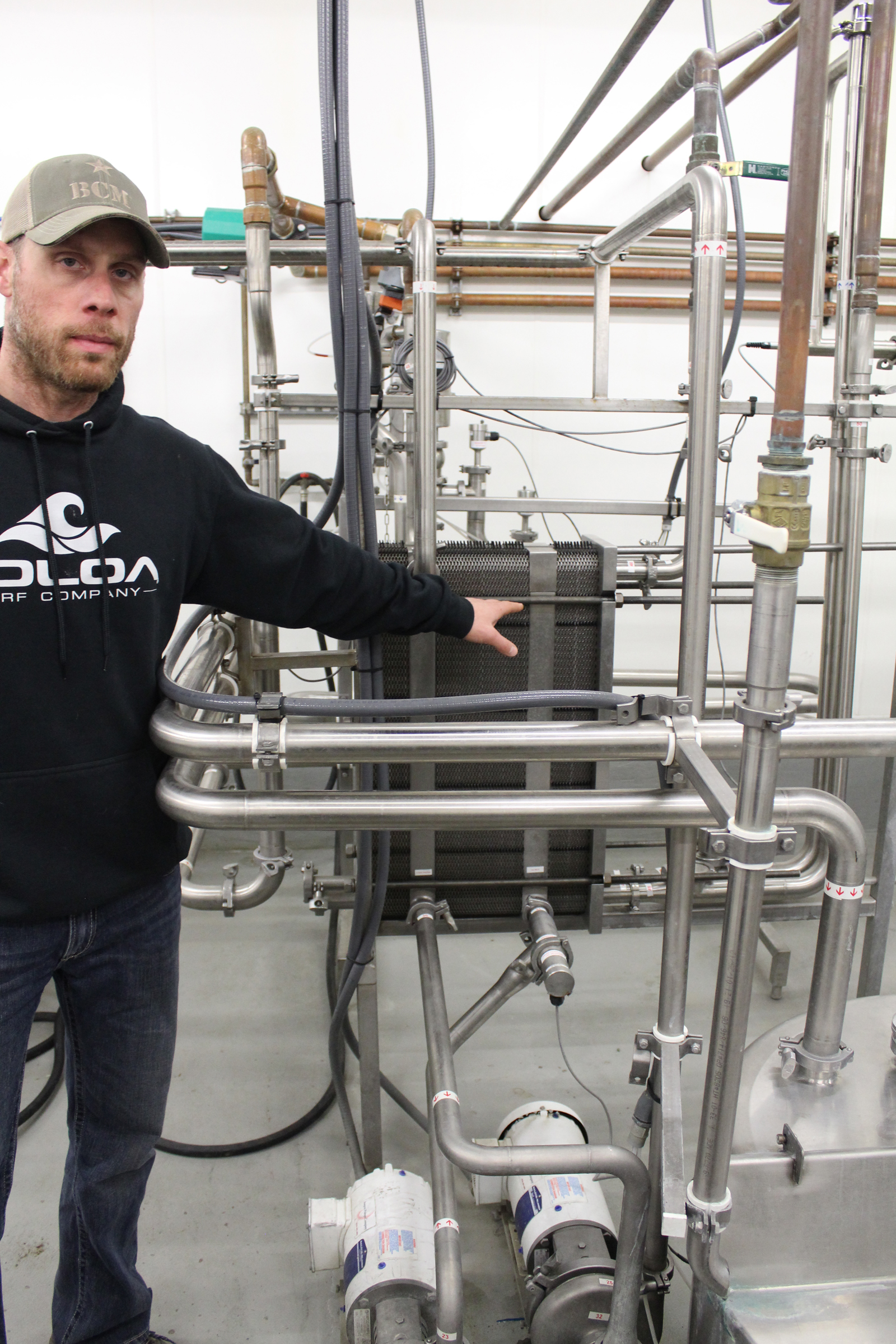
The milk from 150 cows goes through a 1,500-gallon tank before it is separated into skim, 2 percent, and whole. The milk is then put through a balance tank for the pasteurizer where 40-degree milk contacts plates at 165 degrees, heating the milk and killing all the bacteria. The FDA only requires 161 degrees. That pasteurized milk then goes to the homogenizer.
“One of the things the state tests, so on testing days they want to do a test to make sure that the milk is going through and it’s holding temp long enough to kill all the bacteria,” Havemeister said.
The Mat-Su Valley was born a farming community, and has continued to be an agricultural mecca despite the growing pains of a young Borough. Havemeister milk is put into jugs from True North Plastics, a business in Palmer. Alaska Mill drops off 12 tons of feed every 10 days for the cows.
“I try and put out the best product that you can and if you put my whole milk next to, I won’t name names, but any other gallon that’s on the shelf and you drink those side by side, there’s a difference,” Havemeister said.
Havemeister Dairy does not ultra-pasteurize it’s milk, nor do they remove excess fat from the whole milk, meaning what comes out of the cows is pasteurized and bottled without any other subtractions. The quality of the milk and the insistence on Valley milk drinkers to have a product from a local farm is hanging in the balance of the House Finance Committee, who are working through Dunleavy’s budget and making their own changes.
“I get to log onto AKleg and see them in a room and half of the things that get said are fairly inaccurate about the industry about understanding how the process works as far as the inspections, understanding how it works with the feds. If you look at the overall budget what they’re cutting this is very easy to just, you know, but it’s our 80 years of existence,” Havemeister said.
With heightened news coverage of the Dunleavy budget, support from milk drinkers statewide has poured in for the Havemeister family.
“The amount of support that we’ve had locally, the letters the emails that I have gotten through Facebook, the people that have sent letters to their Congressmen to the Senate to their House member, I was shocked,” Havemeister said.
To add to the frustration, the Havemeisters are paying back a loan from the Agricultural Revolving Loan Fund.
“If you go eight years into this, you want us to pay this loan back but you’re not going to give us the service that we kind of agreed upon when we did this. I can’t, again, I can’t pay for my own inspection. It’s not an option for us,” Havemeister said. “There’s 150 animals and they have to be milked every day so we couldn’t even go out of business tomorrow. We’re still going to have to milk those cows and dump the milk because we can’t sell it, continue to feed them with no income, figure out how to slaughter all the animals and it costs a lot.”
If the House passes the budget as it stands without a state dairy inspector, that would end the dairy industry in Alaska forever, according to Havemeister.
“If we go under you will never see another dairy in the state. First of all, you’re not going to have a dairy sanitation program because you cut it, second of all the cost in doing this is outrageous,” Havemeister said. “We’ve got half a million dollars worth of equipment that’s virtually overnight, it’s useless. There’s nothing, what are you going to do with it if you can’t pasteurize? There’s nothing you can really do.”
The future of farming is hanging in the balance of the state budget process.
“I am done. If they do not change this, we are going to have a lot of cheeseburgers to get rid of, that’s the best way I can put it,” Havemeister said.
Contact Frontiersman reporter Tim Rockey at tim.rockey@frontiersman.com.

By Jeremiah Bartz Frontiersman.com A football coach using a hockey reference as the centerpiece for his keynote address may

Frontiersman.com With its headquarters in Wasilla, the Frontiersman has been a primary source of news for the Matanuska-Susitna

By Katie Stavick Frontiersman.com The next generation of leaders took flight this week as the Houston High School Class

By Kyle Wilkinson For the Frontiersman Keynote speaker and Carry the Cure President Bill Pagaran’s words boomed through the