Retiring teacher, coach urges Colony grads to ‘find their 68’
By Jeremiah Bartz Frontiersman.com A football coach using a hockey reference as the centerpiece for his keynote address may


MAT-SU — With snow creeping down the mountains, area farmers are looking at their fields and saying the same thing they’ve been saying since May — two weeks late.
It’s been a cool, wet season that’s stunted some crops and yielded bumper harvests for others. It just depends on what’s growing and where. But farmers from Sheep Mountain to Trapper Creek are in agreement — everything was late.
For consumers, that’s meant Alaska Grown produce hit the markets later this year, but also stayed on the shelves later in the fall, growers say. Consumers can expect to see Alaska Grown lettuce through the end of the month, and a good supply of fall crops like potatoes, carrots, cabbage and onions.
As growers finish out the season, they are busy gathering the last of their frost-susceptible crops, and harvesting of potatoes and carrots is underway.
Like other farmers, Wes and Beth Bannon are hurrying to get their crops in before the cold weather hits. It is tough harvesting 45 acres of potatoes in the rain, with the wet soil bogging down the equipment.
“It’s been going pretty well,” Beth Bannon said Friday, as the rain came down yet again. “I don’t think we’ll have any trouble pulling them out. If it snows — that’s the scary part.”
For Michelle Church at Alaska Herb & Organics, potatoes this year were a disappointment — too many afflicted with hollow heart, a condition caused by the potato having so much water that it grows too quickly and develops a hollow, blackened center.
“Everything else just went gangbusters,” Church said. “Everything did very well. It was just late.”
Over at Arctic Organics in the Butte area, River Bean’s potatoes weren’t too big this year; they were small and the yields were down. But his cabbage, rutabagas, turnips and raspberries were great, but late.
It’s something his customers — subscription, Anchorage Farmers’ Market and at his Friday farm stand — had to accept.
“People are kind of disappointed when they look for specific things and they aren’t there,” Bean said. “That’s hurt us a little bit.”
Bean said farmers’ markets give growers an opportunity to talk to customers, to let them know why certain crops are late or not up to usual standards.
If the weather means crops are small, poor or late, “We have no control over that,” Bean said. “The regular shopper that goes to the grocery store doesn’t know about all that.”
In Trapper Creek, at David and Diane McCown’s Northern Plantation, one crop was earlier than usual this year — red cabbage. Or perhaps, it was on time and the green cabbage, which generally beats the red to maturity, was slow.
Even zucchini — a perennial overproducer — didn’t produce well this year, Diane McCown said.
“We struggled to produce all squash,” McCown said. “The squash was really pathetic.”
Their red raspberries were fair but their goldens produced well. Strawberry production was poor.
It was the first full summer for the Trapper Creek Farmers’ Market, one of the newest markets supported by the Division of Agriculture. This year’s poor production hampered its growth, McCown said, but they will try again next year to build on their base of supportive local consumers.
At the other end of the Mat-Su Borough, at Sheep Mountain, Tom and Trish Lee had trouble getting to a farmers’ market this year. Road construction on the Glenn Highway made a weekly drive to Anchorage impractical, so they limited their production. Weather was less of a factor; they deal with cold summers regularly.
“It was just cool and we grow a lot of cool crops,” Tom Lee explained. He said black currants and cranberries did very well, as did kale and beets. Herbs, which they distill into essential oils, struggled a bit. But all in all, the Lees aren’t complaining.
“It wasn’t all bad for us,” he said.
The checkerboard report on how the season was, beyond late, can be attributed to a host of different microclimates around the Mat-Su Valley.
“It varies from farm to farm, microclimate to microclimate, mile to mile,” Bean said. Even with predictable unpredictability, this year’s been unusual.
“You can’t rely on specific things that are pretty normal,” Bean said, adding that all a grower can do is diversify. The Beans grow about 70 crops.
Pam Bue’s eight acres of carrots will yield fewer pounds of the orange crop, she said. Bue dug half of the acreage and sent smaller-than-usual carrots to market.
“The yield is definitely down because of the size, but the quality is good,” Bue said. “If it stays warm, I think the second half will be pretty normal.”
The biggest vegetable producer in the Valley, Ben VanderWeele, said VanderWeele Farms is harvesting late, but the yield and quality of his potatoes and carrots look good. The carrots are still lagging behind; harvest for most won’t start until the end of September.
“They’re getting to be almost acceptable,” VanderWeele said of the carrots’ size.
Producers are hoping their later-than-usual crops will make up for a dismal spring.
“We didn’t sell anything in June,” VanderWeele said. “That was a financial hit. Now we’re trying to make up for our lost season.”
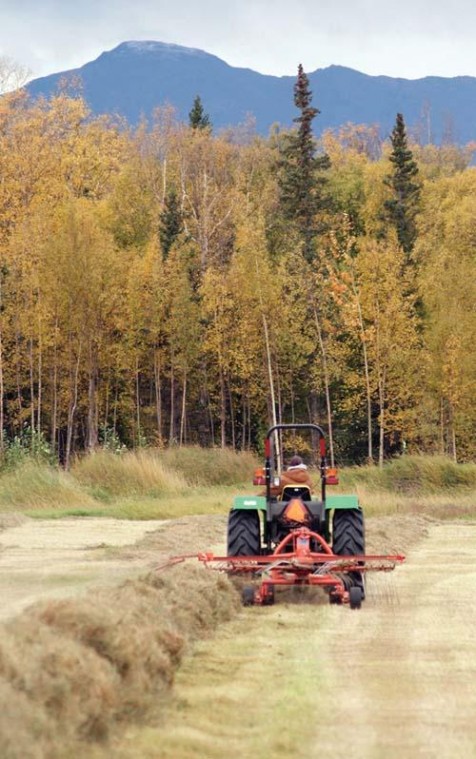
Hay producers had another less-than-stellar year as they struggled to make hay when the sun shined.
Church’s family was in the field last Thursday night, racing to put up hay finally dried out by the day’s brisk winds.
“We’ve had a terrible time getting hay in,” Church said.
Church isn’t alone. For Bill Longbrake, Country Garden Farms, a break in the weather Wednesday evening meant his crew could put up a 30-acre field of hay — beautiful, dry hay at nearly two tons per acre. But before they could get it all covered, the rains came, soaking about half of the bales. About 200 are sitting in the field.
Longbrake figures his hay production is down about one-third this year.
“We had a cold, dry spring and didn’t get the growth we should have, then it turned cold and wet after we got the growth and we couldn’t get it out [of the field],” he said.
Nor could local beekeepers avoid the buzz about the weather. Honey production is down for many apiaries, including Dawn Cowan’s hives.
“A lot of people barely got any,” Cowan said. “I got less than usual.”
Cowan said bees don’t like to fly in the rain and don’t like cold weather, a formula to keep the essential insects grounded unusually often this summer.
Suzan Benz, statistician for the U.S. Department of Agriculture’s Natural Agricultural Statistics Service in Alaska, won’t know the tallies for this year’s production for several weeks. Benz will mail out a survey after the harvest is in.
Early indications are the potato harvest will be down overall, with estimates ranging from 2 to 20 percent, Benz said.
Benz said overall vegetable production may also be down because smaller growers may not have put in second and third plantings of some crops after the dismal start to the growing season. Hay, too, is expected to be off.
“The thing the survey won’t measure is the quality,” Benz pointed out.
The survey results will be later than usual, Benz said — about two weeks late, just like everything else this season.

By Jeremiah Bartz Frontiersman.com A football coach using a hockey reference as the centerpiece for his keynote address may

Frontiersman.com With its headquarters in Wasilla, the Frontiersman has been a primary source of news for the Matanuska-Susitna

By Katie Stavick Frontiersman.com The next generation of leaders took flight this week as the Houston High School Class

By Kyle Wilkinson For the Frontiersman Keynote speaker and Carry the Cure President Bill Pagaran’s words boomed through the