Retiring teacher, coach urges Colony grads to ‘find their 68’
By Jeremiah Bartz Frontiersman.com A football coach using a hockey reference as the centerpiece for his keynote address may


PALMER — A wire looped around the dead moose calf’s neck tightened, dragging the bedraggled carcass through some brush onto the pavement behind a flatbed truck.
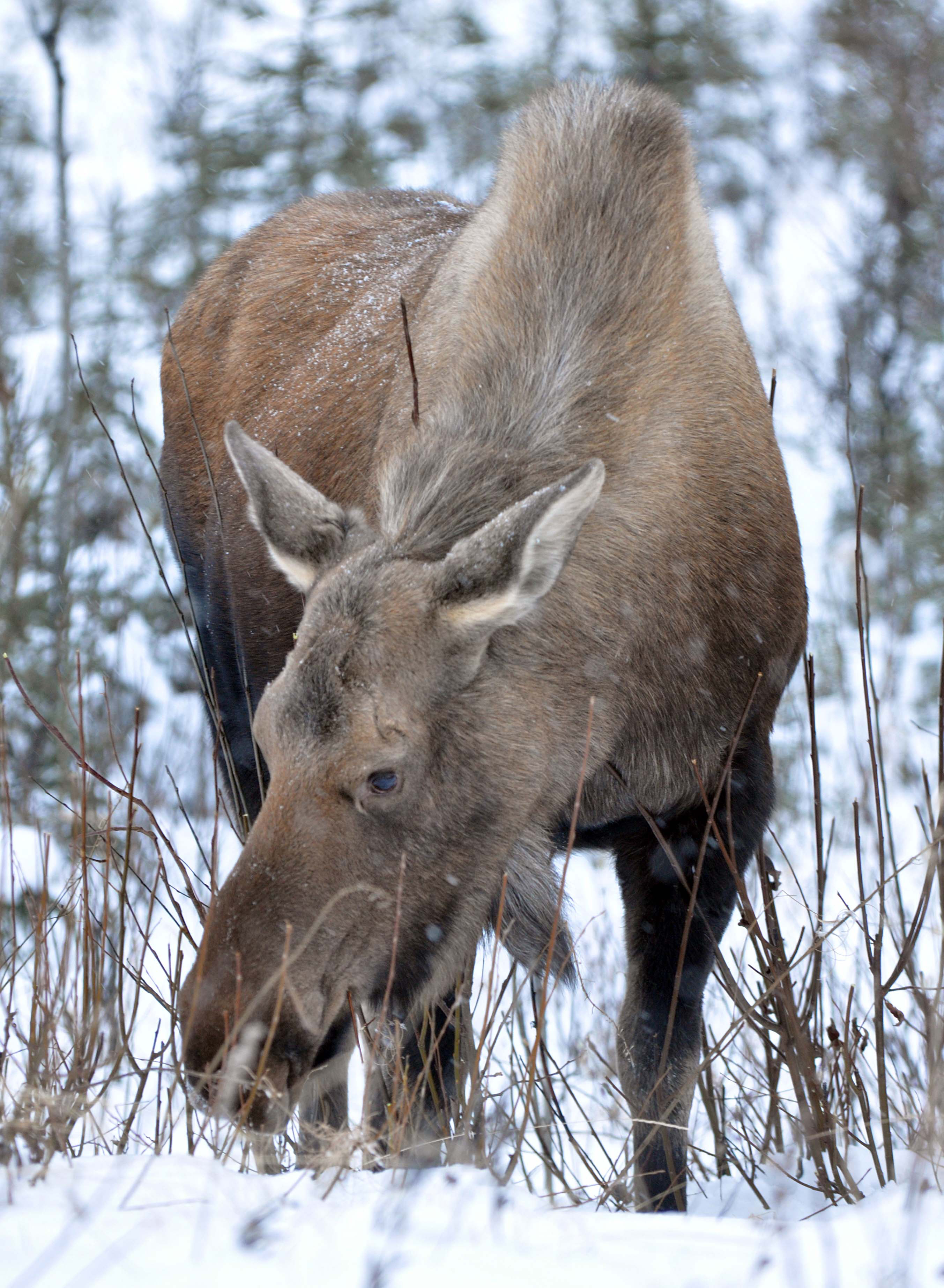
A moment later, a mountain of brown fur lumbered out of some trees, through a roadside ditch alongside Palmer Fishhook Road, and stood guard over the body. The calf’s mother was unwilling to leave her calf, though it had been dead for hours. Alaska State Troopers had euthanized the calf after it sustained a broken leg in a collision with a passing car the night before.
On the roadside, the moose cow met and eyeballed Don Dyer, the head of the Alaska Moose Federation (AMF), who was driving the truck. A resident of a nearby house had called Dyer Monday after the moose calf and its irate mother had taken up temporary shelter on private property nearby. Maternal instincts had become a public safety issue. The moose had chased Dyer off the body once already, when he went into the trees to lasso the carcass.
“I got down there and she stood up and I thought ‘Okay, do I have enough time to get this around its neck?’” he said. “And as soon as I snatched it around its neck, she started charging down and I ran up the hill, and she stood right there over the calf the whole time.”
In an attempt to scare the mama moose off, Dyer banged two metal loading tracks against the rear of the truck and enlisted a passing car with a loud muffler.
The revving engine and the clanging noise scared the cow long enough for Dyer to winch the calf close to the back of the flatbed, but the mother moose returned.
She returned again for several minutes after Dyer pulled off, extinguished road flares used to mark the scene, and called in to local radio dispatchers to check the phone number of the charity that would be receiving the new calf.
Finally, she wandered off into the brush.
For Federation volunteers, the occasional moose stare-down is part of the job, Dyer said.
“It happens probably about once a month,” he said. “She didn’t get close enough to really bother me.”
The night before the distraught cow met Dyer on the side of the road, drivers struck seven moose in the Mat-Su Borough. Dyer collected five of them, including the calf, three on the Parks Highway and another on Wasilla Fishhook Road. Two walked away from the collisions. Some nights, he has more. On a recent night, he was responding to the scene of one moose-car collision when he came upon another moose-car collision.
The federation is going through something of a rebuilding phase after years of lawsuits (the most recent lawsuit was dismissed in April 2015) and the departure of former CEO Gary Olson. Dyer took over the federation’s only position in August, and he and one other volunteer have resumed the AMF’s practice of retrieving moose carcasses from roadways.
The AMF’s mission once veered into orphan moose calf rearing and habitat restoration in addition to roadkill pickup. The Anchorage-based Moose Mamas Alaska (which is not affiliated with the AMF) has taken up the controversial cause of trying to raise orphaned calves.
But the AMF, which serves as the recipient of a capped $300,000 maximum in federal highway funds administered by the Department of Transportation, now focuses exclusively on roadkill collection. Dyer is the lone full-time employee, and AMF volunteers cover an area from the Kenai Peninsula to Fairbanks. The organization receives a fixed amount of money for each retrieved moose, according to Dyer. Given the numbers of moose and the amount per moose, Dyer thinks the federation will fall short of the cap this year, meaning some of that money will go unused.
Dyer acknowledged the organization is working to re-establish its credibility. That means paperwork that requires volunteers to record the geographic coordinates of the moose carcass, the gender and maturity of the animal, the name and contact information of the person who receives the moose for the charity. Federation volunteers aren’t allowed to take moose meat for themselves, and can only deliver the moose to a charity from a Department of Public Safety-maintained list. Each retrieved moose is tied to a state troopers incident number, for example.
“That’s job one for us,” he said, then corrected himself. “Well, job one is pick up the moose and deliver ‘em and keep our drivers safe. But close behind that is re-establish the credibility of the company, the charity and the organization.”
The group’s services are in high demand. Officials with the Department of Fish and Game said 219 moose were struck and killed on Mat-Su roads in 2015, according to figures provided by biologist Todd Rinaldi. That number is 39 percent higher than the five-year average of 157 animals.
Moose populations in the Valley are robust, Rinaldi said. The most recent population survey, taken in 2013, indicated 8,500 moose in the area, Rinaldi said. That was up by about 500 from the last previous survey, taken in 2011.
Officials need a combination of calm winds and abundant snow to spot moose from planes, Rinaldi said. Fish and Game cancelled a planned 2015 count because of unsuitable weather conditions, but biologists can roughly estimate the moose population based on the amount of food available, and the rates at which they observe moose twins versus moose calves (moose cows generally produce twins when resources are more abundant). Based on that data, the population is still growing, Rinaldi said.
The problem has been so pronounced that officials will start a managed moose cow hunt for game management unit 14A (which includes roughly an area stretching from Willow to Chickaloon in the north to the Knik River in the south) on Monday, Rinaldi said. The hunt is closed to all but 12 hunters previously registered with Fish and Game in a window between Oct. 1 and Oct. 31, 2015. Hunters have to call in on each day they plan to spend in the field, and are limited to the type of weapon they can use (12- or 10-gauge shotguns or bow and arrows only). They also face on-scene spot checks from Alaska Wildlife Troopers, and must restrict their hunting to certain stretches of road. Officials may also approve a limited out-of-season hunt for Game Management Unit 14B (roughly everything in the borough northest of Willow) but haven’t decided yet, according to Rinaldi.
Fish and Game officials don’t know precisely why the collision rate is up, Rinaldi said
“There are a lot of factors that are involved here, a lot of factors we really don’t have a solid grasp of,” he said.
For example, moose collisions spike after major snow events, when heavy snow in local uplands drives moose down into the less snowy lower elevations for food. However, the absence of snow is also potentially to blame, since moose blend in better with brown surroundings, reducing their visibility until the last minute. Statistics showed Mat-Su collision rates were also elevated in July, when snowfall was not a factor. Other areas (Anchorage, Kenai, and Fairbanks) didn’t post the same elevated numbers of collisions. Another critical factor is not the moose or the weather, but the number of drivers, Rinaldi said.
Cow hunts are somewhat controversial, but necessary, Rinaldi said. Targeting bulls won’t have the same population impact.
“A cow hunt is something that works well for management,” he said. “We’re going to harvest the reproducers out of the population.”
Every moose killed by a gun is one less that can potentially be killed by a car, Rinaldi said.
“If we can put that moose in someone’s freezer without involving the insurance man, that’s a plus,” he said.
The moose calf killed on Palmer Fishhook ended up on a canvas tarp in a Palmer driveway. After being hung for a few days, the moose will be skinned, gutted and turned into ground meat, according to Dee Chasse of the Moms Club of Palmer. Chasse said the club distributes the meat to families of 16 local children who can’t eat beef or chicken due to dietary restrictions. The group typically received between four and five moose per year when they were first added to the charity list, but didn’t receive a single animal in all of 2014.
Chasse seemed pretty happy for someone who’s just had a large dead animal dumped in her driveway. Without the AMF to pick up the moose, the charities would retrieve the moose themselves — not an easy chore.
Chasse remembers one particularly troublesome moose retrieval.
“We had to drive out to halfway between Glennallen and Sutton,” she said.
At the scene, volunteers had to wait for hours while a relative of a volunteer drove up from Anchorage with a truck big enough to haul the dead animal. Other charities have found themselves retrieving moose from as far as 50 feet off of a roadway without proper equipment.
By contrast, the AMF touts the speed of recovery. Once on scene, Dyer said the federation’s volunteers can usually retrieve a carcass in five to eight minutes, meaning first responders don’t have to wait for charities to respond to the scene. It also means charities can warehouse moose carcasses until volunteer butchers are ready to turn them into food, Dyer said.
“Normally if a charity was to go out there to pick up the moose, the trooper has to wait for the charity to go out and get that moose,” he said. “They can be there for a couple hours. In our case, we show up, we have all the equipment for picking things up.”
Instead, law enforcement can leave the scene once the investigation is completed and the road is cleared, Dyer said.
“It makes if faster for the troopers,” he said. “It makes it possible for them to leave. They know the moose federation is on their way.”
Contact reporter Brian O’Connor at 352-2270, brian.oconnor@frontiersman.com, or on Twitter @reporterbriano
Correction: An earlier version of this story misstated the percentage increase of moose collisions in 2015.

By Jeremiah Bartz Frontiersman.com A football coach using a hockey reference as the centerpiece for his keynote address may

Frontiersman.com With its headquarters in Wasilla, the Frontiersman has been a primary source of news for the Matanuska-Susitna

By Katie Stavick Frontiersman.com The next generation of leaders took flight this week as the Houston High School Class

By Kyle Wilkinson For the Frontiersman Keynote speaker and Carry the Cure President Bill Pagaran’s words boomed through the