Retiring teacher, coach urges Colony grads to ‘find their 68’
By Jeremiah Bartz Frontiersman.com A football coach using a hockey reference as the centerpiece for his keynote address may


WASILLA — The former plot and home of the Veterans Wall of Honor became broken ground on Aug. 17 on land donated by the city of Wasilla with additional money granted from the Mat-Su Borough Assembly and the Mat-Su Health Foundation.
As demolition begins on the concrete that once held the names of fallen heroes at the memorial site that veterans believed would be their place of peace forever, some are left to wonder how this ever happened?
On June 19, the Mat-Su Borough Assembly moved Ordinance 18-063 to remove the deed restriction on the memorial. The borough had sold the piece of land in 2015 to Spring Creek Enterprise for $1,215,000 to build an elder care facility on the ground. At the time of the construction of the wall, there was an agreement between veterans groups and the borough that the memorial would live on that spot forever. However, there is little documentation of said agreement. Mount POW/MIA and Gold Star Peak are visible from the picturesque site. The question that has been asked but never answered is, whose responsibility was it to keep the agreement with the veterans. And why was that agreement not kept?
The engraved stones were taken off of the wall so that they could be moved to the new location for the opening on Nov. 11, 2018, Veterans Day. Many believed the concrete that held the stones would be moved, but they are being demolished. Five veterans groups made up of AM Vets, the American Legion, and VFW posts came together to form a smaller group for talks on where to move the wall if it could not stay at it’s current location. That group was never given the impression that they had the opportunity to stay. Veterans have gathered there on Memorial Day, Veterans Day, and any given day to volunteer in upkeep of the wall or just spend time remembering the fallen heroes.
The Sweeney family has a special connection to the site. Joseph Sweeney was a U.S. Marine and a mason. While suffering from cancer, he built a concrete flag that moved to the site in 1997, three years after he passed. When he retired, people were burning the flag, according to his son Mike. So Joe built a flag that couldn’t be burned.
“When we come here and they have the services, quite often eagles fly over. That’s our dad. He’s flying over,” Sweeney’s daughter Chris Drashner said. “The flag has always been a pretty big part of our lives, therefore we are all pretty emotionally attached to it.”
His ashes were spread around the flag at the family’s home near Wasilla, and when it was moved, the volunteers with the American Legion scraped every last bit of dirt from around it to be brought to it’s new resting place.
“He would’ve said they’re screwing all my buddies and they have to go down there, so I’m going with them.” Mike Sweeney said. “You cannot burn this, you can’t step on it because he made it standing up. That’s who my dad was,”
The Sweeney family has agreed to let the flag be moved to the new location. They are unhappy with the way the borough has dealt with the wall, but moving to make the best out of a bad situation. The meeting that took place in June saw only three public commenters provide testimony, all of them against removing the deed restriction to allow the wall to be moved. The confusion was concerning the deed restriction.
“It was my understanding that the borough had agreed to have them there forever,” said Pio Cottini.
Cottini was listed along with John Shwulst, Leo Kay and William Goodwin on the correspondence between the original group of veterans and Donald Moore, then Borough Manager.
Cottini wonders if there had been greater notification to the public of what the borough was voting on if more people would have showed up to voice their concern. Cottini believes that when the Assembly chambers are full of people, they listen, but when there are only two or three voices against the Borough, they do what they want.
“We were under the impression we had to move,” said Jim Petito, who was involved with the discussions with the veterans group. “If would’ve known it didn’t have to be moved we would’ve never agreed to move it.”
Petito said that he was spit on when he returned from Vietnam. He said that when he moved to Alaska, he found peace, and that the first time anyone ever thanked him for his service was at the wall.
The Mat-Su Borough immediately pitched in $150,000 for the construction of the new wall. The Mat-Su Health Foundation donated $312,000. According to Wasilla Mayor Bert Cottle, there is still $200,000 to be raised for the completion of phase two. Some veterans have questioned the borough money management, inferring that the borough will create a greater tax base with an elder care facility than from a group of veterans. Was the decision about money, or was it unclear whose job it was to honor a deed restriction given to veterans in 1992?
“It means something to me too. I said, look I don’t care if you put it in the Butte, we need to take care of the wall. We need to give it a final resting spot. There needs to be some closure so people can move on. I’d love to see the wall stay up there. It’s not going to stay there. It’s just not going to happen,” Cottle said. “We will treat it with respect and it will be something we can all be proud of. I can’t do anything about the mountain. I can’t move the mountain.”
Confusion over whose responsibility it was to honor the deed restriction on the wall was directed toward the attorney, who speculated that if the Veterans groups agreed to the move, the borough could not force them to stay.
“I respect what the attorney is saying. It’s the actual owner of the memorial. It’s an attachment to, but not part of the property, which makes it a legal difficulty,” Assemblywoman Barb Doty said. “I don’t know whether there was a coercion in that decision.”
Hater said that he also wanted the wall to stay in it’s original spot, but argued that it would be a better facility at the new location. Mat-Su Borough Manager John Moosey talked of plans to build a covered pavilion so that families would not have to stay out in the rain. Sweeney and Petito both said that no matter how cold or how bad the weather, families would still be at the wall to honor their loved ones.
“I said I didn’t want it moved but I could see this was the correct way to go, and the funding was there, and it’ll be a better facility,” Mat-Su Borough Mayor Vern Halter said. “I always personally wanted it to stay up where it was but physically it cannot do that.”
The Sweeney family gathered on a Monday to honor their Dad. They talked about him, the project of building the flag, and what kind of effect he had on their lives. They gazed up at Gold Star Peak. Mike, who is a mason himself, examined the concrete pieces left that once held the names of fallen soldiers. Mike bought a 12-pack of Pabst Blue Ribbon. Joe always drank Old Milwaukee, but Mike said he didn’t want to have to buy 30 of them, so they settled for PBR instead. They gathered at the flag and spent time as a family, where they have since their father passed and the flag was moved to the site in 1997. Hundreds of families visited the site every year.
“Those men did everything in their power to get permission for this to be here. They believed in their hearts that this was going to stay here. Those men still did what they did, they died for their country, and those guys over there don’t recognize that,” Mike Sweeney said. “It isn’t anything about the view. It’s those men that made this place.”
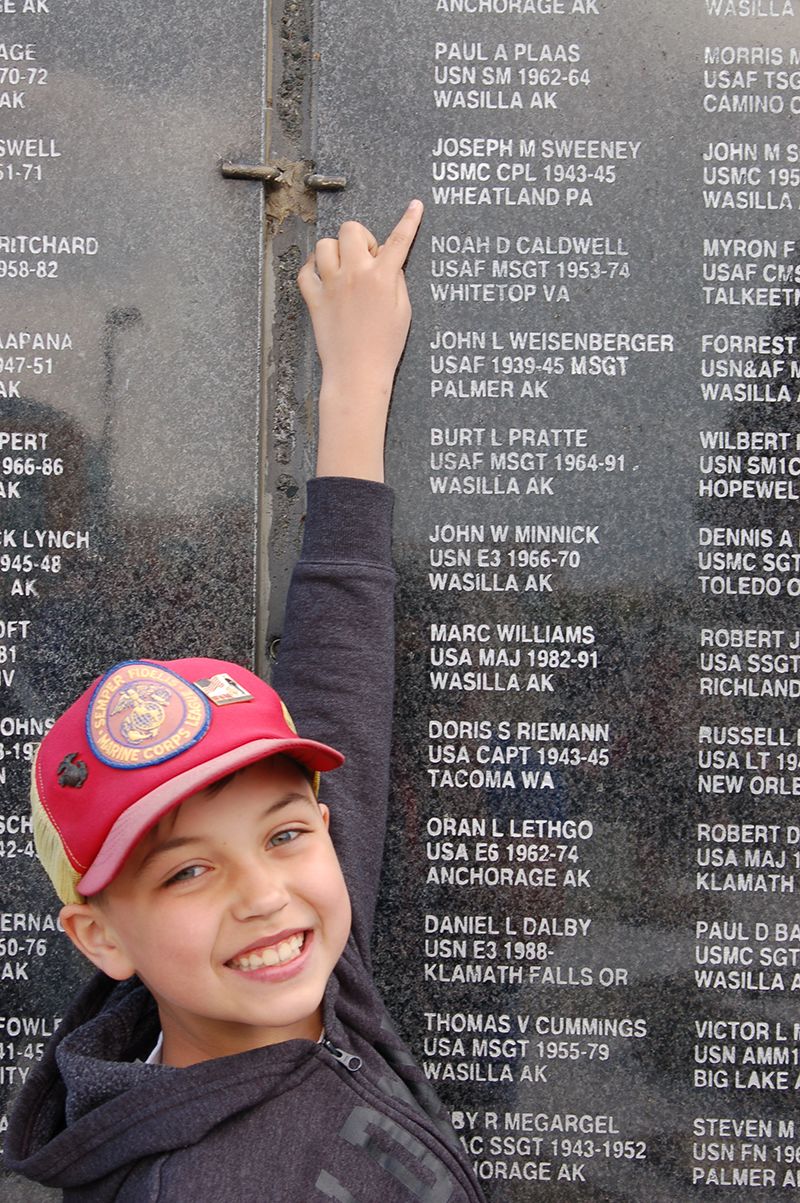
Joe Sweeney’s grandson Cameron points at his grandfather’s name while wearing his cap.
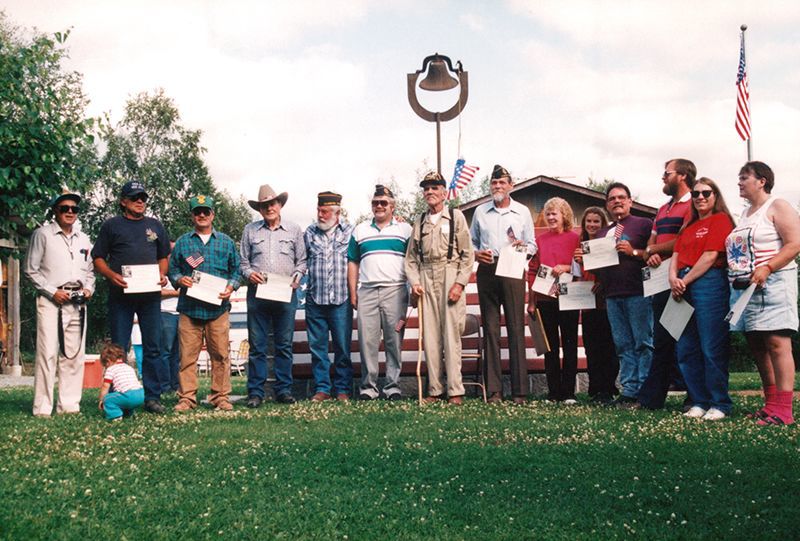
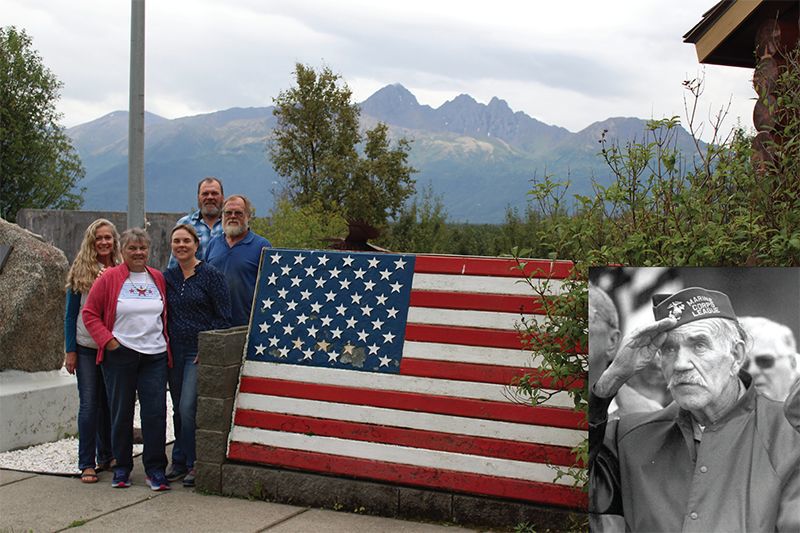
The Sweeney family, left, have a personal connection to the former home of the Veteran’s Wall of Homer. Joe Sweeney, right, a U.S. Marine and mason build a concrete flag that was moved to the site in 1997, three years after he died.

By Jeremiah Bartz Frontiersman.com A football coach using a hockey reference as the centerpiece for his keynote address may

Frontiersman.com With its headquarters in Wasilla, the Frontiersman has been a primary source of news for the Matanuska-Susitna

By Katie Stavick Frontiersman.com The next generation of leaders took flight this week as the Houston High School Class

By Kyle Wilkinson For the Frontiersman Keynote speaker and Carry the Cure President Bill Pagaran’s words boomed through the