Retiring teacher, coach urges Colony grads to ‘find their 68’
By Jeremiah Bartz Frontiersman.com A football coach using a hockey reference as the centerpiece for his keynote address may


Seward has some of the best, least-visited ski terrain in Alaska. Resurrection Peaks, Mount Marathon, Mt. Alice and Mt. Eva encircle the small town in an alpine amphitheatre. The relief is dizzying, as these peaks seem to rise vertically from surf to skyline. Despite their imposing grandeur, these mountains have a surprising variety of ski terrain, from forested glades to steep couloirs and exposed faces. Mt. Eva, just a few miles from town, provides the full spectrum of Seward skiing, from rainforest glades to its remote alpine summit.
To visit Mt. Eva, turn east onto Bear Lake Road, then turn right onto Tiehacker Road. In a few hundred yards, Tiehacker ends at a trailhead. Generally, a snowmachine trail, skin track or both will lead southeast out of the small parking lot through the woods toward Salmon Creek. It shouldn’t take more than about ten minutes of meandering through massive, moss-draped spruce trees before the trail emerges into the snow-covered Salmon Creek valley. Continue up the creek, and look for a skin track to re-enter the woods on the south side of Salmon Creek near the toe of Mt. Eva. From here, you soon begin climbing steeply through a magnificent rainforest, switchbacking up through the trees. If snow cover is in line with historical averages for the area, brush should be minimal. Treeline is around 1,600 feet, near a small knoll that overlooks the glades, and meadows where local skiers go to make laps in the trees.
This is a good location to turn around in low visibility. To skier’s right, open meadows descend toward Salmon Creek and the skin track. Steeper, tighter trees are another option for descent, generally following the fall line in the vicinity of your skin track. It is difficult to get lost: Far to the left, a deep gully discourages passage to the south, and Salmon Creek feeds you back to the skin track if you head far right off the knoll.
Some of these pitches are in avalanche terrain, so take care to follow safe travel protocol and have an understanding of the snowpack. That can be difficult, since Seward is outside of common forecasting zones. By distance, it is close to the Summit Lake area for which the Chugach National Forest Avalanche Information Center (cnfaic.org) forecasts, but its snowpack is often completely different. Summit generally has a thinner, more continental snowpack, whereas Seward’s is thicker and more maritime. That often means Mt. Eva may have better stability than Summit, but it all depends upon conditions.
Eva’s trees are a worthy destination by themselves. They are much steeper and more continuous than Tin Can or Eddies, with pillows and other features for additional entertainment. The mature trees are more widely spaced than the small spruces in Turnagain, providing more space to make turns in the forest. However, there are additional options beyond treeline if weather and stability permit.
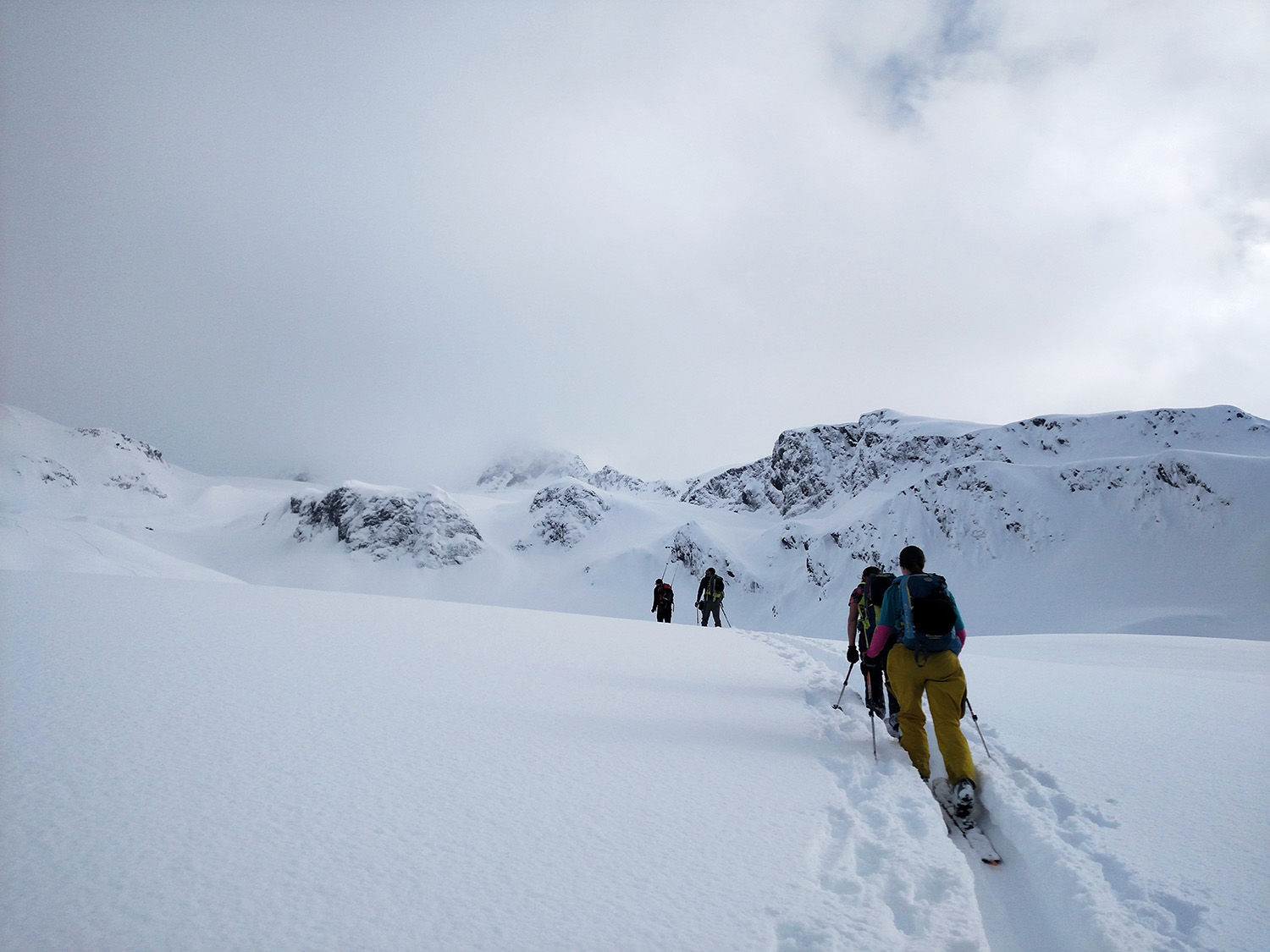
Beyond treeline, a mellow bowl provides relaxing skinning toward the terminus of Eva’s large, northwest glacier. This bowl includes non-avalanche terrain for snowpit tests to assess the stability of Eva’s alpine snowpack. Slope angles steepen as you climb up the moraine and bedrock at the toe of the glacier, much of which is avalanche terrain. There is an easy ascent route on skier’s left. It would be wise to have good visibility and rope up if continuing up Eva’s glacier toward the summit. Substantial crevasses are visible on multiple parts of the glacier, and some run parallel to the route of travel. Fortunately, Seward’s typically massive alpine snowpack makes travel feasible when there is good visibility. Though Eva’s blocky, vertical, rocky summit pinnacle will not be an inviting ascent for most skiers, there is fairly non-technical terrain most of the way up toward the summit. Beyond a tour of the mountain, numerous couloirs and bowls in Eva’s large cirque provide days of possible skiing on north, west, and south aspects. Many of these lines are accessible without skiing across the glacier.
It’s a much longer drive to Seward than Turnagain, and you may want to stay in town and ski for the weekend. Fortunately, there are numerous affordable lodging options in the winter. Some, like the Sauerdough Lodge, include kitchens so you can cook for yourself. Hardly any restaurants are open in the winter, and those that are tend to be expensive. Downtown is a wonderful place to stay, as it looks out over Resurrection Bay, and toward Mt. Alice’s imposing western slopes.
If you’re tired of skiing Tin Can and Eddies but still want to ski trees, head south to Mt. Eva. When the weather opens up, Eva’s alpine has a wide variety of touring, from gentle bowls to steep chutes and glacier travel. There are few places on earth where you can ski from a glacier to sea level through a rain forest, and this particular mountain is only a couple hours from home.

By Kyle Wilkinson Kyle in the outside Our spring bear hunt was bittersweet this year. We’re heading home without

By Barbara Hunt Palmer Buzz Green-Up happened at exactly 9:34 am on Saturday morning in Palmer. This was

By Christian Hartley Now You Know Every spring, the snow melts and residents look at their roads with frustration. The
By Katie Stavick Frontiersman.com The Alaska Department of Environmental Conservation (DEC) has detected Perfluoroalkyl Substances (PFAS) in groundwater near