Retiring teacher, coach urges Colony grads to ‘find their 68’
By Jeremiah Bartz Frontiersman.com A football coach using a hockey reference as the centerpiece for his keynote address may


WILLOW — As he completed his final preparations for Iditarod 40 on Sunday, Ryan Redington had a great view of the musher he knows best.
Across the staging area his brother, Ray Redington Jr., wearing bib No. 2, would be first out of the chute. Ryan brought up the rear, drawing bib No. 67 at the musher’s banquet Thursday night.
“It’s pretty neat for being the 40th year of the race to have a Redington going first and a Redington going last,” Ryan said.
And he said doesn’t mind being last.
“I know I start off last, but we won’t end up that way,” Ryan said. “We might have some pretty chewed up trail in the beginning, but Iditarod has put a lot of work into the trail so it will be better than other years.”
Iditarod Trail Sled Dog Race Marshall Mark Nordman said the trail is in good shape.
“There is a lot of snow, and with this warmer weather there is going to be a little bit of overflow here and there, but I am pretty pleased all in all,” Nordman said Sunday afternoon from Willow Lake. “Our trailbreakers went out day before yesterday on Friday. We’ve got eight of them up front and they are up toward Puntilla right now working on trail concerns. It looks like it is going to be a working dog’s race.”
Because of the amount of snow, the infamous section of trail known as the Steps was added back to the race route. Nordman said the trail committee had planned to run the race on another route that would have bypassed that section of trail.
“We did have another trail that we were going to put in, but we found this year that there is so much snow up there and there has been so much wind that the Steps sound really good,” he said. “It’s a better safer trail for all the competitors.”
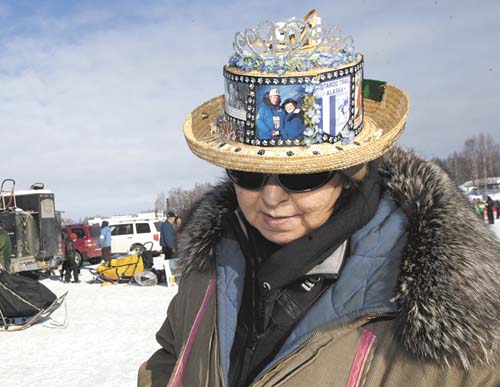
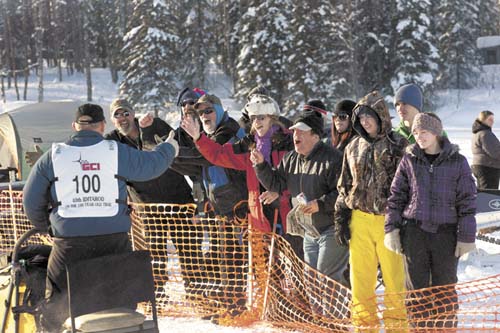
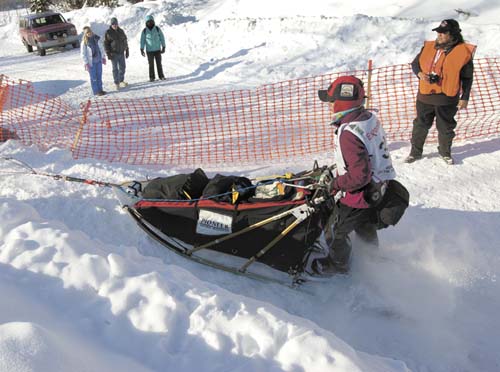
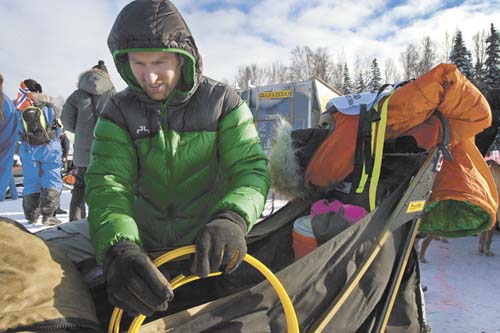
Annually, Iditarod awards its bib No. 1 to a ceremonial musher who doesn’t actually race. This year that bib went to Dave Olson, a longtime volunteer, race co-founder Joe Redington Sr.’s right-hand man and a four-time finisher. The total number of mushers out of Willow this year was 66. Many were veterans and quite a few are former champions. Crowds of people, many barbequing and many more snapping photos, lined the starting chute along the trail across Willow Lake and beyond. They watched teams take off in two-minute intervals, mushers waving and dogs barking.
By Monday evening, the leading 10 mushers, including Mackey and last year’s champion John Baker, had left the checkpoint at Rainy Pass with Hugh Neff in the lead. Neff, Mackey, Ally Zirkle and Ray Redington, Jr, had spent six hours in Rainy Pass, having arrived there early that morning. Iditarod reported none of the 66 teams had scratched.
At the restart, Lance Mackey, whose four back-to-back victories secure him a solid spot in the pantheon of great Iditarod mushers, said although he didn’t win last year, he plans to be competitive this year. Or not. Either way, he’s fine with it.
“Last year, I went into the Iditarod thinking, ‘Hell yeah, I got a dog team that can win the Iditarod a fifth straight time.’ But then I crashed into a reality check,” Mackey said.
He thinks the problem was that he was racing to win that year, rather than other years when he was racing for fun and winning was secondary. He doesn’t plan to be caught in that trap this year.
“I will have a smile on my face when I get there, whether I’m first or 61st,” Mackey said.
Like Ryan and Ray, Iditarod is a family affair for Mackey and Anjanette Steer of Sheep Mountain. She paused to get ketchup on a hot dog fresh off the grill while answering a reporter’s questions. Her parking spot on the lake was packed with family. She’s racing with some of her husband, Zack Steer’s, dogs. She’s a rookie this year. Asked what she expects to find out on the trail, she said adventure, beautiful scenery and, mostly, the unknown.
“I think that’s what makes it so exciting for a rookie,” she said. “Maybe this is mundane for Martin Buser or DeeDee Jonrowe because they’ve done it 30 times but I tell you what, I’m excited,” Steer said.
Also joining in the family fun are three generations of Seaveys, Dan, Mitch and Dallas. Two of the three are in it to win it and one is playing the role of ambassador.
“Obviously, my grandpa’s not going out there to win it. You know he’s in his early 70s and just wants to do the trail one more time,” said young gun Dallas Seavey. “He ran the very first Iditarod and the second one, so he’s out there more for history’s sake, nostalgia and to get one more trip over the Iditarod Trail in.”
But not so for the father and son.
“My dad and I both have a little different goal,” Dallas Seavey said. “Basically, we’re both gunning for the same position. It makes it a lot of fun and I hope we both have good runs out there.”
The younger Seavey moved from his early training ground of Sterling to Willow in 2009. Conditions for mushing are pretty good and steady, but does the difference in areas and terrain play into one team outrunning another in a family of hardcore mushers? For the youngest Seavey, he said it is best to be well-rounded.
“Every musher here has been training in more or less a different location and traveled in different quantities,” he said. “I know my dad has traveled a lot this year and so have I. No one area has everything, every sort of condition, so you have to get on the rivers, the coastal, the mountains — you have got to try out everything. I think both of us have tried to develop well-rounded teams that can handle any sort of conditions. I don’t feel my team is necessarily favored by any one type of terrain. I feel we can be equally successful on any trail.”
For his part, Buser, of Big Lake, said restart day on his 29th Iditarod found him “relaxed and organized, excited and waiting for the ‘3, 2, 1 go!’”
He said after running the race more than two dozen times he is confident this year’s race will be another challenging trip up the trail.
“I don’t think there is ever an easy Iditarod,” Buser said.
As experience grows so do expectations. While a rookie might be happy just to get to Nome, a veteran would be disappointed with a low ranking finish. And a really competitive veteran might not be satisfied without a win, he said.
“Everybody will be challenged to the max,” Buser said. “I call it the ultimate equal opportunity sport.”
Representing another Iditarod legacy family, Buser’s son Rohn also is racing this year. Asked if there is any competition between father and son for the best dogs, Rohn Buser replied, “Ownership has its privileges.”
OK, but seriously, who has the better team?
“We’ll tell you in Nome,” Rohn Buser said.
Wade Marrs of the storied Knik mushing community is racing for a second time. He said his rookie year put him into Nome in 47th place.
“I was just having fun last time,” he said.
So no fun this year?
“It’s always for fun, but we’re going to try to be a little bit more serious about it this time,” Marrs said.
He said the team works all year toward race day.
“It’s a pretty big deal. I spend all my time and money on it,” he said of the sport.
Race veteran and Wasilla dentist Kelly Maixner is not that worried about the snow or the last minute return of the Steps to the race route.
“The Steps coming back doesn’t really change my strategy at all,” Maixner said. “I am going to rest in the same spots I was going to rest anyway. “I didn’t mind the Steps. They were pretty deep last year when I went through because I went through at the end. It’s just a big hill and you have to go down lots of hills when you’re training. I kind of like that it is back, just tradition and all.”
Maixner, who lives in Big Lake, said he has been training in deep snow and feels comfortable with where his team is.
“I am not a musher that travels at a high speed. I don’t like to go over 10 miles per hour,” he said. “So the deeper snow should slow the faster teams down and I won’t have to slow down that much slower than I usually run, so I think the deeper snow helps me more than it hurts me.”
A big part of Maixner’s sled dog team is older and the rookies have racing in their blood. Maixner said he has five rookies in the team, but all with the same bloodline as last year’s dogs.
“I’ve been raising these dogs since they were puppies,” he said. “They are starting to mature, so it is pretty cool to see how much stronger and faster they are this year than last year.”
Contact reporter Andrew Wellner at andrew.wellner@frontiersman.com or 352-2270.

By Jeremiah Bartz Frontiersman.com A football coach using a hockey reference as the centerpiece for his keynote address may

Frontiersman.com With its headquarters in Wasilla, the Frontiersman has been a primary source of news for the Matanuska-Susitna

By Katie Stavick Frontiersman.com The next generation of leaders took flight this week as the Houston High School Class

By Kyle Wilkinson For the Frontiersman Keynote speaker and Carry the Cure President Bill Pagaran’s words boomed through the