Retiring teacher, coach urges Colony grads to ‘find their 68’
By Jeremiah Bartz Frontiersman.com A football coach using a hockey reference as the centerpiece for his keynote address may


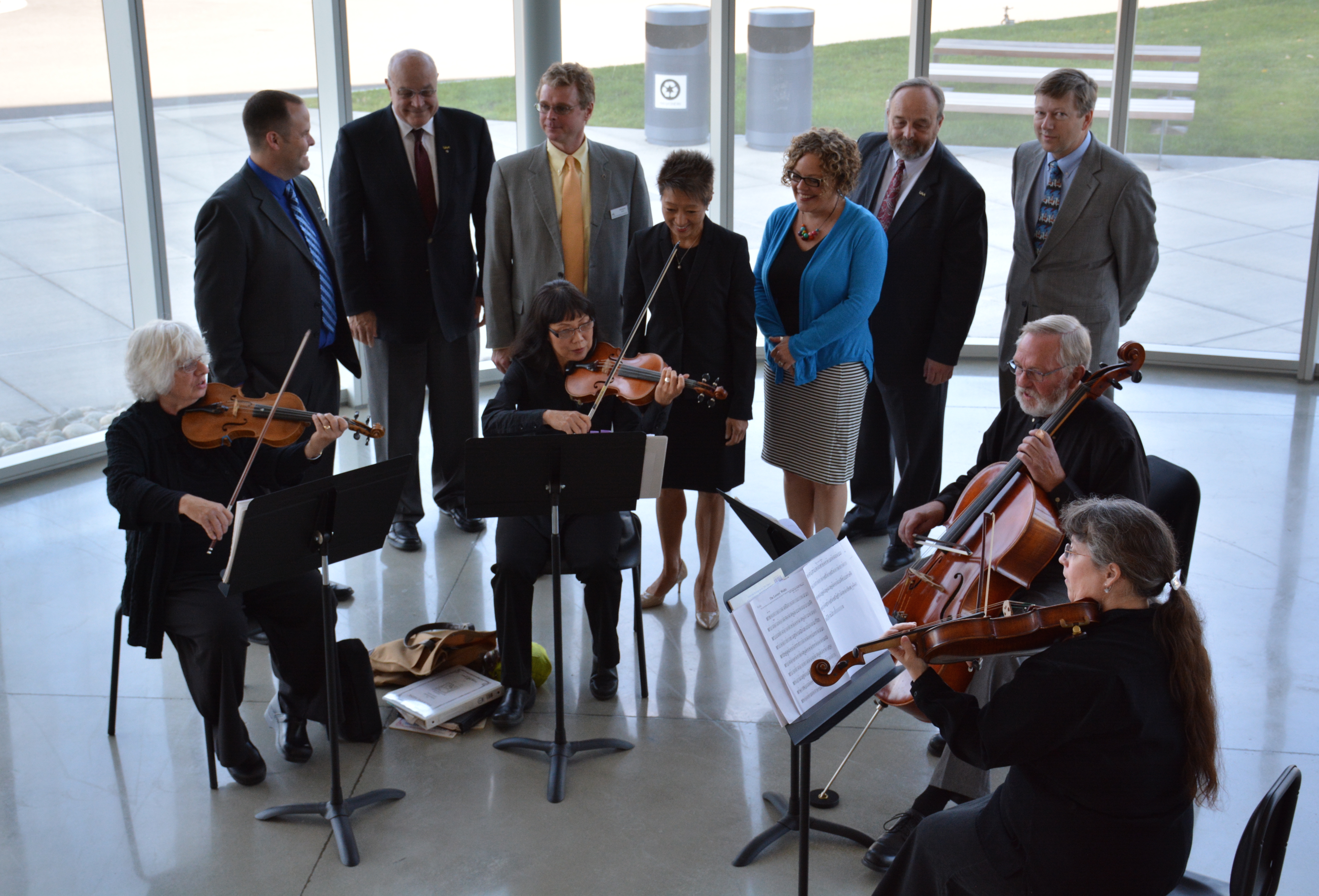
PALMER — Jane Chu, chairwoman for the National Endowment for the Arts (NEA), says Alaska is one of the “most dynamic” locations for art in the country.
Chu spoke to about 50 local artists, educators and other notables, including Mat-Su College Director Talis Colberg and University of Alaska Chancellor Tom Case at the Glenn Massay Theater Friday morning.
Colberg and Alaska State Council on the Arts Chairman Ben Brown, both Palmer High School graduates, made introductions.
“UAA has 16 campuses, and Jane Chu chose to come here,” Colberg said to emphasize the significance of the chairwoman’s visit.
Given the unique nature of the Mat-Su Valley, her choice made sense, Brown said.
“The future of Alaska in many ways is going to be driven by what happens in this part of the state,” he said.
And that future includes the arts, which “infuse our lives in so many different ways,” Chu said. Whether one connects with art through a child’s collage, a video game, a well-designed web page, a worship service, native traditions, or a school project, it is “an essential part of our everyday lives,” she said. It can even be therapy for post-traumatic stress and other disorders.
“There is something for everyone, and nowhere is that better represented than in Alaska,” Chu said. “My goal as chairman of the National Endowment for the Arts is to ensure that all Americans have the opportunity to honor and participate in art in many forms, just as Alaskans do.”
Chu cited mostly Alaska Native artwork as an example of what Alaska has to offer the artistic world, but art in schools soon became the focus of discussion. Chu said arts-based curriculum in other states have produced “stabilization of school attendance” as well as “fewer trips to the principal’s office.” Such curriculum has also contributed to higher test scores in subjects such as science, she said, especially with lower-income students who may not have had the same opportunities for success as their peers.
“We know there’s a value in the arts. We have seen way too much of a successful pattern across the nation … to believe that these findings are just luck and chance,” Chu said.
Mat-Su Borough School District School Board member Debbie Retherford was the first to ask a school-related question, asking how to overcome the “misguided perception” that the arts in schools are “expendable.”
In response, Chu reiterated her point on test scores, saying that research has shown better all-around performance by students engaged in the arts than those who are not. That research, when presented to the right people, makes change.
But if the audience members are any indication of who is hearing what needs to be said about art, Chu was “preaching to the choir,” according to Colony High School art teacher Melody Mann.
“It’s nice to hear that the work we do is appreciated on a national level,” Mann said, but she wondered about the local level.
“Why are there no principals here? Where is our superintendent?” she asked.
Houston High School art teacher Roxann Dayton agreed it would be beneficial for “the decision makers,” as Retherford called them, to take note of what motivates a large proportion of Valley students.
“The kids, they come to school just because of the arts,” Dayton said. “And they want more. They want more variety.”
It’s not just because those classes are fun, the teachers said — they go beyond the arts.
“I teach problem solving,” Mann said.
Mat-Su College art professor Felicia Desimini said that’s the kind of thing that more teachers, administrators and school officials need to recognize in the arts. While STEM education (science, technology, engineering and math) is all well and good, she said, what schools really need is an emphasis on “STEAM,” to include the arts.
“This is so necessary,” Desimini said, of talks and appearances like Chu’s.
And they need more, she said.
Burchell High School English teacher Paul Morley said he’s more interested “cross-curriculum training” for teachers on how to incorporate writing into their lesson plans, so that all teachers can properly instruct students in writing.
“When you write something, you’ve thought about it deeply, and you’re engaged in communicating your thoughts,” Morley said. “Everything is about communication.”
The National Endowment for the Arts offers grants for professional development in the arts for teachers of all subjects, as well as project- and program-oriented grants, Chu said, but they don’t offer the kind of “brick and mortar grants” that small museum directors like Selena Ortega-Chiolero really need.
Ortega-Chiolero said that, until three years ago, the Palmer Museum was still using display cases from the 1980s in its 1972 log cabin, cases that didn’t have interior lighting or tempered glass, which are necessary for museum accreditation. The Dorothy Page Museum in Wasilla is in the same boat, she said, with insufficiencies in things like proper humidity control.
“(These) are buildings that weren’t designed to be museums,” Ortega-Chiolero said. “You can’t get museum accreditation unless you have the proper museum environment.”
While she wished federal organizations like the NEA could look at more ways to help state organizations help local outfits in such a way, Ortega-Chiolero was grateful to have the attention of Chu, at least for an hour.
“Having somebody come here to our community … it kind of makes it a little more personal,” she said. “That means a lot.”
This year marks the National Endowment for the Arts’ 50th anniversary. In honor of the occasion, Chairwoman Chu invited audience and other community members to share their arts stories online at arts.gov.

By Jeremiah Bartz Frontiersman.com A football coach using a hockey reference as the centerpiece for his keynote address may

Frontiersman.com With its headquarters in Wasilla, the Frontiersman has been a primary source of news for the Matanuska-Susitna

By Katie Stavick Frontiersman.com The next generation of leaders took flight this week as the Houston High School Class

By Kyle Wilkinson For the Frontiersman Keynote speaker and Carry the Cure President Bill Pagaran’s words boomed through the