Retiring teacher, coach urges Colony grads to ‘find their 68’
By Jeremiah Bartz Frontiersman.com A football coach using a hockey reference as the centerpiece for his keynote address may


ANCHORAGE — Two hospitals especially put upon by the nation’s opioid addiction epidemic made their cases to the Alaska Certificate of Need board on Thursday at the Frontier Building in midtown Anchorage.
Representatives from both the Mat-Su Regional Medical Center, requesting permission to expand by 36 beds for behavioral health and substance abuse patients, and Alaska Regional Hospital, seeking 24 for the same, made it clear they supported the other facility’s request, and that the two interests should not be seen as competing.
That said, the board could opt to approve both requests, one of the requests, neither, or any compromise in between, so as MSRMC’s Business Development Director Jared Kosin, and Alaska Regional CEO Julie Taylor gave their presentations they vigorously defended their particular side’s cause.
Kosin presented first and built his chief arguments around facts of population growth.
“The Mat-Su Valley is the fastest growing (borough) in the state growing at four times the rate of Anchorage and three times the rate of Alaska, as a whole,” Kosin said. “Ninety-two percent of our patients are Mat-Su residents, so we really don’t get Anchorage residents. We fully support Alaska Regional’s project and I think it’s fair to say they support us, but if they move forward (alone) it’s not going to do a thing for us in the Mat-Su. We’re big enough to have our own project.”
Kosin expressed how the population boom in the Mat-Su, combined with the opioid crisis have made mental health issues a tremendous burden on the facility’s emergency room in very short order. He said the hospital currently has two beds dedicated for mental health patients and that back in 2012 there were only five occasions in which patients were waiting for one of those rooms. In 2016, Kosin said, there were 234 separate occasions in which behavioral health patients, often suffering from a combination of mental health and drug abuse issues, could not be served.
The remedy for that, as it exists now, is to transport those patients to the Alaska Psychiatric Institute in Anchorage, but as Taylor pointed out, API is constantly overbooked, as well.
“We are desperately in need of more resources,” Taylor said in her presentation. “In API’s history, at one point, they had over 200 beds. In recent years it’s been downsized to 80, and that’s 50 for adults, 10 for children and 20 for forensic and that’s not nearly enough for a state hospital that should be the facility for longer term care.”
Taylor added that over the last 25 years, discharges have doubled while capacity has been cut in half, and that according to national needs standards, 150 behavioral health service beds are needed for each 100,000 in population. Alaska, with a population of 750,000 could get by with 350 beds, but currently with just 98 beds statewide, the mentally ill and drug addicted wind up being treated by the prison system.
“What frightens me is SB91,” Taylor said of the 2016 Alaska law. “There was goodwill behind in it because there is actually an intention to reduce the prison population by 21 percent over the next 10 years… but we need to be ready with the resources on the outside and we clearly are not. Sixty-five percent of the prison population has some level of behavioral health disorder… The prison population is where these people are being served and it is absolutely the wrong thing to do.”
So both hospitals are asking the Certificate of Need board to expand with private dollars to serve behavioral health patients without burdening their emergency rooms — which, by definition, are built to treat and release. Both hospitals’ plans would include long-term stay solutions and outpatient solutions.
Taylor highlighted her hospital’s corporate backing with HCA — the nation’s largest hospital chain with 174 operations — as grounds for approval based on the rapidity with which they could have the unit up and running.
“We’ve renovated of late and are about 80 percent complete,” Taylor said. “We’re licensed for 250 beds and right now we have 166 physically in service. That means I’ve got excess and we’ve got 24 ready to be converted into behavioral health units rapidly and economically.”
After his presentation, Kosin handed a stack of papers to Alexandra Hicks, the commissioner for the Certificate of Need office. Each of them carried testimonials from Mat-Su residents expressing the need for the additional units. He said there were probably even more that were mailed to her directly.
After the presentations from hospital brass it was time for public comment and a line snaked around the full classroom on the building’s eighth floor, as more than two dozen health care providers, recovering addicts and their families addressed the crowd as well as Hicks, who was representing the state Division of Health Care Services of Certificate of Need program.
Among them was Michael Carson with the Mat-Su Opioid Task Force representing MyHouse in Wasilla.
“In the next 10 years they’re estimating that 650,000 people are going to do die because of the opioid epidemic,” Carson said. “That’s almost the entire population of the state of Alaska. We need to do something to save lives and we need to start today.”
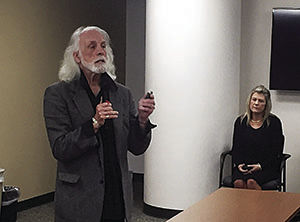
The last to speak was prominent Anchorage physician, longtime radio talk show host and father of a bipolar son, Dr. Bruce Kiessling.
“This really is a no brainer and a parent is only as well as their sickest child,” Kiessling said. “Whenever we have mental illness it involves whole community. We need sanctuary.”
Hicks said she would be passing on the transcripts of the speakers and written information on to the Certificate of Need Commissioner Valerie Davidson, who will ultimately make the decision, hopefully within 60 days of the filing deadline, which was July 27.
There will be a second public hearing for both Certificate of Need requests on Aug. 31 at 4:30 p.m. at Mat-Su College.
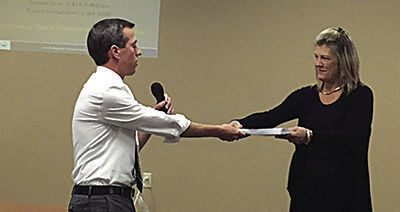
MATT HICKMAN/Frontiersman

By Jeremiah Bartz Frontiersman.com A football coach using a hockey reference as the centerpiece for his keynote address may

Frontiersman.com With its headquarters in Wasilla, the Frontiersman has been a primary source of news for the Matanuska-Susitna

By Katie Stavick Frontiersman.com The next generation of leaders took flight this week as the Houston High School Class

By Kyle Wilkinson For the Frontiersman Keynote speaker and Carry the Cure President Bill Pagaran’s words boomed through the